 Custer
 Siding Built for the Sumas & Custer Climate
Homes around Sumas and Custer sit in one of the wetter, greyer corners of Whatcom County. You get long stretches of low cloud and drizzle through fall and winter, wind that carries moisture off the Salish Sea and the Nooksack lowlands, and a moss and algae season that can run most of the year on north-facing walls and shaded siding. None of that is unusual for northwest Washington, but it is hard on exterior materials that weren't built with this kind of exposure in mind. Wood-based sidings absorb that moisture. Cheap or improperly sealed products swell, cup, or grow soft at the edges. Paint fails faster than it should. Over ten or fifteen years, a siding choice that looked fine on day one can turn into a maintenance headache that never really lets up.
We work on homes throughout this part of Whatcom County, and the pattern is consistent: the siding that holds up best here is the siding that was engineered for a wet, cool, marine-influenced climate — not the siding that happened to be cheapest or fastest to install.
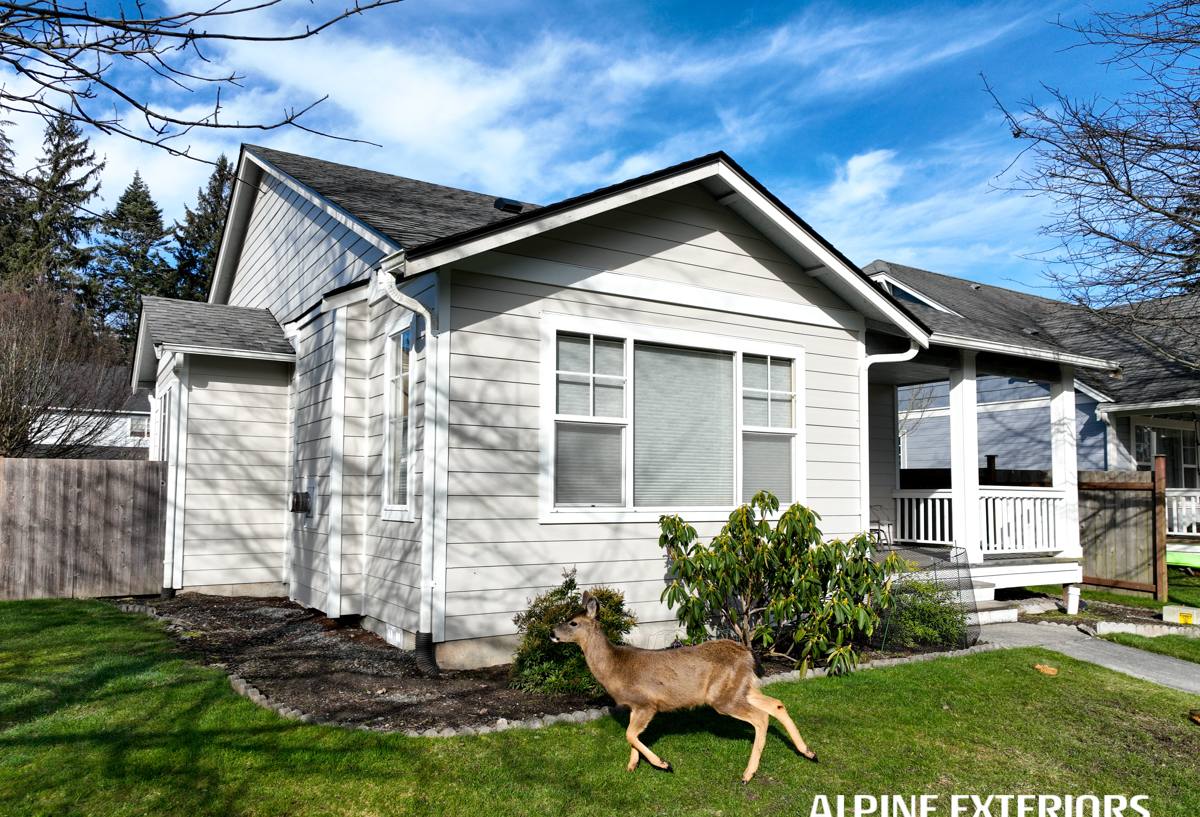
What This Climate Actually Does to a House
A few things show up again and again on homes we inspect in the Sumas and Custer area:
- Moss and algae staining on shaded or north-facing walls, especially near tree lines and under eaves with limited sun exposure
- Paint and caulk failure at seams, corners, and butt joints where water finds a way in and doesn't dry out quickly
- Soft or swollen board edges on wood-based or engineered wood siding where moisture has been wicking in over time
- Corrosion or staining on fasteners and trim in areas closer to the water where salt-laden air is part of the equation
- Gutter and flashing issues that get worse in a region where it can rain steadily for days at a stretch
Individually, none of these are dramatic. Together, over years of driving rain and short drying windows, they add up to real repair costs — and sometimes to siding that needs to be replaced well before it should.
Why We Install Only James Hardie Fiber Cement
We don't install LP SmartSide, vinyl, Cemplank, Allura, primed spruce, or cedar. That's a deliberate standard, not a matter of preference, and it's worth explaining honestly rather than just stating it.
Engineered wood products like LP SmartSide use treated wood strand technology, and manufacturers have improved moisture resistance over the years. But it's still a wood-based product at its core, and wood-based siding depends heavily on caulking, paint maintenance, and correct field installation to keep water out over the long run. In a climate that stays wet for months at a time, that's a lot riding on maintenance schedules and workmanship staying perfect for decades. Vinyl is affordable and low-maintenance in the sense that it doesn't need painting, but it can warp in heat, crack in cold, fade over time, and it doesn't offer the same fire performance or resale perception as fiber cement. Primed spruce and cedar are traditional and look great initially, but real wood siding in a marine climate is a long-term maintenance commitment — repainting, recaulking, and watching for rot are simply part of owning it.
James Hardie fiber cement siding is engineered specifically to handle moisture, freeze-thaw cycling, and UV exposure without the same maintenance burden. It's non-combustible, it holds paint and factory finish far longer than wood, and it doesn't feed moss and mildew the way organic wood fiber can. Hardie backs it with a strong transferable warranty, and when it's installed to spec — correct clearances, flashing, and fastening — it performs consistently in exactly the kind of weather Sumas and Custer see most of the year. That's the whole reason we standardized on one product line instead of offering several: we'd rather install one thing well than install several things and hope they hold up.
The James Hardie Lines We Use
| Product | Best For | What It Offers |
|---|---|---|
| HardiePlank lap siding | Most single-family homes | Traditional lap look, wide color and texture range, engineered for climate zones like ours |
| HardieShingle siding | Accent gables, cottage-style homes | Staggered or straight-edge shingle profile without the maintenance of cedar shakes |
| HardiePanel vertical siding | Modern builds, shop-style structures, accent walls | Clean vertical lines, often paired with board-and-batten trim |
| HardieTrim boards | Corners, window and door trim, fascia | Consistent factory finish that matches the field siding and resists the same weathering |
Most of these come with ColorPlus Technology, a factory-applied finish that's baked on and warrantied against fading and peeling — a real advantage over field-applied paint in a climate where rain limits how often exterior surfaces really get to dry out and cure.
HZ5 Engineering
James Hardie makes climate-specific product formulations, and the HZ5 line is engineered for the Pacific Northwest's freeze-thaw cycling and moisture load. It's not a marketing label — the composition is adjusted for the region, which matters when you're deciding what goes on a home that will see a hundred-plus rainy days a year.
What Correct Installation Looks Like Here
Fiber cement siding performs the way it's supposed to only when it's installed correctly, and installation details matter more in a wet climate than a dry one. On every job we pay close attention to:
- Proper weather-resistive barrier and rain screen behind the siding so any moisture that does get past the surface can drain and dry out
- Correct clearance between siding and grade, decks, patios, and roof lines so water doesn't wick up into the bottom edge
- Flashing at every window, door, and roof-to-wall intersection — the majority of moisture problems we find start at a flashing detail, not the siding field itself
- Manufacturer-specified fastening and joint treatment so butt joints and corners don't become entry points over time
- Caulking only where Hardie's install specs actually call for it, not as a substitute for proper flashing
These aren't optional extras. They're the difference between siding that lasts the decades it's rated for and siding that develops the same rot and staining problems that pushed a homeowner to replace their old siding in the first place.
Roofing, Windows, and Decks
Siding rarely fails in isolation. A roof that's shedding water onto a wall, a window that's no longer sealing correctly, or a deck ledger board tied into the wall without proper flashing can all undermine even well-installed siding. Because we handle siding, roofing, windows, and decks, we look at the whole envelope rather than treating siding as a standalone project. If a leaking roof valley or a failing window flashing is what's actually driving moisture into a wall, patching just the siding doesn't solve the problem — it just hides it for a while.
Why a Local Crew Matters
A crew that works Whatcom County regularly knows what this climate does to a house because they see it on job after job — not from a training manual, but from tearing off old siding and finding out firsthand where water actually gets in. That familiarity shows up in small decisions: where to add extra flashing even though it's not strictly required, how much clearance to leave at grade on a lot that floods slightly in winter, which details tend to fail first on homes in this area. It also means someone answers the phone if a warranty question comes up years down the road, rather than chasing a contractor who's moved on to another region.
What Affects the Cost of a Siding Project
| Factor | Why It Matters |
|---|---|
| Home size and wall complexity | More corners, gables, and dormers mean more cutting, trim, and labor time |
| Current siding removal | Tear-off, disposal, and any sheathing repair found underneath add time and cost |
| Product selection | Lap width, shingle profile, and vertical panel choices carry different material costs |
| Trim and detail work | Corner boards, window trim, and fascia work add labor beyond the flat wall area |
| Access and site conditions | Steep grades, tight lot lines, or limited equipment access can affect labor time |
We won't quote a number without seeing the house, but these are the factors that actually move a bid up or down — worth knowing before you start collecting estimates.
Signs It's Time to Have Your Siding Looked At
- Soft spots, warping, or visible swelling anywhere along the siding, especially near the bottom courses
- Paint that's peeling, bubbling, or chalking well before you'd expect a normal repaint cycle
- Persistent moss or algae growth that comes back quickly after cleaning
- Gaps opening up at seams, corners, or trim boards
- Musty smells or visible staining on interior walls that share an exterior wall with a problem area
Any one of these on its own isn't necessarily an emergency, but they're worth a professional look before winter rain turns a small issue into a bigger repair.
Get a Free, No-Pressure Estimate
If you're weighing siding options for a home in Sumas, Custer, or anywhere else in our Whatcom County service area, we're happy to take a look and walk you through what we see — no obligation, no pressure. Use the form below to request a free estimate.