 Custer
 Siding in Everson: Built for Whatcom County Weather
Everson sits in the low, green country of Whatcom County, close enough to the Nooksack River and the Salish Sea's influence that homes here deal with a particular mix of moisture problems most of the year. It's not dramatic weather — no hurricanes, no hailstorms — but it's relentless. Long stretches of driving rain, damp marine air carrying trace salt inland from the coast, and short, dark winter days that never quite dry a north-facing wall out. Add a mild climate that never gets cold enough to kill moss and algae, and you've got a recipe for exterior materials that look tired well before their time.
Siding in this part of the county isn't just a cosmetic choice. It's the first line of defense against a slow, steady kind of water exposure that doesn't announce itself with a single bad storm — it works quietly, season after season, into caulk joints, lap seams, and anywhere water can find a path behind the cladding. Homes that get it right stay dry and look good for decades. Homes that don't end up with soft trim, peeling paint, and siding panels that need replacing far sooner than anyone expected.
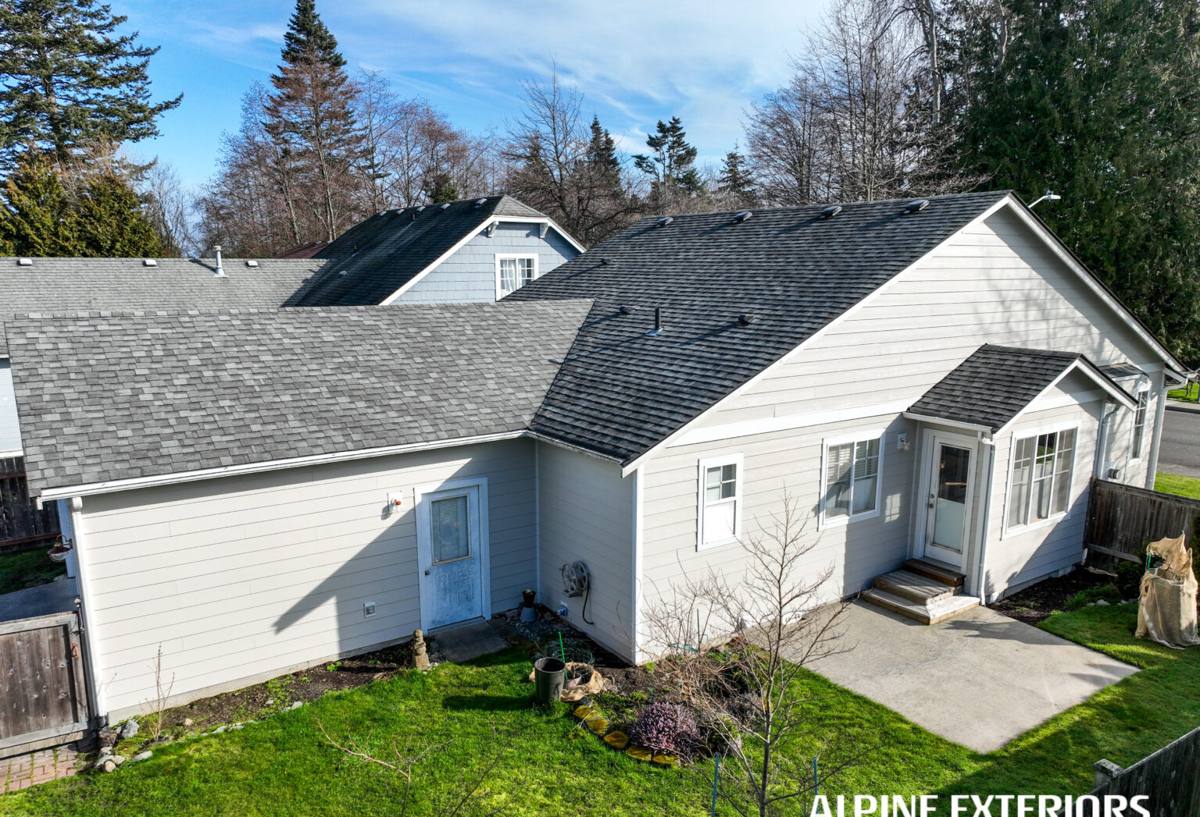
What Local Homes Are Actually Up Against
Driving Rain and Wind-Driven Moisture
Rain in this region rarely falls straight down. Wind off the water pushes it sideways into wall assemblies, which means lap siding, window trim, and butt joints take on more water exposure than a simple rainfall total would suggest. Materials and installation details that work fine in a drier climate — thin caulk beads, minimal overlaps, unsealed cut ends — fail faster here because the water finds every gap.
Salt-Laden Air
Everson isn't beachfront, but Whatcom County's proximity to Puget Sound and the Strait of Georgia means salt-tinged marine air travels further inland than people expect, especially during onshore wind patterns. Over years, that salt content accelerates corrosion on fasteners, staples, and any exposed metal flashing, and it interacts with lower-grade sidings in ways that speed up surface breakdown.
Moss, Algae, and a Long Wet Season
The same mild, wet climate that keeps lawns green most of the year also keeps moss and algae thriving on north- and west-facing walls, especially anywhere shaded by trees or a neighboring structure. Porous or wood-based siding gives these organisms something to hold onto and feed on; a hard, factory-finished surface gives them far less to work with. It's one of the more visible differences between a home that's aging well and one that isn't.
Why the Siding Material You Choose Matters More Here
Every siding product on the market claims to handle wet climates. The difference shows up after five, ten, and fifteen years — not on day one. In a climate like this, the material's actual moisture behavior, not its marketing, determines how much maintenance a homeowner is signing up for.
| Material | Moisture Behavior | Maintenance Burden | Typical Longevity Here |
|---|---|---|---|
| Vinyl | Doesn't rot, but seams and warping issues show up with temperature swings and impact | Low, but limited repair options — often full-panel replacement | Moderate; fades and becomes brittle over time |
| Cedar / wood | Absorbs moisture readily; prone to swelling, checking, and moss growth without diligent upkeep | High — regular refinishing, caulking, and moss treatment | Shorter unless maintained aggressively |
| Primed spruce / engineered wood panels | Vulnerable at cut edges and fastener points if not field-sealed correctly | Moderate to high — edge sealing and paint upkeep matter | Dependent heavily on installation quality |
| James Hardie fiber cement | Non-combustible, engineered for wet climates, factory-finished to resist moisture intrusion at the surface | Low — occasional wash, no repainting for years | Long-term when installed to spec |
This isn't a knock on every homeowner who has cedar siding or an engineered wood product on their house today — plenty of those homes are well cared for and look fine. It's simply why, as a company, we made a decision about what we're willing to put our name behind and warranty going forward.
Why We Install Only James Hardie Fiber Cement
We don't install vinyl, LP SmartSide, Cemplank, Allura, primed spruce, or cedar. That's a deliberate standard, not a lack of options. Each of those products has legitimate strengths — vinyl is inexpensive and low-maintenance in mild climates, cedar has a natural look many homeowners love, engineered wood panels install quickly and cost less upfront. But in a climate that stays wet for months at a stretch, the trade-offs on those products — seam vulnerability, edge-moisture sensitivity, refinishing cycles, or shorter real-world service life before something needs attention — are trade-offs we don't want to hand a Whatcom County homeowner without a serious conversation first.
James Hardie fiber cement is engineered specifically around climate. Their HZ5 product line, built for wetter regions like the Pacific Northwest, is formulated to resist moisture-related damage better than the standard formulation sold in drier climates. It's non-combustible, which matters more every year as wildfire smoke and ember exposure become a regional concern even outside fire-prone zones. It carries a factory-applied ColorPlus finish, meaning the color and protective coating are baked on under controlled conditions rather than applied on-site where weather, temperature, and technique all introduce variability. And it comes with a strong, transferable warranty — one that reflects the manufacturer's confidence in how the product performs over decades, not just years.
None of that makes Hardie maintenance-free or installation-proof. It still depends entirely on correct detailing — flashing, clearances, fastening pattern, caulking at the right joints and nowhere else. That's the other half of the equation, and it's where a lot of siding jobs, regardless of material, go wrong.
What Correct Installation Actually Involves
Fiber cement siding is only as good as the assembly behind it. In a high-moisture climate, the details that don't show up in a drive-by photo are usually the ones that determine whether a home stays dry for thirty years or develops problems in five.
- Proper weather-resistive barrier installed and lapped correctly behind the siding, not just stapled up as an afterthought
- Flashing at every window, door, and roof-to-wall transition, installed to shed water outward rather than trap it
- Correct clearance between the bottom of the siding and grade, decks, roofs, and walkways — a common shortcut that leads to wicking
- Fastener placement and type that match Hardie's engineering specs, not just whatever is fastest to shoot
- Cut-edge sealing on any field cuts, since factory-finished panels are only fully protected on the finished face and edges until sealed
- Caulking only where the manufacturer specifies — over-caulking joints that are designed to allow drainage traps water instead of shedding it
Skip any one of these steps and even the best material on the market will underperform. This is the real argument for hiring a crew that installs Hardie every day rather than occasionally — the product tolerates very little improvisation in a climate like this one.
More Than Siding: The Whole Exterior Works Together
Siding doesn't perform in isolation. On most homes we look at in the Custer and Everson area, siding problems trace back to something happening above or around it — a roof detail directing water toward a wall, a window that isn't flashed correctly, or a deck ledger board trapping moisture against the house. Because we handle roofing, windows, decks, and siding, we look at the whole envelope rather than treating siding as a standalone product. A new Hardie install on a home with a failing roof valley or an unflashed window is still going to have problems — just in a different spot.
That's also why a local crew matters more than it might seem. A contractor working in Whatcom County day in and day out has seen how homes in this specific microclimate actually fail — where moss builds up fastest, which wall orientations take the worst of the wind-driven rain, which older homes were built with details that don't hold up anymore. That local pattern recognition shortens the conversation about what your home actually needs versus what a generic checklist would suggest.
Signs Your Home May Be Telling You Something
Most siding failures give warning signs well before anything looks catastrophic. Worth a look if you notice:
- Moss or algae building up on north- or west-facing walls faster than it used to
- Paint that's peeling, bubbling, or chalking, especially near the bottom courses of siding
- Soft or spongy spots when you press on siding or trim near ground level, decks, or downspouts
- Visible gaps or separation at seams, corners, or around window and door trim
- Staining or streaking below joints that suggests water is running behind the surface, not off it
- Warping, cupping, or panels that no longer sit flat against the wall
Any one of these on its own might be minor. Several together, especially on a home that's twenty or more years old, usually mean it's worth having someone look at the whole wall assembly rather than patching the visible symptom.
What Working With a Local Crew Looks Like
A straightforward process matters as much as the product. That means an honest look at your existing siding and the conditions specific to your property — sun exposure, tree cover, drainage, prevailing wind direction — before any recommendation gets made. It means a clear explanation of what's driving any problems we find, not just a quote to replace everything. And if your home is a good candidate for a partial repair or targeted fix rather than a full re-side, that's what we'll tell you. The goal is a home that holds up through another twenty Whatcom County winters, not just a bigger invoice.
Ready for a Straight Answer About Your Siding?
If you're noticing moss, peeling paint, soft trim, or you're simply due for an honest assessment of how your siding is holding up against this climate, we're glad to take a look. Reach out for a free, no-pressure estimate — we'll walk the exterior with you, explain what we see, and lay out real options for your home in Everson and the surrounding Whatcom County area.