 Custer
 Two Different Answers to the Same Question
James Hardie fiber cement and LP SmartSide engineered wood siding get compared constantly, and for good reason — they're often cross-shopped by homeowners in Whatcom County who are done with cedar maintenance or vinyl that's cracked and faded. Both are marketed as low-maintenance upgrades over traditional wood siding. But they're built from fundamentally different materials, and those materials behave differently over a lifetime of Custer's salt air, driving rain, and long moss season. This page is an honest side-by-side, not a takedown. LP SmartSide has real strengths and a place in the market. We just don't install it, and by the end of this page you'll understand exactly why.
What Each Product Actually Is
James Hardie Fiber Cement
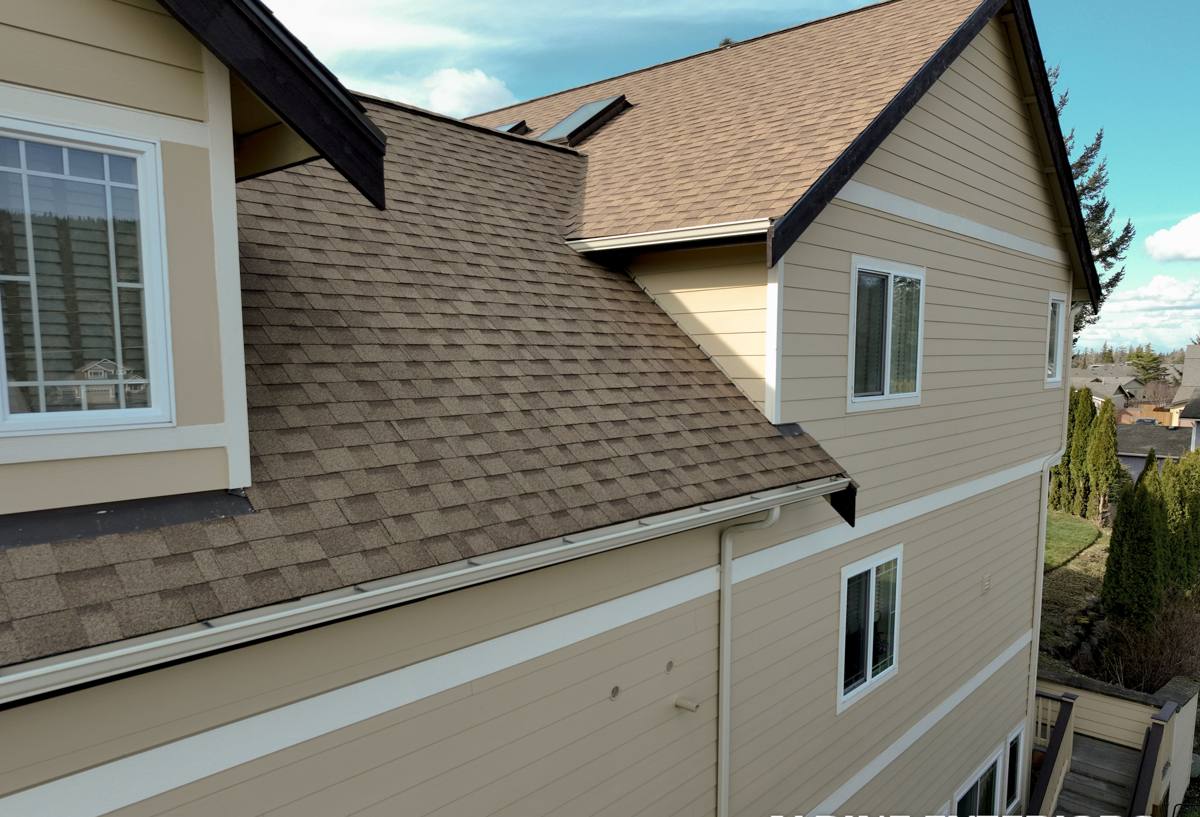
Hardie siding is made from a mix of Portland cement, sand, and cellulose fibers, cured into a dense, rigid board. It's non-combustible, doesn't absorb water the way wood-based products do, and holds paint or factory finish far longer than wood substrates because there's no wood grain telegraphing through the surface over time. It's heavier than most alternatives and requires specific fastening and installation practices, but the material itself doesn't rot, and insects have nothing to eat.
LP SmartSide Engineered Wood
LP SmartSide is a wood-based product — strand-oriented wood fiber treated with resin and a zinc borate additive for insect and fungal resistance, then coated with a wax and resin overlay. It's lighter and easier to handle than fiber cement, cuts with standard woodworking tools, and costs less installed in most markets. But at its core, it's still wood. The treatments and overlay slow moisture absorption and decay; they don't eliminate the fact that the base material is engineered wood fiber, which behaves like wood when its protective surface is compromised.
Side-by-Side: The Factors That Matter Most
| Factor | James Hardie Fiber Cement | LP SmartSide |
|---|---|---|
| Base material | Cement, sand, cellulose fiber | Engineered wood strand, resin-treated |
| Combustibility | Non-combustible | Combustible (wood-based) |
| Moisture behavior | Doesn't absorb water into the substrate | Resistant while surface coating is intact; wood-based core beneath |
| Insect resistance | Nothing for insects to eat | Borate-treated, but treatment is a barrier, not a material change |
| Finish durability | Factory ColorPlus finish backed by a separate finish warranty | Field-applied or factory-primed finish, typically repainted on a shorter cycle |
| Weight / handling | Heavier, requires specific fastening and cutting practices | Lighter, easier to handle and install |
| Typical installed cost | Higher upfront | Lower upfront |
| Long-run maintenance | Low, if installed to spec | Moderate — cut edges and butt joints need diligent field sealing |
Why Moisture Is the Real Dividing Line
Whatcom County's climate is the reason this comparison matters more here than it might in a drier region. Custer sits inland enough to avoid direct salt spray off the water, but it still gets salt-laden marine air on winter storms, long stretches of wind-driven rain, and a moss and mildew season that can run most of the year on shaded, north-facing walls. That's a demanding environment for any exterior product, but it's a particularly unforgiving one for anything with a wood-based core.
LP SmartSide's resin treatment and wax overlay are engineered to resist moisture, and the product performs reasonably well when every cut edge is field-sealed correctly, every joint is caulked and maintained, and the coating stays intact. The problem is real-world installation and maintenance discipline over 20-30 years rarely holds to that standard. A missed cut-edge seal, a caulk joint that cracks and isn't caught in time, or a spot where two panels meet and trap moisture — those are the failure points where a wood-based substrate starts absorbing water it wasn't designed to hold long-term. Fiber cement doesn't have that same failure mode, because there's no wood fiber underneath the surface to swell, soften, or decay in the first place.
What This Looks Like Over Time
On a well-installed, well-maintained home, both products can look good for years. The difference shows up at the margins — the cut edge nobody caulked quite right, the corner trim joint that opens up a hairline gap after a few seasons of freeze-thaw and wind flex, the north wall that stays damp under a mossy overhang for months at a stretch. Those are exactly the conditions Custer produces regularly, and they're exactly the conditions where a moisture-resistant coating on a wood substrate is more likely to eventually be tested than a cement-based board that simply doesn't have the same vulnerability.
Fire Performance: A Real Consideration Here
Fiber cement is non-combustible. Engineered wood siding, regardless of treatment, is still a wood-based combustible material. This isn't a Whatcom County-specific wildfire concern in the way it is in drier parts of Washington, but it's a legitimate factor in overall risk, insurance conversations, and simple peace of mind that we think homeowners deserve a clear answer on rather than a marketing footnote.
Finish and Color: Factory-Applied vs. Field-Applied
Hardie's ColorPlus technology bakes a factory finish onto the board under controlled conditions, which produces more even coverage and better long-term color retention than a finish applied on-site, and it's backed by its own warranty separate from the substrate warranty. LP SmartSide is often installed primed and field-painted, or with a factory finish depending on the product line, but repaint cycles tend to come sooner — which means more scaffolding, more labor, and more disruption to the household over the life of the siding. In a climate where moss and mildew take hold quickly on any exterior surface, a finish that holds up longer between repaints is a meaningful, practical advantage, not just a cosmetic one.
Warranty Structure Worth Reading Closely
Both manufacturers offer warranties, but the details matter more than the length of coverage printed on the brochure. Homeowners should ask pointed questions before assuming any siding warranty will actually protect them:
- Is the warranty prorated after a certain number of years, reducing the payout as the siding ages?
- Is the finish warranty separate from the substrate warranty, and what does each one actually cover?
- Is the warranty transferable if the home is sold, and are there conditions attached to that transfer?
- Does improper installation void the warranty, and who determines what counts as "improper"?
- Does the warranty require proof of specific maintenance — like caulk inspection and repainting on schedule — to remain valid?
Hardie's warranty structure and the transferability terms are a real part of why we standardized on the product. A strong warranty on paper only matters if the terms hold up when a homeowner actually needs them.
Installation Sensitivity: Where Products Succeed or Fail
Neither product installs itself, and both are installer-dependent in terms of long-term performance. Fiber cement requires correct fastener spacing, specific blade and dust-control practices when cutting, and proper clearance and flashing details at every joint and penetration. LP SmartSide requires the same attention to flashing and joint sealing, but with less room for error at cut edges and seams, because that's precisely where its moisture protection is thinnest. In both cases, the installer's discipline determines whether the manufacturer's stated performance is what the homeowner actually gets. We chose to build our installation standards, training, and warranty backing around one product rather than splitting focus across several, and Hardie is the one we settled on.
Cost: The Honest Picture
LP SmartSide typically costs less installed than James Hardie fiber cement, and that price gap is real — it's the main reason SmartSide gets specified on cost-sensitive projects. What that upfront number doesn't capture is the difference in repaint cycles, the risk profile at cut edges and joints in a wet climate, and the combustibility difference. We'd rather a homeowner know the full cost picture, including the maintenance and repaint burden over 20-30 years, than compare only the installed price on day one.
Why We Install Only James Hardie
We don't install LP SmartSide, vinyl, or any of the other products competing in this space, and it's not because those products have no merit. It's because we made a decision to stand behind one system — Hardie's HZ5 product line engineered for exactly the kind of wet, wind-driven marine climate Custer sits in, factory-applied ColorPlus finish, a non-combustible substrate, and a warranty structure we're comfortable putting our name behind. Splitting our crew's training, fastening practices, and warranty relationships across multiple siding systems means being mediocre at several things instead of genuinely good at one. We'd rather every home we side get the same standard, installed by people who've done nothing else for years.
If you're weighing James Hardie against LP SmartSide or another alternative for a Custer property, we're glad to walk through the specifics for your home — the wall exposures, the sun and shade pattern, the existing siding condition — and give you a straightforward, no-pressure estimate.