 Custer
 Bellingham's Climate Is Harder on Siding Than It Looks
Bellingham sits where Puget Sound weather meets the edge of the Salish Sea, and that combination is tougher on a home's exterior than most homeowners realize. The proximity to saltwater brings a fine mist of salt-laden air that settles on siding, trim, and fasteners year-round. Add in the driving, wind-pushed rain that rolls through Whatcom County for much of the fall, winter, and spring, and you've got moisture finding its way into every gap, seam, and nail hole a lesser siding product leaves exposed. Then there's the moss and algae season, which in this part of Washington isn't really a season at all — it's closer to a permanent condition on shaded, north-facing, or tree-covered walls.
None of this is unusual for the Pacific Northwest, but it does mean that siding choices which work fine in a dry climate can fail early here. We've built our whole business around installing one product system that's engineered to handle exactly these conditions, and we back it up with installation practices that respect how water actually moves on a Bellingham house.
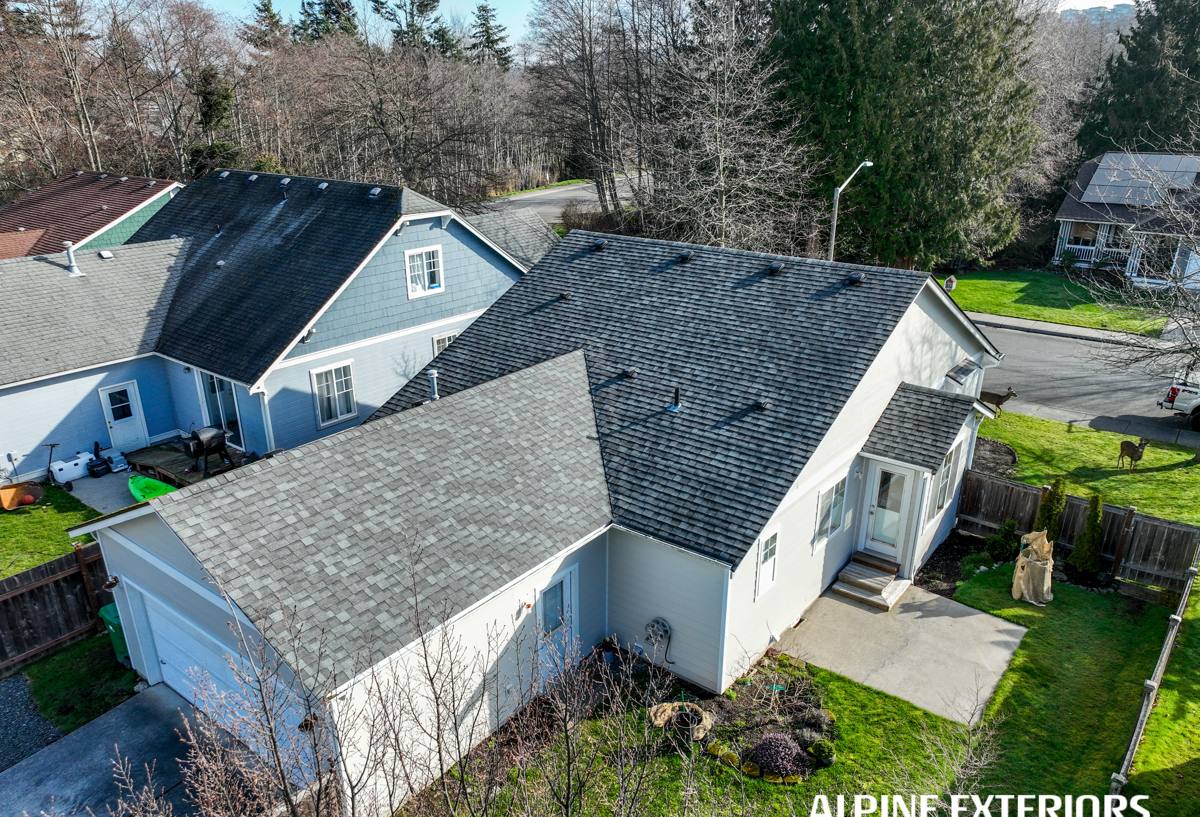
What We Actually See on Bellingham Homes
Moss and Algae Buildup
Constant shade from mature trees, narrow side yards between houses, and long stretches of overcast, damp weather give moss and algae everything they need to take hold. On porous or textured siding materials, spores get a foothold in the surface itself, not just on top of it, which makes cleaning a losing battle over time. A dense, factory-cured surface resists that foothold far better than a soft or absorbent one.
Moisture Intrusion at Seams and Fasteners
Driving rain doesn't fall straight down — wind pushes it sideways into laps, corners, and butt joints. Siding that swells, cups, or delaminates when wet opens tiny gaps that get bigger every wet season. Once moisture gets behind the cladding, it can sit against sheathing and framing for months at a time given how few really dry stretches this region gets.
Salt Air Corrosion
Homes closer to Bellingham Bay and the surrounding waterways deal with an added layer of wear: airborne salt accelerates corrosion on fasteners, flashing, and any metal trim components. It also speeds up the breakdown of lower-grade paint finishes, which is part of why we care so much about how a siding product is finished, not just what it's made of.
Why We Install Only James Hardie Fiber Cement
We get asked regularly why we don't offer vinyl, LP SmartSide, cedar, or other fiber cement brands like Cemplank or Allura. The honest answer is that we made a standard for our own crews based on what holds up in this exact climate, and James Hardie is what we settled on.
Vinyl siding is affordable and low-maintenance in mild climates, but it's a petroleum-based product that expands and contracts with temperature swings, can crack in cold snaps, and relies on overlapping panels that give wind-driven rain plenty of entry points over time. Engineered wood products like LP SmartSide use a wood-strand core that's genuinely improved over older wood composites, but any wood-based core is still vulnerable if moisture gets past the surface — and in a climate this wet, that's not a small risk. Cedar is a beautiful, honest material, but it demands a maintenance commitment — regular refinishing, vigilant caulking, ongoing moss control — that most homeowners underestimate until they're a few years in. Other fiber cement brands make reasonable products, but we standardized on one manufacturer so our crews master one installation system inside and out, rather than splitting attention across several.
James Hardie fiber cement is a mix of cement, sand, and cellulose fiber, cured into a dense, non-combustible board that doesn't absorb water the way wood or wood-composite products can, and doesn't expand and contract the way vinyl does. It's factory-finished with ColorPlus technology, a baked-on finish that's more consistent and more fade- and chip-resistant than paint applied on-site after installation. For a climate that alternates between soaking rain and salt air, that combination of moisture stability and finish durability is what matters most.
The Hardie Product Lines We Work With
Hardie makes several distinct product lines, and part of doing this right is matching the right line to the right part of the house.
| Product | Typical Use | Why It Fits This Climate |
|---|---|---|
| HardiePlank lap siding | Primary wall cladding, most common choice | Overlapping horizontal boards shed driving rain well when installed with correct reveal and flashing |
| HardiePanel vertical siding | Accent walls, gables, modern/farmhouse styles | Fewer horizontal seams reduces water-catching joints on exposed elevations |
| HardieShingle | Accent sections, gable ends, dormers | Non-combustible alternative to cedar shingle look without the moisture upkeep |
| HardieTrim | Corners, window and door trim, fascia | Dense board resists the swelling and rot that wood trim shows first |
Hardie also engineers its boards by climate zone (HZ5 and HZ10 designations), which affects moisture resistance formulation for the region a home is in. We install the product line and ColorPlus color that fit the specific house, not a one-size answer for every job.
Beyond Siding: Roofing, Windows, and Decks
Siding doesn't work in isolation — it's one part of a home's exterior envelope, and the same climate pressures that wear down siding affect roofing, windows, and decking. We handle all four so the details that matter at the transitions — where roof meets wall, where window meets siding, where a deck ledger attaches to the house — are treated as one connected system instead of separate trades that don't talk to each other.
- Roofing that sheds heavy Pacific Northwest rainfall and resists moss growth on shaded slopes
- Windows with flashing details that tie correctly into new siding, not just caulked over old gaps
- Decks built with moisture-conscious framing and ledger flashing, since deck rot is one of the most common hidden failures we find in this region
- Siding that integrates cleanly with all of the above, rather than being installed as an afterthought
What Correct Installation Actually Involves
Fiber cement siding performs the way it's engineered to only when it's installed correctly — Hardie's own warranty terms depend on following their installation specifications. In a wet climate like Whatcom County, the details underneath the siding matter as much as the siding itself.
- Weather-resistant barrier installed and lapped correctly behind the siding
- Proper flashing at windows, doors, and any horizontal trim or transition
- Correct fastener type and placement to avoid splitting and to keep water out of nail penetrations
- Minimum clearance maintained between siding and grade, decks, roofing, and other surfaces
- Factory-cut edges primed and sealed per manufacturer specification, especially at butt joints
- Proper reveal and overlap on lap siding to shed wind-driven rain
Skipping any one of these doesn't usually cause an immediate problem — it shows up two, five, or ten years later as staining, soft trim, or a warranty claim that gets denied because the installation didn't meet spec. That gap between "looks fine on install day" and "performs for decades" is where a lot of exterior work quietly falls short.
Why a Local Crew Matters Here
A crew that works in Whatcom County regularly understands things that don't show up in a manufacturer's install guide: which elevations in this area take the worst wind-driven rain, how much moss pressure to expect on a shaded lot near the water, how salt air affects fastener choice on homes closer to the bay. That local pattern recognition shows up in small decisions — extra attention to a north wall, a flashing detail on a west-facing gable — that a crew unfamiliar with the region might not think twice about.
It also matters for accountability. A local company is answerable to the same neighborhood, the same community, and the same reputation year after year — which is a real incentive to do the job right the first time rather than move on to the next town.
What Affects the Cost of a Siding Project
Every home is different, but the same handful of factors drive most of the variation in siding project cost. This is meant as a general guide, not a quote — actual pricing depends on the specifics of your home.
| Factor | How It Affects Cost |
|---|---|
| Home size and wall complexity | More square footage, more corners, and more roof lines mean more material and labor time |
| Existing siding removal | Tear-off and disposal of old siding adds labor beyond a straightforward install |
| Hidden moisture or rot damage | Damaged sheathing or framing found once old siding comes off needs repair before new siding goes on |
| Product line and profile | HardiePanel, HardieShingle accents, and wider trim packages cost more than standard lap siding |
| Color and finish | Factory ColorPlus finishes in standard colors are typically more cost-effective than premium or custom tones |
| Access and site conditions | Tight lots, multi-story walls, and limited equipment access can add labor time |
Ready for a Straight Answer on Your Home
If moss, staining, soft trim, or aging siding has you wondering what your Bellingham home actually needs, we're glad to take a look and give you an honest read on what's going on and what it would take to fix it right. There's no pressure and no obligation — just a straightforward assessment from a crew that works in this climate every day. Fill out the form below to schedule a free estimate.