 Custer
 Building Along the Whatcom Coast
Blaine sits close enough to the water that salt air is part of daily life, not just a coastal talking point. Homes here face a different combination of stresses than siding just a few miles inland in Lynden or Everson: salt-laden wind off the Strait of Georgia and Semiahmoo Bay, driving rain that comes in sideways during winter storms, and a moss season that can run most of the year in shaded spots. Custer and the surrounding Whatcom County countryside share the rain and moisture load, but Blaine's proximity to open water adds the salt-air factor on top of it.
None of that means a home in Blaine is doomed to constant repairs. It means the siding, the installation details, and the maintenance habits all need to match what the location actually throws at a house. That's the lens we use on every estimate in this area.
What the Coastal Climate Does to Siding
Salt Air and Corrosion
Airborne salt doesn't just sit on the surface of a house — it works into fasteners, trim joints, and any exposed metal. Over years, that accelerates corrosion on lower-quality hardware and can cause staining or pitting on materials that aren't rated to handle it. It's a slow process, which is exactly why it gets overlooked until a homeowner is dealing with rust streaks or failed fasteners a decade in.
Driving Rain and Wind-Driven Moisture
Storms coming off the water don't just drop rain straight down — wind pushes it sideways and up under laps, trim, and around windows and doors. A siding system with weak water-management details (thin butt joints, poor flashing, gaps where trim meets field) will let moisture behind the cladding long before the surface itself shows any wear. Once water gets behind siding and can't dry out, that's when sheathing rot and hidden structural damage start.
Moss, Algae, and Extended Damp Seasons
Whatcom County's mild, wet winters and shaded lots (especially under mature evergreens, common throughout Custer and Blaine) create ideal conditions for moss and algae to take hold on north-facing walls and anything that stays damp for extended stretches. Porous or absorbent siding materials hold that moisture and feed the growth. Denser, factory-finished materials give moss and algae less to grab onto and make cleaning far less damaging to the surface underneath.
Why We Standardized on James Hardie Fiber Cement
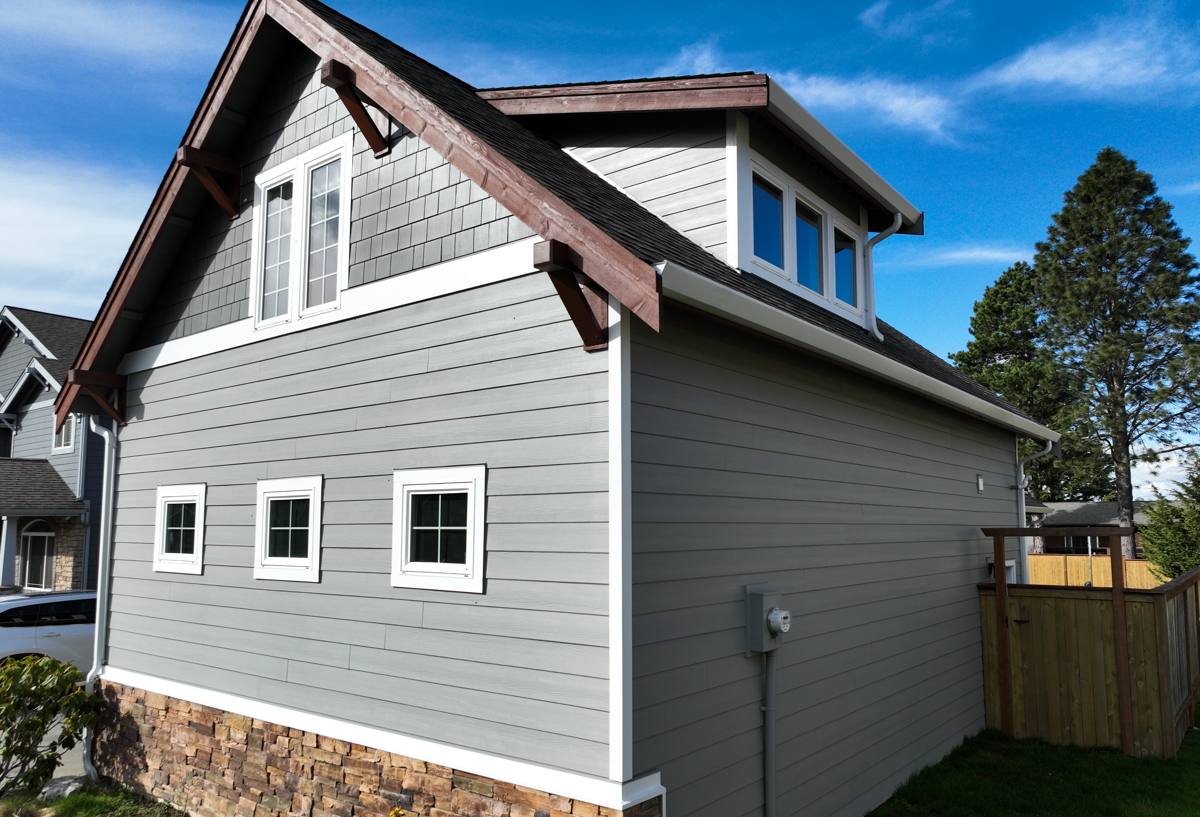
We install James Hardie fiber cement siding exclusively — not vinyl, not LP SmartSide, not Cemplank, Allura, primed spruce, or cedar. That's not a marketing position; it's a decision built around what actually holds up in this climate over the long haul.
- Non-combustible core: Fiber cement doesn't feed a fire the way wood-based and some engineered products can, which matters for insurance conversations as much as safety.
- Factory-applied ColorPlus finish: baked-on color that resists fading and chipping far better than field-applied paint, which matters when you're fighting salt air and UV exposure year-round.
- Climate-engineered HZ5 formulation: Hardie's HZ5 product line is engineered for the Pacific Northwest's freeze-thaw and moisture cycles specifically, not a generic national blend.
- Dense, moisture-resistant composition: harder for moss and algae to colonize than wood or engineered wood products, and it doesn't swell, delaminate, or rot the way moisture-compromised wood-based siding can.
- Strong transferable warranty: backed by Hardie's manufacturer warranty when installed to their specification, and transferable to a future buyer — a real asset if you ever sell.
We go into more depth on the specific trade-offs of other products on our pages comparing James Hardie to LP SmartSide, cedar, primed spruce, and Allura — worth a read if you're weighing options.
How We Approach a Blaine or Custer Project
Inspection First
Before we talk product or price, we look at the house: what direction it faces, how much shade and moss exposure it gets, what condition the existing siding and sheathing are in, and whether there's any sign of hidden moisture damage. A house tucked into trees on the Custer side of the area needs a different conversation than an open lot closer to the water in Blaine.
Water Management Details
The siding material is only part of the equation. Correct installation in this climate means proper flashing at windows, doors, and rooflines; correct lap spacing and fastening per Hardie's specification; and rainscreen or drainage detailing where it's called for. These are the details that determine whether wind-driven rain stays out or finds its way behind the wall.
Full Exterior Scope
Siding, roofing, windows, and decks all interact on a coastal Whatcom County home — a roof leak can show up as siding damage two stories down, and failed window flashing can rot the siding around it. Because we handle all four, we can flag issues across trades during one inspection instead of a siding crew missing a roofing problem that's actually driving the damage.
Comparing Common Siding Options for This Climate
| Material | Salt Air / Moisture Resistance | Moss Resistance | Maintenance | Long-Term Outlook |
|---|---|---|---|---|
| James Hardie Fiber Cement | Strong, HZ5-engineered | Good — dense surface, factory finish | Periodic wash; no repainting needed | Long service life when installed to spec |
| Vinyl | Doesn't rot, but can warp/crack in wind and cold | Moderate — grooves can trap grime | Low, but panels can't be spot-repaired invisibly | Shorter functional life in harsh coastal wind exposure |
| Cedar | Absorbs moisture; needs consistent sealing | Poor without regular treatment | High — refinishing on a recurring cycle | Can look excellent, but demands ongoing upkeep here |
| LP SmartSide | Engineered wood; edge-sealing is critical | Moderate | Moderate; installation precision matters | Performance leans heavily on installation quality |
| Primed Spruce | Weak; prone to moisture uptake | Poor | High — repainting and monitoring required | Not something we recommend for this climate |
What Local Really Means
A crew that works Whatcom County regularly knows which walls in Custer hold moss the longest, which stretches near Blaine take the hardest wind off the water, and how the local building department expects flashing and weather-resistive barrier details to be handled. That's not something a crew rotating through from out of the area picks up on the first job. It also means when there's a warranty question or a follow-up need, you're calling a business that's still local, not chasing down a crew that's moved on to the next region.
We also know the practical stuff: permitting expectations in this part of the county, how to sequence work around the wetter months, and which details matter most on homes exposed to open water versus homes tucked back into tree cover near Custer.
What to Ask Any Siding Contractor Before You Hire
- Are you licensed and insured in Washington, and can you provide proof?
- What siding manufacturer's installation specification do you follow, and are your installers certified on it?
- How do you handle flashing and water management at windows, doors, and rooflines?
- What does the manufacturer's warranty cover, and is it transferable if I sell the home?
- Can you walk me through how you'd handle moss and shading issues specific to my lot?
- Do you carry the same crew through from tear-off to final trim, or subcontract pieces out?
Signs Your Siding Is Losing the Fight
Between the salt air, rain, and moss pressure in this area, a few warning signs are worth acting on before they become bigger repairs:
- Soft or spongy spots when you press on siding, especially near the bottom courses or around windows
- Persistent moss or dark streaking that returns quickly after cleaning
- Visible gaps, cracking, or separation at seams and trim joints
- Paint that's peeling or bubbling rather than just fading
- Rust staining running down from fasteners or trim
- Rooms that feel damp or musty near exterior walls
Cost Factors Worth Understanding
Every home is different, but a few factors consistently move the price on a siding project in this area: the total square footage and number of stories, how much of the existing siding and sheathing needs to come off versus stays, the complexity of the roofline and trim details, and how much of the water-management work (flashing, house wrap, rainscreen) needs to be brought up to current standards. Homes with existing moisture damage from wind-driven rain or long-term moss cover typically need more sheathing repair than homes that were properly maintained, which is something we'll flag honestly during inspection rather than after the tear-off starts.
Get a Straightforward, No-Pressure Estimate
If you're in Blaine, Custer, or anywhere else along this stretch of Whatcom County and want an honest look at what your siding, roofing, windows, or decking actually need, we're glad to come take a look. There's no pressure and no hard sell — just a clear picture of your home's condition and what your options are. Use the form below to request a free estimate.