 Custer
 Two Very Different Materials, One Big Decision
If you're re-siding a home in Custer or anywhere else in Whatcom County, you've probably narrowed your search down to two finalists: vinyl siding and James Hardie fiber cement. Both are common, both are sold by reputable installers, and both will make your house look better than it does today. But they are not interchangeable products, and the differences matter more here than they would in a dry, mild climate.
We're a Custer-based siding contractor, and we install James Hardie fiber cement exclusively. We don't carry vinyl, LP SmartSide, or other engineered wood products. That's a deliberate standard, not a sales pitch, and we think homeowners deserve to know exactly why before they sign a contract with anyone — us included. This page lays out how the two materials actually compare, where vinyl does fine, and where our local conditions push the decision toward fiber cement.
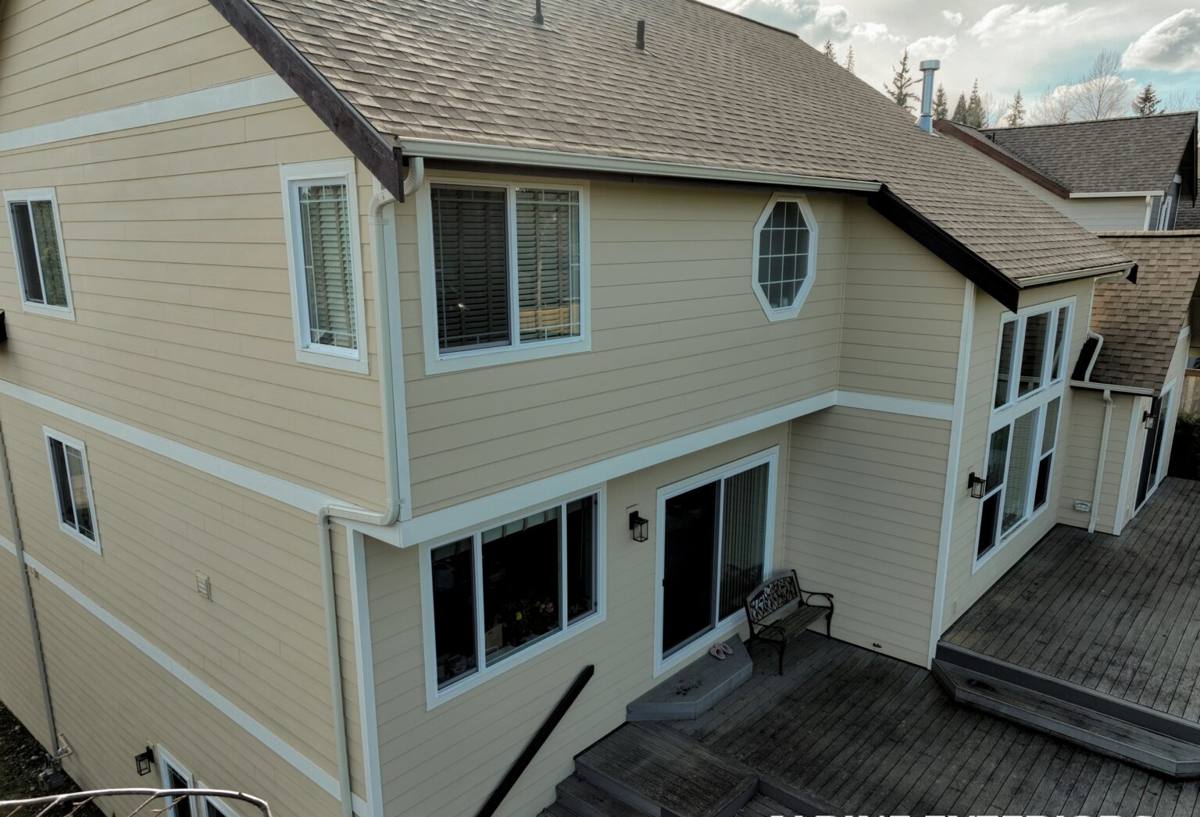
What Vinyl Siding Actually Is
Vinyl siding is extruded PVC (polyvinyl chloride) formed into interlocking panels. It's been a mainstream siding choice since the 1970s because it's inexpensive to manufacture, lightweight, and fast to install. Modern vinyl has improved a lot from the thin, brittle panels of decades past — thicker gauge products, better UV-stable colors, and insulated backer options are all widely available now.
Vinyl's core selling points are upfront cost and low maintenance in the sense that it never needs painting. It doesn't rot, and it sheds rain reasonably well when installed correctly. For a lot of homeowners in drier climates, that's enough.
What James Hardie Fiber Cement Actually Is
James Hardie siding is made from cement, sand, and cellulose fiber, cured into dense, rigid boards and panels. It's a completely different material class from vinyl — closer in behavior to masonry than to plastic. It's engineered to be non-combustible, dimensionally stable across temperature swings, and resistant to moisture absorption when the factory finish is intact.
Hardie's HZ5 product line, in particular, is engineered for cold, wet, freeze-prone climates like ours — it's rated for regions that see the kind of driving rain and temperature cycling that Whatcom County gets off the Strait of Georgia and Puget Sound. The ColorPlus factory finish is baked on under controlled conditions, which gives it more consistent coverage and UV resistance than field-applied paint.
Why Local Climate Changes the Calculus
Custer sits close enough to the water that salt air is a real factor on siding, trim, and fasteners. Combine that with Whatcom County's long, wet fall-through-spring stretch and the moss and algae growth that comes with shaded, damp exteriors, and you've got a climate that stress-tests siding harder than most of the country does.
Vinyl doesn't rot or corrode, but it does have real limits here. It expands and contracts significantly with temperature swings — more than fiber cement — which over years can loosen fastening and open gaps at seams and corners. Those gaps are exactly where wind-driven rain gets pushed during a winter storm coming off the water. Vinyl panels are also thin enough that persistent damp, mossy conditions on north-facing or shaded walls can trap moisture behind the panel against the house wrap and sheathing, where problems go unseen until they're expensive.
Fiber cement's rigidity and lower thermal movement mean tighter, more stable seams over time, and the material itself doesn't feed mold or moss growth the way wood-based products can. It still needs proper flashing, gapping, and caulking to manage our rain volume — no siding material is a substitute for correct installation — but the material itself is working with you instead of against you in this climate.
Salt Air and Coastal Exposure
Homes closer to the water deal with airborne salt settling on every exterior surface. Vinyl doesn't corrode from salt, but its fasteners and any exposed metal trim can. Fiber cement pairs well with corrosion-resistant fastening and factory-finished trim, and the board itself isn't degraded by salt exposure the way some coatings and adhesives can be over time.
Side-by-Side Comparison
| Factor | Vinyl Siding | James Hardie Fiber Cement |
|---|---|---|
| Material | Extruded PVC plastic | Cement, sand, cellulose fiber |
| Fire performance | Combustible, can melt/deform near heat | Non-combustible |
| Impact resistance | Can crack or shatter in cold, especially older/thin panels | Dense and impact-resistant |
| Thermal movement | Expands/contracts noticeably | Minimal expansion and contraction |
| Moisture behavior | Sheds water but seams can open over time | Engineered HZ5 lines for wet, cold climates |
| Finish | Color molded through panel; fades with UV over years | ColorPlus factory-baked finish, field-touch-up available |
| Typical lifespan | 20-30 years, variable with climate exposure | 30-50+ years when installed and maintained to spec |
| Upfront cost | Lower | Higher |
| Warranty structure | Varies widely by manufacturer and grade | Strong transferable limited warranty from James Hardie |
| Repainting | Not typically painted; replace panel if faded/damaged | Can be repainted; ColorPlus reduces need for years |
Where Vinyl Genuinely Makes Sense
We're not going to pretend vinyl is a bad product across the board — it isn't. It's a reasonable, cost-effective choice for homeowners who need to hit a tight budget, who plan to sell within a handful of years, or who live somewhere with milder weather exposure than we get on the Whatcom County coastline. Millions of homes are sided in vinyl and perform fine for decades. Our decision not to install it isn't a claim that it fails everywhere — it's that we don't think it's the right long-term investment for the conditions our clients' homes actually face.
Why We Standardized on James Hardie
We made a business decision years ago to install one siding system and install it well, rather than carry several products and be mediocre at all of them. James Hardie won that decision for a few concrete reasons:
- Non-combustible material — a meaningful safety difference, particularly relevant given wildfire smoke and ember exposure that reaches even western Washington in dry summer stretches.
- Climate-matched product lines — HZ5 is specifically engineered for our freeze-thaw, high-moisture region rather than a one-size-fits-all product.
- Dimensional stability — less expansion and contraction means seams, caulking, and paint lines stay tighter for longer.
- Factory-cured ColorPlus finish — more consistent and UV-stable than field-applied paint, with less risk of chalking or fading unevenly.
- Strong transferable warranty — meaningful protection for the current owner and for resale.
- Proven long-term performance — a track record in wet coastal climates like ours, not just a marketing claim.
The tradeoff is real: Hardie costs more upfront and requires a more skilled, more careful installation than vinyl does. We think that tradeoff is worth it for a product that's going on a home for decades, in a climate that doesn't forgive shortcuts.
What Correct Fiber Cement Installation Requires
Fiber cement is not a forgiving material for a rushed or inexperienced crew. Getting the performance the manufacturer promises depends on details that don't show up in a driveway estimate:
- Proper weather-resistive barrier and rainscreen or drainage gap behind the siding
- Correct flashing at every window, door, and roof-to-wall intersection
- Manufacturer-specified fastening pattern, nail type, and embedment depth
- Gapping and sealing at butt joints, corners, and penetrations per Hardie's install guide
- Field-cut edges primed and sealed before installation
- Correct clearance from grade, decks, and roof lines to keep the bottom edge dry
Skip any of these and you can undercut even the best siding material's performance — which is part of why installer experience matters as much as the product choice itself.
Cost Factors Worth Understanding
Vinyl's lower material and labor cost is real and immediate. Fiber cement costs more per square foot in materials and takes longer to install correctly, which shows up in the bid. Where the comparison shifts is over a 20-30 year ownership horizon: vinyl in a harsh, wet, salt-exposed climate may need panel replacement, recaulking, or full re-siding sooner than a well-installed Hardie system, which is built to go multiple decades between major work. Whether that long-term math matters to you depends on how long you plan to own the home and how much you value not thinking about your siding again for a long time.
A Practical Checklist Before You Decide
- How long do you plan to stay in the home?
- Is your property exposed to direct salt air, or shaded and prone to moss?
- Does your budget allow for a higher upfront cost in exchange for a longer service life?
- Have you gotten a written scope showing flashing, gapping, and fastening details — not just "siding replacement"?
- Does the installer carry manufacturer certification for the product they're proposing?
- Does the warranty transfer to a future buyer if you sell?
Our Bottom Line
Vinyl siding isn't a scam and it isn't automatically the wrong choice everywhere — it's a reasonable product for the right situation. But for homes in Custer and across Whatcom County dealing with salt air, driving rain, and a long moss season, we've made the professional judgment that James Hardie fiber cement holds up better, ages better, and protects the house underneath it more reliably over the decades that matter. That's why it's the only siding system we install.
If you're weighing your options and want a straight answer about what your specific home and exposure call for, we're happy to walk the property with you. Reach out for a free, no-pressure estimate — we'll tell you what we'd actually recommend, not just what we sell.