 Custer
 Siding Work in Laurel, from a Crew That Works This Part of Whatcom County Regularly
Laurel sits in the quiet, rural stretch of Whatcom County between Ferndale and Lynden, part of the same flat, low-lying farm and pasture land that surrounds Custer. It's not a waterfront community, but it's close enough to the Salish Sea and the Strait of Georgia that marine weather reaches every property here — carried inland on winter storms and settling into the low ground that defines this part of the county. Homes around Laurel deal with a specific combination of salt-tinged air, wind-driven rain, and a moss season that can run most of the year, and that combination shapes almost every decision we make on a siding job out here.
We work this stretch of Whatcom County on a regular basis, not as an occasional stop between jobs closer to Bellingham or the coast, and that regular presence matters. We install siding, roofing, windows, and decks, because on a rural property like the ones around Laurel, those four systems tend to fail together — a gap in roof flashing or a worn window seal often shows up months later as staining or softness in the siding below it, not as a problem in the place it actually started. On the siding side, we install James Hardie fiber cement exclusively. That's a professional standard we hold to, not a sales pitch, and this page walks through both the climate reasoning behind it and what a real siding project looks like for a Laurel home.
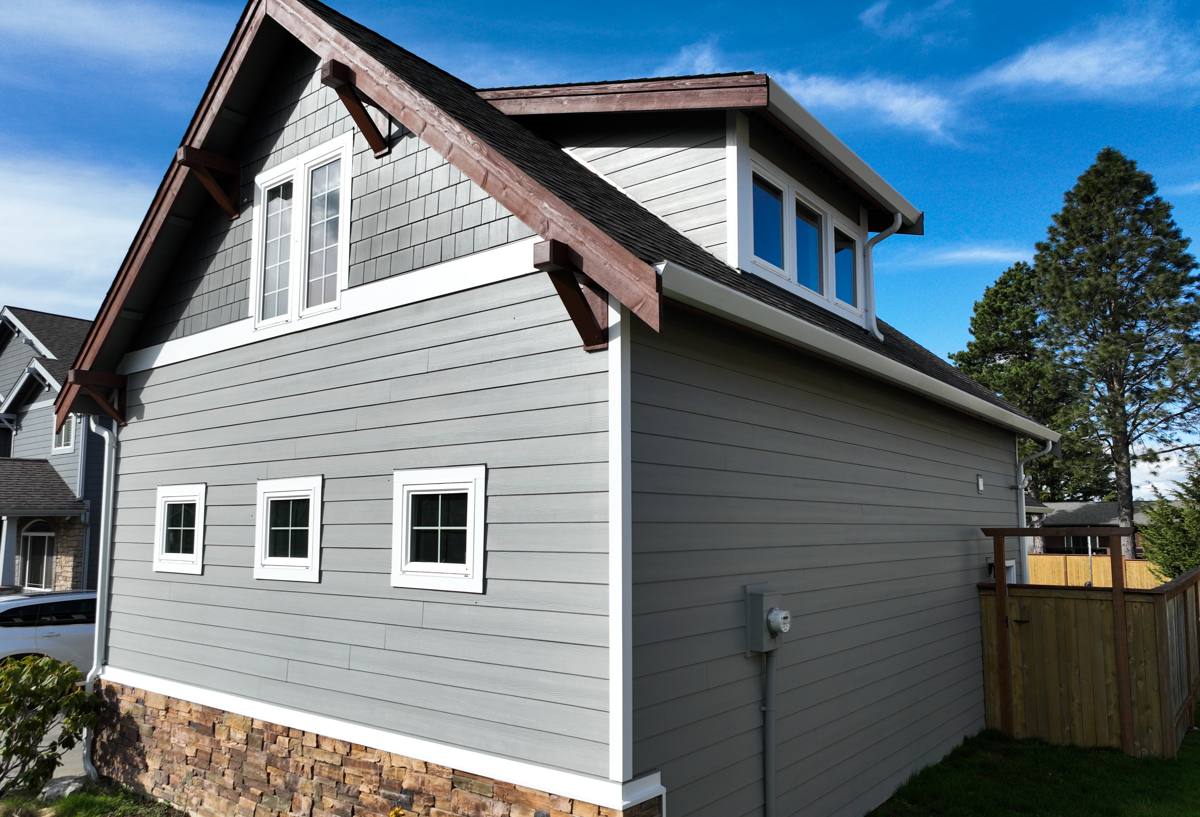
What Laurel's Climate Puts Exterior Materials Through
Salt Air, Carried Inland Across Open Ground
Laurel isn't on the water the way some Whatcom County communities are, but it sits on flat, open land with little tree cover or elevation to slow weather moving in off the Strait of Georgia and the Salish Sea. That means salt-laden marine air reaches properties here more consistently than a lot of homeowners expect for an inland location. Over years, that steady low-grade salt exposure accelerates corrosion on fasteners, flashing, and lower-grade trim hardware — slower than it would on a home right at the water's edge, but faster than it would in a truly dry, inland climate.
Driving Rain With Nothing to Break It
The same open, flat terrain that lets salt air travel inland also does nothing to slow wind-driven rain. Storms moving across this part of the county tend to push moisture sideways into siding joints, window flashing, and roof-to-wall transitions rather than dropping it straight down. On a farmhouse or rural property around Laurel with few windbreaks nearby, that wind-driven load is often the real test of how well an exterior was actually installed — not just what the material is rated for on a spec sheet.
A Long, Persistent Moss Season
Mild temperatures and near-constant moisture add up to a moss and mildew season that runs close to year-round on shaded or north-facing walls, and the tree lines, hedgerows, and outbuildings common on rural Laurel properties create plenty of shaded, slow-drying surfaces. Any siding material that's even slightly porous, or that holds moisture against the substrate instead of shedding it, turns into a growth surface over time. Fields and ditches nearby can also keep ground-level humidity higher than in town, which adds to the load on siding closer to grade.
Why We Install Only James Hardie Fiber Cement
We narrowed our siding offering down to one system after years of tear-offs and service calls across this part of Whatcom County made a pattern obvious: what holds up through repeated wet seasons and what looks good on a spec sheet aren't always the same thing.
- Non-combustible core: Fiber cement doesn't feed a fire the way wood-based siding can, which matters for homeowner safety and for insurance underwriting on rural properties.
- Factory-applied ColorPlus finish: Baked on in a controlled factory process rather than brushed on in the field, holding color and adhesion far longer under sustained marine air and UV exposure.
- Climate-engineered HZ product lines: Hardie's HZ5 formulation is built for regions with significant moisture exposure and freeze-thaw cycling, a fit for Laurel and the rest of the Whatcom County lowlands.
- Dimensional stability: Fiber cement doesn't swell, cup, or warp the way engineered wood siding can after repeated wetting cycles.
- A strong transferable warranty: Hardie backs the product with one of the more robust warranty structures in the industry, provided installation follows their published specs.
We don't install LP SmartSide, vinyl siding, Cemplank, Allura, primed spruce, or cedar. Each has a place in the broader market, and plenty of homeowners elsewhere are satisfied with them. Our position is specific to this climate: in an area that sees this much sustained marine moisture and wind-driven rain, we'd rather stand fully behind one system than offer a cheaper alternative that quietly shifts maintenance risk onto the homeowner a few years down the road.
Where Other Products Fall Short in This Climate
| Product | Common trade-off in Laurel's climate |
|---|---|
| Vinyl siding | Expands and contracts with temperature swings; lapped, non-sealed seams give wind-driven rain an entry point |
| LP SmartSide / engineered wood | Wood-strand core is more moisture-sensitive at cut edges and fastener points, a real concern under sustained rain |
| Primed spruce or cedar | Requires an ongoing paint and moisture maintenance schedule to avoid rot; organic surface is hospitable to moss |
| Other fiber cement brands | May lack a climate-specific HZ-style formulation or the same factory-finish warranty depth as James Hardie |
How a Siding Project Runs on a Laurel Home
Inspection and Estimate
Every job starts with an honest walk-around of the house — current siding condition, any signs of trapped moisture or sheathing damage, and how sun, shade, and wind exposure vary across the different walls. On a rural property, that often means checking how nearby trees, outbuildings, or hedgerows are affecting drying time on specific elevations. That assessment drives the estimate rather than a flat per-square-foot guess.
Tear-Off and Substrate Check
Once old siding comes off, we check the sheathing underneath for rot or soft spots before anything new goes up. Covering damaged sheathing with new siding just hides a problem that gets worse behind the wall — we'd rather find it and deal with it at this stage, even if it adds a step to the project.
Weather Barrier and Flashing Detail
Most siding failure in this climate traces back to water getting behind the cladding, not through it. The house wrap, window flashing, and every wall penetration get careful attention on a Laurel job, especially on walls that take the brunt of wind-driven rain with no windbreak nearby. This step is easy to rush and hard to inspect once the siding is up, so we treat it as non-negotiable.
Installation to Manufacturer Spec
James Hardie's warranty depends on installation following their published specifications — correct fastener spacing, clearances above grade and roofline, and proper field-cutting and sealing practices. We install to that spec as the baseline, not as an upsell.
Final Walkthrough
We walk the finished job with the homeowner, cover care and maintenance expectations specific to a rural, moisture-heavy property, and confirm everything matches what was estimated before calling the job complete.
Roofing, Windows, and Decks While We're There
Because siding problems on Laurel homes so often start with a roof or window issue, it's worth having those checked at the same time as a siding project, even when siding is the main concern. A roof with failing flashing at a wall transition, or a window with a compromised seal, can undo a brand-new siding job within a couple of wet seasons by feeding moisture in from a different direction entirely. Decks on rural properties face a related but distinct set of pressures — ground contact, standing water in low-lying yards, and the same moss and moisture load that affects the walls and roof, just at a different angle. We handle all four so a homeowner isn't stuck coordinating between separate contractors who each only see their own piece of the house.
Signs a Laurel Home's Siding Needs Attention
- Moss or dark staining that returns quickly after cleaning, especially on shaded or north-facing walls
- Soft or spongy siding, particularly low on the wall or around window and door trim
- Peeling paint or visible warping, most common on older wood-based or engineered wood siding
- Cracked, buckled, or missing panels after a windstorm crossing open farmland
- Rust staining running down from fasteners or trim hardware
- Musty odors or staining on interior walls that back up to exterior siding
- Siding older than 20-25 years with no documented replacement history
None of these automatically mean a full replacement is needed, but each is worth a professional look before the next wet season adds to the damage rather than after it.
What Affects Siding Cost on a Laurel Property
Every estimate is specific to the house, but a few factors consistently move the number: total square footage and number of stories, how much trim and detail work surrounds windows and rooflines, the condition of the sheathing underneath once old siding comes off, how exposed the property is to open wind versus sheltered by trees or outbuildings, and which James Hardie product line and color fits the home. Rural properties with outbuildings, detached garages, or larger footprints also tend to have more total wall area than an equivalent in-town lot, which is worth factoring in early. We walk through these factors specifically during the estimate rather than handing over a number with no explanation behind it.
Why a Local Crew Matters Out Here
Working across this part of Whatcom County, including the rural stretches around Laurel and Custer, means being on job sites here through every season, not just when the weather cooperates. That repeated exposure shapes real decisions on the job — which walls stay wet longest given the prevailing wind, where extra flashing attention earns its keep on an exposed rural property, and which install-day details are worth the time so a homeowner isn't dealing with a callback two winters later. It also means that when a warranty question or maintenance issue comes up years down the line, it's a call to a crew still working in the same area, not a company that's moved on somewhere else.
If your Laurel home needs new siding, or you'd like a roof, window, or deck looked at alongside it, we're glad to come take a look and give you a straightforward, no-pressure estimate. Reach out using the form below to get started.