 Custer
 Birch Bay's Exterior Problem: It's the Water, Not Just the Weather
Birch Bay sits right where Whatcom County's marine climate does its worst work on a house. Homes here don't just get rained on — they get salt-laden air off the water, driving wind-blown rain that finds every gap in a building envelope, and long stretches of gray, damp months where surfaces rarely get a full dry-out. That combination is harder on exterior materials than a straightforward "lots of rain" climate inland, because salt air accelerates corrosion and finish breakdown in ways plain fresh water doesn't.
Add in the tree cover common to this part of Whatcom County, and you get near-constant shade on north- and west-facing walls and rooflines. Shade plus moisture plus mild year-round temperatures is exactly the recipe moss and algae need. Homeowners in Birch Bay tend to notice the same pattern: siding that stays damp longer than it should, roof edges and valleys that grow moss faster than the rest of the roof, and window and door trim that shows rot before anything else on the house does.
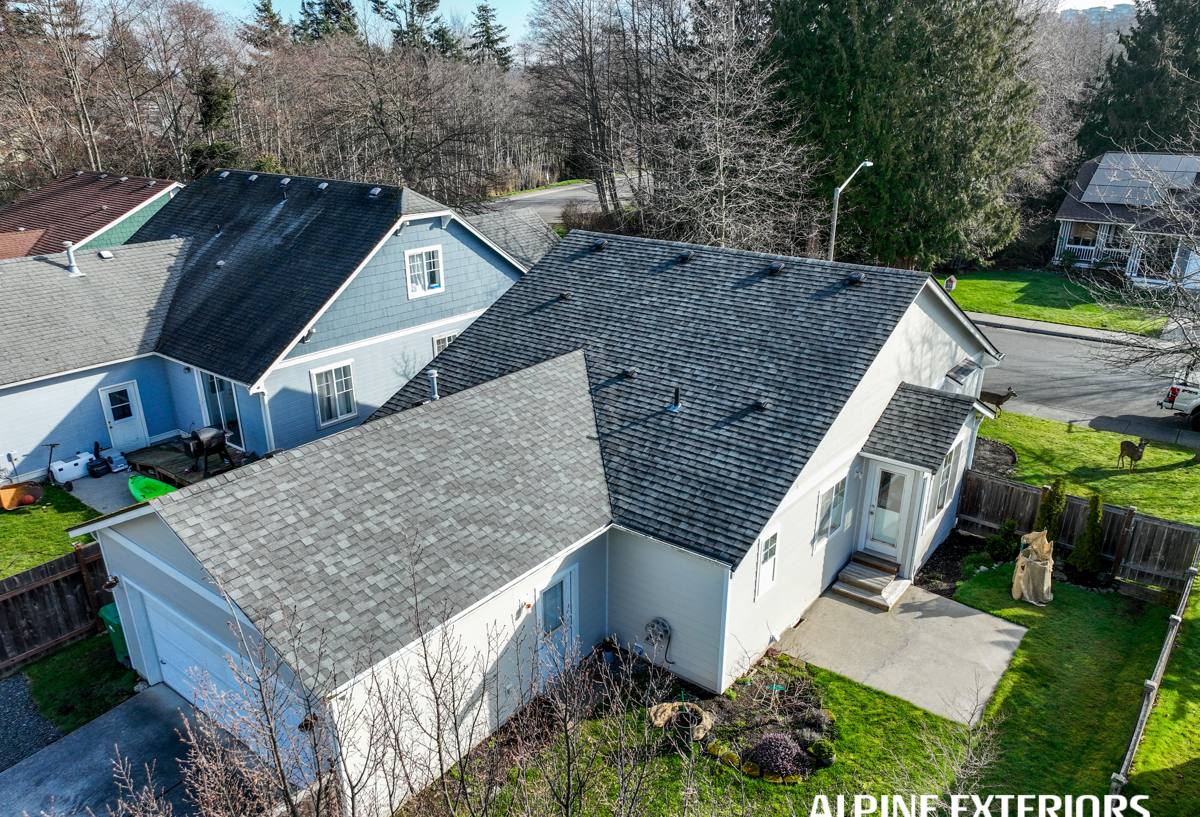
What Salt Air and Driving Rain Actually Do to a House
Siding
Wood-based and wood-composite siding products absorb moisture at cut edges, fastener holes, and butt joints. Once water gets behind or into the material, it doesn't evaporate quickly in a marine climate — there just aren't enough dry, sunny days in a row. That leads to swelling, delamination, and paint failure, usually starting at the bottom courses and around penetrations like hose bibs and light fixtures.
Roofing
Driving rain in coastal Whatcom County doesn't fall straight down — wind pushes it sideways and up under shingle edges, flashing laps, and vent boots. A roof system that's only detailed for vertical rainfall will eventually leak in a spot like this. Moss growth on shaded roof planes also lifts shingle edges over time, giving wind-driven rain an easier path underneath.
Windows
Older window units and poorly sealed installations let wind-driven rain track in around the frame rather than through the glass itself. Salt air also degrades some seals and finishes faster than an inland install would experience, which is part of why window failures near the water tend to show up sooner than the manufacturer's general expectations.
Decks
Exposed decks take the full combination — standing moisture, salt air on any metal fasteners or connectors, and moss on any shaded or low-airflow section of decking. Ledger board connections and any framing tucked against the house are the areas most likely to hide a moisture problem before it's visible from the top.
Siding: Why We Only Install James Hardie Fiber Cement
For siding, our company installs one product system: James Hardie fiber cement. We don't install vinyl, LP SmartSide, Cemplank, Allura, primed spruce, or cedar. That's a deliberate standard, not a sales pitch, and it's worth explaining honestly rather than just asserting it.
Wood-based siding — including engineered wood products and traditional cedar — depends on paint and sealants staying intact to keep water out of the wood fiber underneath. In a climate like Birch Bay's, where surfaces stay damp for extended stretches and salt air accelerates finish wear, that maintenance burden is real and ongoing. Vinyl siding sheds water reasonably well but can warp or become brittle with temperature swings and UV exposure over time, and it doesn't offer the impact resistance or paintable, factory-finished look that many homeowners want for a long-term exterior.
Fiber cement is a different material entirely — it's cement, sand, and cellulose fiber, not wood. It doesn't rot, and it isn't a food source for the moss and algae that thrive in this climate. James Hardie's ColorPlus factory finish is baked on under controlled conditions, which holds up better against sun and salt exposure than field-applied paint, and it comes with a strong transferable warranty on both the substrate and the finish. Hardie also engineers specific product lines (their HZ5 line, for example) for wetter, more marine-exposed climates like ours — the product is built with this kind of weather in mind rather than adapted after the fact.
None of this means other products are without merit — cedar has a real appearance and history that some homeowners value, and vinyl has a lower up-front cost. But for the way weather behaves in Birch Bay, we've made a standard: fiber cement is what we put on homes, and we'd rather explain that trade-off honestly upfront than install something we don't believe will perform here long-term.
Roofing Built for Wind-Driven Rain and Moss Pressure
Roofing in this area needs to be detailed for water moving sideways and upward, not just falling straight down. That means careful attention to flashing at valleys, walls, and penetrations, and underlayment choices that give a second line of defense if wind-driven rain gets past the roof covering itself. Moss control matters just as much as the roofing material — regular removal and treatment on shaded, north-facing planes keeps moss from lifting shingles and shortening the roof's service life. We look at ventilation too, since a roof deck that can't breathe holds moisture longer and accelerates both moss growth and material breakdown from underneath.
Windows That Actually Seal Out a Marine Climate
Window performance in Birch Bay comes down to two things: the unit itself and the installation. A well-built window can still leak if it's flashed incorrectly or if the sealant around it fails. We pay close attention to flashing details — proper lapping so water sheds down and out rather than behind the siding — and to using sealants and materials suited to sustained damp exposure rather than just a quick caulk bead. For homeowners weighing a window replacement, energy performance matters, but in this climate, water management around the unit is just as important to get right.
Decks Designed for Coastal Exposure
A deck near Birch Bay needs attention paid to a few areas that don't get much notice inland: the ledger board connection to the house, fastener and hardware corrosion resistance given salt air exposure, and airflow underneath and between boards so moisture doesn't sit. We also look at how the deck interacts with the house's water management overall — a poorly flashed ledger board is a common hidden source of water intrusion into the structure, not just a deck problem.
Material Comparison for a Birch Bay Exterior
| Material | How It Handles Salt Air & Rain | Maintenance Burden | Our Position |
|---|---|---|---|
| James Hardie fiber cement | Non-combustible, doesn't rot, factory finish holds up to sun/salt exposure | Low — periodic cleaning, no repainting cycle in most cases | What we install |
| Cedar / primed spruce | Absorbs moisture at joints and cuts; finish wears faster in constant damp conditions | High — regular repainting/sealing to keep water out of the wood | Not installed by us |
| LP SmartSide / Cemplank / Allura | Engineered wood or alternate fiber cement; performance varies by product and installation care | Moderate to high depending on product | Not installed by us |
| Vinyl siding | Sheds water well but can warp/become brittle with temperature swings and long-term UV exposure | Low, but limited repair/refinish options if damaged | Not installed by us |
Why a Local Crew Matters in Birch Bay
Whatcom County's marine exposure isn't uniform even within a small area — a home a few blocks from the water can face different wind and salt exposure than one further back, and tree cover changes moss pressure block by block. A crew that works this specific area regularly gets a feel for which details matter most on a given lot: where wind-driven rain tends to find weak points, which roof planes need extra moss attention, and how to flash a deck ledger or window opening so it holds up through another wet season. That local familiarity shows up in the small decisions made on-site, not just the materials on the truck.
Signs Your Birch Bay Home Needs Exterior Attention
- Moss buildup on roof edges, valleys, or shaded siding sections
- Paint peeling or bubbling on wood siding, especially near the bottom courses
- Soft or spongy spots on wood trim around windows, doors, or deck ledgers
- Water staining on interior ceilings near roof valleys or wall penetrations
- Window frames that feel damp or drafty during wind-driven rain
- Visible corrosion on deck fasteners, hinges, or metal connectors
- Siding that stays visibly wet longer than the rest of the house after rain stops
What to Expect From Our Process
- A walk-around inspection that looks at siding, roofline, windows, and any decks or attached structures together, since problems in one area often connect to another
- An honest assessment of what needs replacement now versus what can be monitored or maintained
- A written estimate that explains material choices and why we're recommending them for this specific home and exposure
- Scheduling that accounts for Whatcom County's wetter months, since some work is better timed around drier stretches
If you're dealing with any of the issues above, or just want a second opinion on how your home's exterior is holding up against Birch Bay's salt air and rain, we're happy to take a look. Reach out for a free, no-pressure estimate — the form below gets you started.