 Custer
 Moisture Is the Real Enemy, Not the Weather Itself
Rain doesn't rot siding. Trapped moisture does. Almost every siding failure we get called out to investigate in Whatcom County traces back to the same root cause: water got behind the siding, or into it, and had nowhere to go. The siding itself might look fine from the driveway while the wall behind it is quietly falling apart.
Understanding that distinction changes how you think about siding. The question isn't "will it rain on my house" — in Custer, it obviously will, a lot. The real question is whether your siding system is built to shed water, dry out fast when it does get wet, and keep moisture from tracking into the wood framing behind it. That's a design and installation problem as much as a material one, and it's the whole reason this page exists.
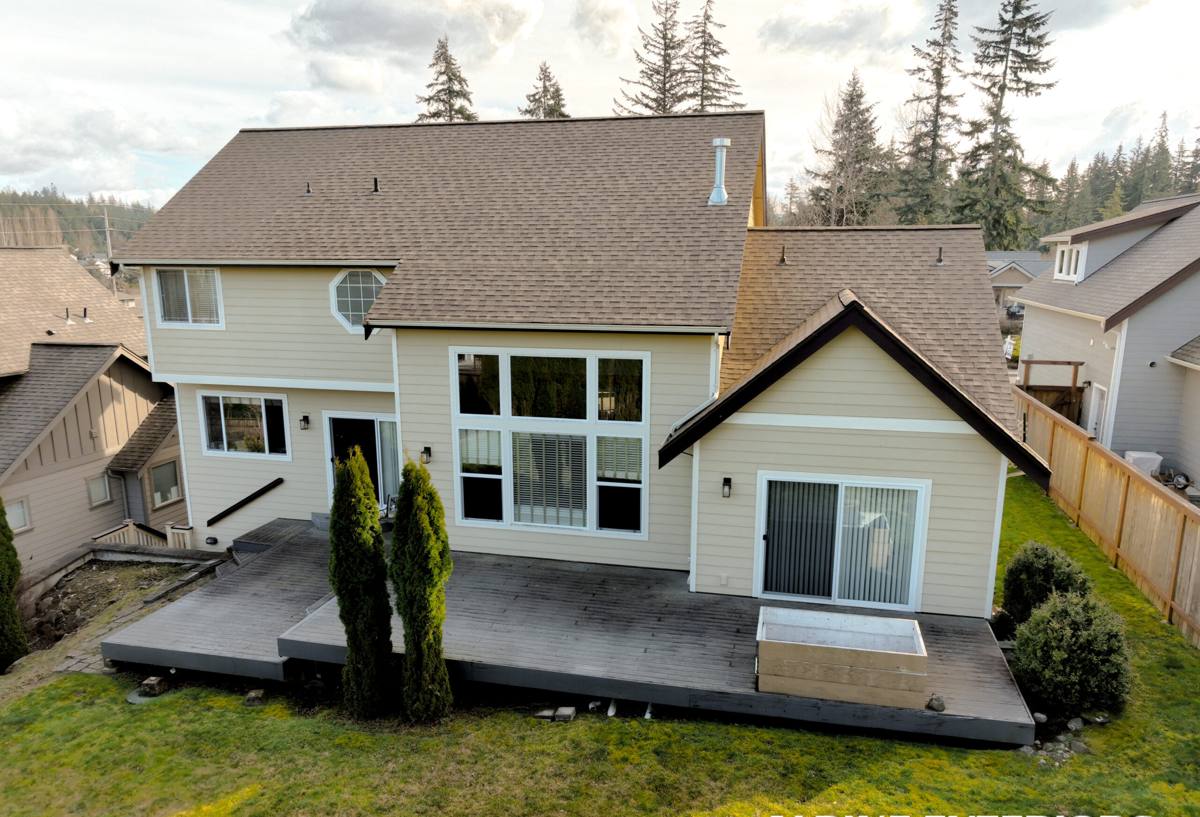
What Custer's Climate Actually Does to a House
Custer sits close enough to the water that salt air is a real, daily factor on exterior materials — not just a coastal-town cliché. Salt-laden moisture accelerates corrosion on fasteners, flashing, and any exposed metal, and it settles into porous surfaces in a way plain rainwater doesn't. Combine that with the driving rain that comes off Georgia Strait and Bellingham Bay during fall and winter storms — rain that hits siding sideways, not just straight down — and you've got water finding its way into every gap, seam, and nail hole that isn't properly sealed.
Then there's moss. Whatcom County's long, wet, mild winters create a moss and algae season that runs far longer here than in drier parts of the state. Moss holds moisture against a surface for weeks at a time, keeps it in constant contact with siding and trim, and creates the exact damp, shaded conditions that wood-based products and even some cementitious products struggle with over the long haul.
None of this means Custer is an unusually hostile place to build. It means the margin for error in siding material and installation is smaller here than it is in, say, eastern Washington. What gets away with mediocre installation in a dry climate will show problems here in a fraction of the time.
How Moisture Actually Gets Behind Siding
Most homeowners assume water gets in through the face of the siding itself. Sometimes it does, especially with absorbent materials. But the more common failure points are at the edges and penetrations:
- Butt joints and seams where siding pieces meet, especially if caulk has shrunk, cracked, or was never applied correctly
- Around windows and doors where flashing was skipped, reversed, or installed without proper overlap
- At the bottom edge near grade, where splashback and standing water sit against the siding for hours after every storm
- Nail penetrations that were overdriven, under-driven, or placed in the wrong zone of the panel
- Behind trim boards and corner boards where the water-resistive barrier wasn't lapped correctly
- Roof-to-wall intersections and deck ledgers, where flashing details are easy to get wrong and hard to inspect once covered
This is why we say installation quality matters as much as the product itself. A premium siding material installed with sloppy flashing and caulking will fail faster than a modest material installed correctly. Both matter — but you can't material your way out of bad installation.
The Water-Resistive Barrier: The Part No One Sees
Behind every siding system should be a water-resistive barrier (WRB) — housewrap or a similar membrane — that's the real backstop against moisture reaching your sheathing. Siding is the first line of defense; the WRB, properly lapped and taped at every seam and penetration, is the second. When we tear off old siding on a Custer home, the condition of that barrier tells us more about the house's moisture history than the siding ever did.
What Happens Once Moisture Gets In
Wood-based sheathing and framing don't fail the first time they get wet. They fail from repeated wetting without adequate drying time in between. That's the cycle that does the damage:
- Water enters through a gap, seam, or absorbed through a porous surface
- It gets trapped against sheathing or framing with limited airflow to dry it out
- Fungal decay organisms, which need moisture to survive, begin breaking down wood fiber
- The damage stays hidden behind the siding for months or years, since surface paint or coating can still look intact
- By the time staining, soft spots, or a musty smell show up inside, the rot is usually well established
In our climate, with roughly eight months of the year offering real drying weather and the rest delivering steady rain and long damp stretches, that cycle repeats often enough that any weak point in the siding system gets tested year after year.
How Different Siding Materials Handle Moisture
Not all siding materials respond to moisture the same way. This is the core of why we made the product decision we did.
| Material | Moisture Behavior | Long-Term Concern in This Climate |
|---|---|---|
| Cedar / natural wood | Absorbs and releases moisture readily; performance depends heavily on coating maintenance | Recoating on a strict schedule; rot at joints and end grain if maintenance lapses |
| Primed spruce / engineered wood siding (unfinished) | Wood-fiber core is vulnerable if the factory coating or field-applied paint is breached | Edge and cut-end swelling, delamination, and rot once moisture reaches the core |
| LP SmartSide and similar engineered wood panels | Treated wood-strand core resists moisture better than raw wood but still relies on intact coatings and sealed edges | Manufacturer's own warranty terms hinge on strict field-caulking and touch-up-paint requirements at every cut and seam |
| Vinyl siding | Doesn't absorb water itself, but isn't a moisture barrier — water travels behind and beneath panels | Relies entirely on the WRB behind it since the panels themselves aren't sealed at seams; can trap moisture behind the wall assembly |
| Fiber cement (James Hardie) | Non-combustible, dimensionally stable material that doesn't swell, warp, or rot; factory-baked ColorPlus finish resists moisture intrusion at the surface | Still requires correct flashing, caulking, and clearance details — no siding is maintenance-free |
The pattern across the wood-based and wood-fiber products is the same: they perform well when the factory coating and field sealing stay perfectly intact, and they're vulnerable the moment that protective layer is breached — by a missed caulk joint, a scratch, a woodpecker, or just years of UV and weather wear. In a climate with this much sustained moisture exposure, that's a maintenance burden we're not willing to put a homeowner's wall framing behind.
Moss, Algae, and the Salt Air Combination
Moss and algae growth on siding isn't just cosmetic in this climate — it's a moisture-retention problem. Once a colony establishes on a north-facing wall or under an overhang that doesn't get sun exposure, it holds water against the surface long after the rest of the house has dried. Over a full moss season, that's a lot of extra wet-hours on that section of wall compared to the rest of the house.
Salt air compounds this by accelerating the breakdown of fasteners and flashing metal, and by leaving a residue that can hold moisture against surfaces even without visible rain. Homes closer to open water or exposed to prevailing coastal winds see this more than homes tucked into more sheltered lots, but no property in this part of Whatcom County is entirely exempt from it.
Why We Standardized on James Hardie Fiber Cement
We made a deliberate decision to install only James Hardie fiber cement siding, and this climate is a big part of why. Fiber cement is dimensionally stable — it doesn't swell, cup, or rot the way wood and wood-fiber products can when moisture reaches the core. It's non-combustible, which matters given the wildfire smoke and drought stress the Pacific Northwest has seen in recent summers. And Hardie's ColorPlus factory finish is baked on under controlled conditions, which gives it a more consistent, durable bond than field-applied paint can typically achieve, especially in a climate where good painting weather is limited.
Hardie also engineers specific product lines (HZ5, for example) for climate zones like ours, and backs the product with a strong transferable warranty. None of that makes a Hardie installation "set it and forget it" — flashing, caulking, and clearances still have to be done right, on Hardie or anything else. But it removes the core material vulnerability that drives most of the moisture failures we see on wood-based sidings in this area, which is exactly the trade-off we weighed before refusing to install those alternatives.
Warning Signs Worth Checking For
Most rot damage is preventable if it's caught early. A few minutes walking your property a couple of times a year can catch problems while they're still cheap to fix:
- Soft or spongy spots when you press on siding, especially near the bottom courses and around windows
- Paint or finish that's bubbling, peeling, or cracking in a localized area rather than uniformly
- Dark staining or streaking below seams, trim, or window flashing
- Persistent moss or algae growth that keeps coming back on the same section of wall
- Gaps or cracks in caulking at joints, corners, and window and door trim
- A musty smell in an interior room along an exterior wall
- Visible warping, buckling, or separation at panel seams
Any one of these is worth a closer look. Several together, especially in the same area, usually means moisture has been getting in for a while.
What Actually Prevents This
Prevention comes down to a short list of things done consistently: keep gutters and downspouts directing water away from the foundation and walls, keep vegetation and moss trimmed back from siding surfaces, re-caulk seams and trim joints when they show wear rather than waiting for a failure, and get an honest visual inspection every year or two, particularly after a hard storm season. On any siding material, catching a failed seal in year three is a caulk tube and twenty minutes. Catching it in year eight, after it's been feeding moisture into the wall the whole time, is a very different job.
If you're seeing any of the warning signs above, or you're just planning ahead for a siding project and want a straight answer about what your walls are actually dealing with in this climate, we're happy to come take a look. The estimate is free, there's no pressure, and you'll get a clear read on where things stand.