 Custer
 Living on the Water in Sandy Point
Sandy Point sits right up against the water in northern Whatcom County, and that location shapes everything about how a house ages here. Homes a few blocks from the beach take on a different set of stresses than homes further inland in Custer or Blaine — more salt in the air, more wind-driven moisture hitting the walls, and long stretches of shade and dampness that push moss and mildew into places they wouldn't get a foothold elsewhere. None of that means a house in Sandy Point is doomed to look tired in ten years. It means the exterior materials and the workmanship have to be matched to the actual conditions, not just picked off a shelf because they're common somewhere drier.
We've worked on homes up and down this stretch of Whatcom County, and the pattern is consistent: houses that were sided, roofed, or trimmed with materials that weren't built for salt exposure and constant moisture tend to show it early — soft trim, streaking, panels that have swollen or delaminated at the seams. Houses built or re-clad with the right materials, installed correctly, tend to just look clean, year after year, with normal upkeep.
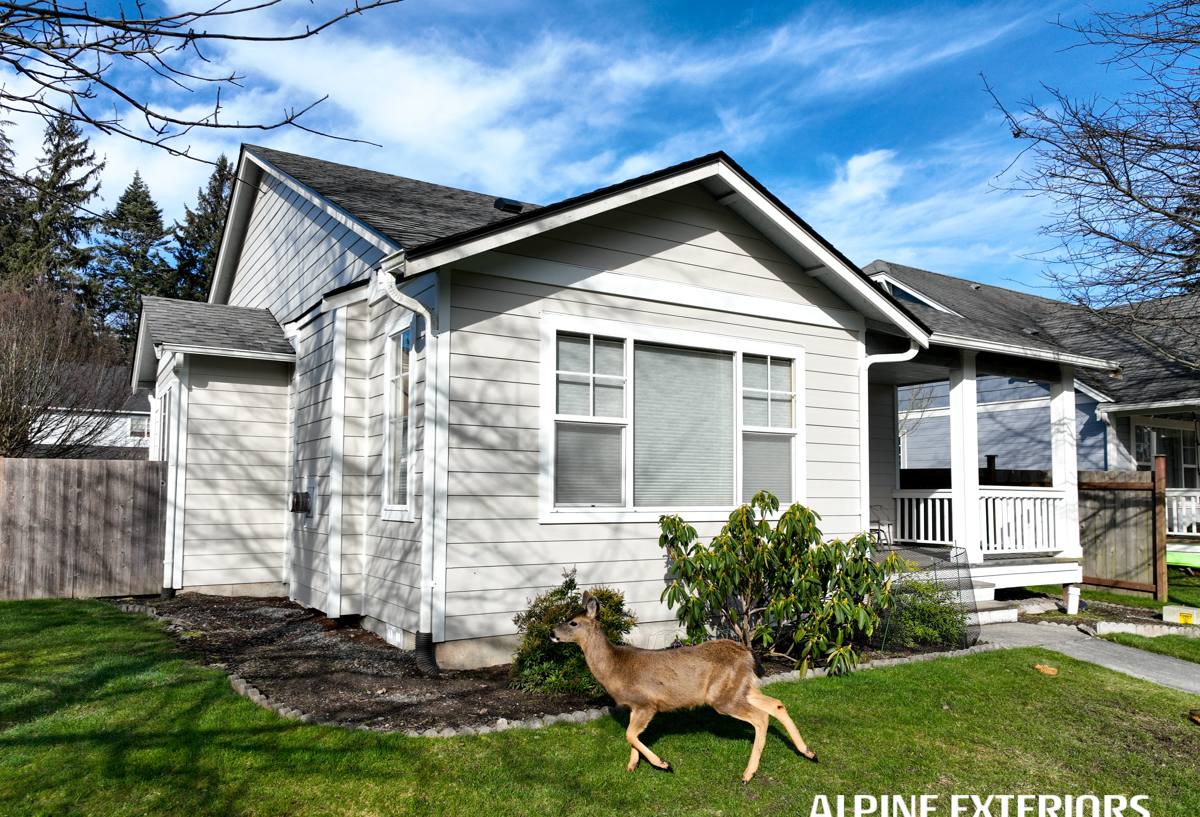
What Salt Air Actually Does to a House
Salt air isn't just a smell near the water — it's airborne moisture carrying dissolved salt that settles on every exterior surface, including siding, trim, fasteners, and flashing. A few concrete effects worth knowing about:
- Salt is hygroscopic — it pulls moisture out of the air and holds it against the surface it's sitting on, which keeps siding and trim damp longer than a straight rain event would.
- Uncoated or poorly coated metal fasteners, flashing, and hardware corrode faster in salt air, and a corroding fastener can telegraph a rust stain right through paint or finish.
- Painted wood and some engineered wood products absorb this repeated damp-dry cycling at the surface, which is where peeling, checking, and early paint failure usually start.
- Any product with exposed wood fiber at a cut edge or seam is more vulnerable here than the same product would be twenty miles inland.
None of this is unique to Sandy Point — it's true anywhere on the Salish Sea shoreline — but the closer a house sits to open water, the more it matters, and Sandy Point homes are about as exposed as it gets in this part of the county.
Driving Rain and Water Management
Whatcom County gets a lot of rain, but the rain that does the real damage to a house isn't the gentle, straight-down kind — it's wind-driven rain hitting a wall sideways, working into every seam, corner, and penetration it can find. Sandy Point's exposure to wind off the water means driving rain is a regular event here, not an occasional storm.
That changes how an exterior has to be built, not just what it's covered with:
- Flashing details at windows, doors, and roof-to-wall transitions have to be sequenced correctly (water-resistive barrier, then flashing, then siding, lapped so water always sheds outward) — this matters more here than in a sheltered inland lot.
- House wrap and weather barriers need to be installed without gaps or shortcuts, since driving rain will find any weak point over time.
- Siding laps and joints need tight, consistent overlap, because wind pressure can push water upward and sideways, not just let it run down.
This is also where the difference between a rushed install and a careful one shows up years later. A siding product can be excellent and still fail early if the flashing and water management behind it were done wrong — which is why we treat installation sequencing as seriously as the material choice itself.
Moss Season Is Longer Here Than People Expect
Between the marine humidity, the tree cover in and around Custer, and the number of overcast days Whatcom County gets through fall, winter, and spring, moss and algae have a long window to establish themselves on north-facing walls, roof valleys, and anywhere shade keeps a surface from drying out fully between rains. On siding, that shows up as green or black streaking and, over time, a surface that stays damp longer than it should. On roofing, moss is more than cosmetic — it lifts shingles and holds water against the roof deck.
The fix isn't a chemical wash every spring — it's material and design choices that reduce how long surfaces stay wet in the first place: siding that doesn't wick or hold moisture at the surface, roof edges and valleys that shed water cleanly, and gutters and downspouts sized and placed to actually move water off the house instead of letting it sheet down a wall.
Why We Standardized on James Hardie Fiber Cement
We install James Hardie fiber cement siding exclusively — not vinyl, not LP SmartSide or other engineered wood products, not cedar, not primed spruce. That's a deliberate call, not a default, and in an environment like Sandy Point the reasoning holds up especially well:
- Fiber cement is non-combustible and doesn't have the wood fiber content that makes engineered wood siding vulnerable to swelling and edge deterioration when it stays damp for long stretches.
- Hardie's HZ5 product line is engineered specifically for wetter, harsher climates — it's the right specification for a coastal location like this one, as opposed to a standard-climate product.
- The ColorPlus factory finish is baked on and warranted separately from the substrate, which matters in an environment where a site-applied paint job would be fighting salt air and damp cycling from day one.
- It doesn't rot, and it isn't a target for the kind of moisture-driven pest or decay issues that wood-based products can develop over time.
We're upfront that vinyl and engineered wood siding both have real advantages elsewhere — cost, weight, ease of install — and we'll say so if asked. But for a house exposed to salt air and driving rain the way Sandy Point homes are, we don't think those products hold up as well long-term, and we'd rather turn down that install than put something on a house we don't expect to perform.
It's Not Just Siding — The Whole Envelope Has to Work Together
Siding takes the headlines, but on a coastal property the roof, windows, and any exposed deck structure are dealing with the exact same salt air and driving rain, and they all interact. A few examples of how that plays out:
- Roofing — roof edges, valleys, and penetrations are where wind-driven rain and moss both concentrate; a roof that's shedding water poorly will eventually push moisture back into the wall assembly below it.
- Windows — window flashing has to tie into the siding's water-resistive barrier correctly, or you get leaks at the window perimeter regardless of how good the siding itself is.
- Decks — structures exposed to salt air need fasteners, connectors, and finishes rated for that exposure, and ledger-to-house flashing has to be done right to avoid feeding water into the wall behind it.
Because we handle all four trades, we look at a Sandy Point property as one connected water-management system rather than four separate jobs. That matters when, for example, a re-siding job uncovers a window flashing issue, or a roof tune-up reveals a gutter that's been dumping water onto a wall for years.
Why a Local Crew Matters Here
A contractor who mostly works inland, or in a different climate zone, doesn't necessarily know that a marine-exposed wall needs different flashing attention than a sheltered one, or that a north-facing wall under tree cover in Custer is going to hold moss longer than the same wall would in a more open, sunnier location. That knowledge comes from working this specific stretch of Whatcom County repeatedly, seeing which details hold up and which don't, and adjusting.
A local crew also means faster response if something needs a look after a bad storm, and a company that's still around — and still known in the area — years after the original install, which matters for warranty follow-through.
What Affects Cost on a Sandy Point Project
Every property is different, but the factors that tend to move price on an exterior project in this area are fairly consistent:
| Factor | Why It Matters Here |
|---|---|
| Distance from open water / wind exposure | More exposed elevations need more rigorous flashing and water-barrier detailing |
| Existing siding/roofing condition | Hidden moisture damage from prior driving-rain intrusion adds repair scope |
| Home size and wall complexity | More corners, dormers, and penetrations mean more flashing detail work |
| Tree cover and shade | Heavier shade means more moss-prone surfaces and drainage planning |
| Access | Waterfront lots and tighter side yards can affect staging and scaffolding |
| Product line selected | Hardie's HZ5 climate-specific line vs. standard specification affects material cost |
We walk every property before quoting anything, because a number generated from square footage alone misses the details that actually drive cost on a house like this.
A Practical Maintenance Checklist for Coastal Whatcom County Homes
- Rinse salt residue off siding and windows periodically, especially after storms with onshore wind
- Keep gutters and downspouts clear so water isn't sheeting down walls
- Trim back vegetation that's keeping walls or roof sections shaded and damp
- Check caulking and sealant at window and door trim annually — it's the first thing driving rain finds a way through
- Have moss on roof valleys and north-facing walls addressed before it establishes a heavy mat
- Inspect deck ledger boards and fasteners for corrosion, especially on structures closer to the water
What to Expect Working With Us
We start with an on-site walkthrough, not a phone estimate — for a coastal property like this, we want to see the actual exposure, existing moisture damage if any, and how the roof, siding, and windows are currently interacting before we recommend anything. From there we'll walk through material options honestly, including why we'd steer you toward Hardie fiber cement for this location, and give you a clear, itemized scope before any work starts.
If you're in Sandy Point and dealing with siding that's showing its age, a roof that's holding moss it shouldn't, or you're just planning ahead for a home in this environment, we'd be glad to take a look. Reach out for a free, no-pressure estimate — the form below gets it started.