 Custer
 Point Roberts Is Its Own Kind of Job Site
Point Roberts sits on a small peninsula that only connects to the rest of the U.S. by water or air — to drive there, you cross into Canada and back out again. That geography shapes everything about how homes are built and maintained out there. Materials, crews, and equipment all have to be planned for ahead of time, and a contractor who treats the trip as an afterthought usually treats the workmanship the same way. We service Point Roberts as part of our regular coverage out of Custer, and we plan every job there with the crossing, the weather window, and the site conditions built into the schedule from day one.
The other thing that sets Point Roberts apart is exposure. Homes sit close to the water on a peninsula that catches wind and weather off the Strait of Georgia and the wider Salish Sea from multiple directions. That combination of salt air, driving rain, and long stretches of damp, shaded weather is hard on exterior building materials in ways that inland Whatcom County homes don't experience to the same degree.
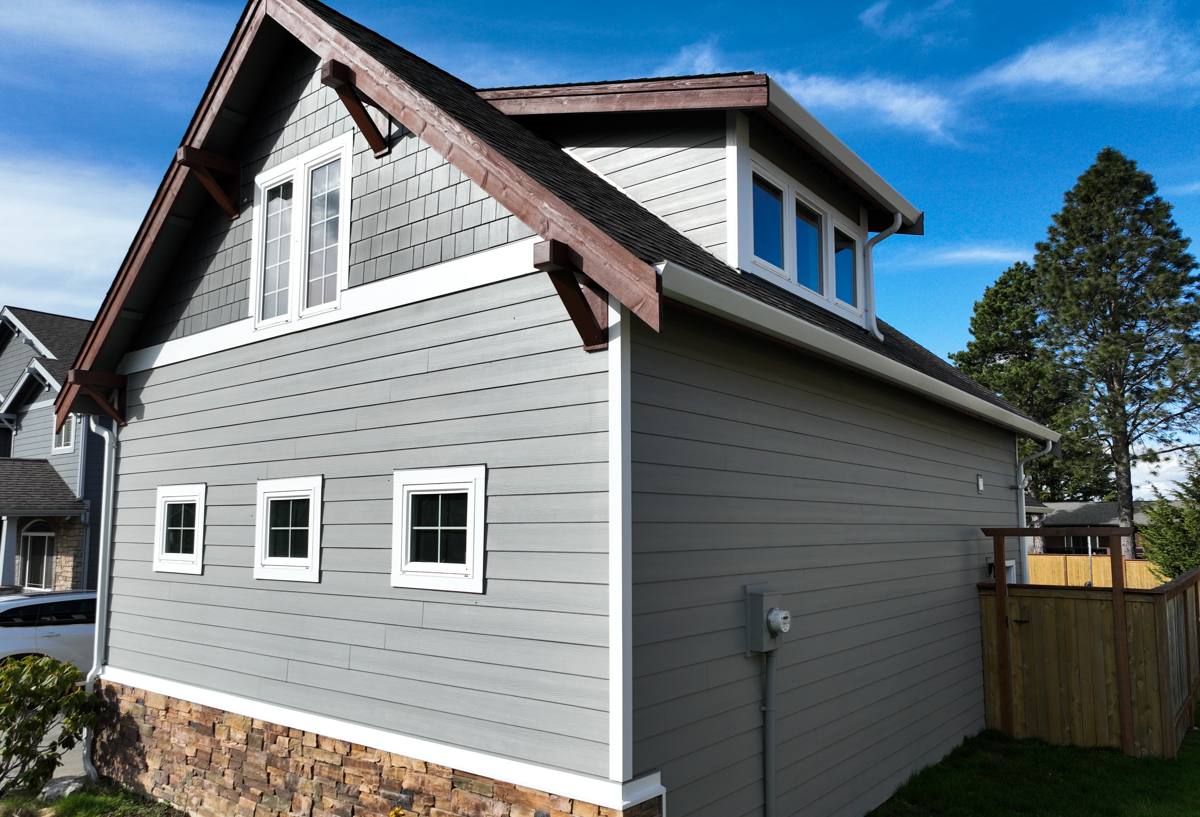
What Salt Air and Driving Rain Actually Do to a House
Salt Air and Metal Fasteners
Airborne salt doesn't just sit on the surface of a house — it works into fastener heads, joints, and any exposed metal trim. Over years, that accelerates corrosion on lower-quality fasteners and flashing, which shows up as rust streaking, staining, and eventually loosened trim or siding panels. It's a slow process, but it's constant, and it's one of the reasons material choice and fastener choice both matter more here than they do a few miles inland.
Driving Rain and Wind-Driven Moisture
Peninsula and waterfront exposure means rain doesn't just fall straight down — wind pushes it sideways into wall assemblies, especially around windows, corners, and anywhere siding laps aren't detailed correctly. Wind-driven rain finds gaps that vertical rain never would. If the water-resistive barrier, flashing, and siding overlaps aren't done right, moisture gets behind the cladding, and that's where rot and hidden damage start — often long before anything shows on the surface.
Moss, Algae, and the Long Damp Season
Western Washington's long wet season, combined with tree cover and shade common on wooded lots, keeps north-facing walls and lower siding courses damp for extended stretches. That's ideal conditions for moss and algae growth. On wood-based siding products, that persistent moisture also feeds swelling, delamination, and rot at the edges and butt joints. A material that resists water absorption at its core, not just at the paint layer, holds up dramatically better through that cycle year after year.
Why We Only Install James Hardie Fiber Cement
We install James Hardie fiber cement siding exclusively. We don't install vinyl, LP SmartSide, Cemplank, Allura, or primed wood products like spruce or cedar lap siding. That's a deliberate standard, not a sales pitch, and it's worth explaining honestly.
Wood-based and engineered-wood sidings can perform fine in dry, sheltered climates, but they depend heavily on an intact factory coating and disciplined maintenance to keep moisture out of the wood fiber substrate. In a marine environment with salt exposure and long damp seasons, that margin for error shrinks. Vinyl handles moisture well on its own but is a thin, flexible material that can crack in cold snaps, deform under heat and reflected sunlight, and rarely holds a factory finish as long or as richly as a baked-on coating. Fiber cement made by other manufacturers can be a reasonable product, but we've standardized on one system so we can guarantee installation detailing, flashing practices, and warranty support without gaps between products.
What Hardie Brings to This Climate Specifically
- Non-combustible core — fiber cement doesn't feed a fire the way wood-based products can.
- HZ5 engineered formulation — Hardie's HZ5 product line is engineered for cold, wet, freeze-prone climates like ours, which matters through a wet Whatcom County winter and shoulder-season freeze events.
- ColorPlus factory finish — a baked-on, multi-coat finish applied under controlled conditions, which holds color and resists fading and chipping far better than field-applied paint.
- Dimensional stability — fiber cement doesn't swell, warp, or split the way wood and some engineered wood products can when they take on repeated moisture cycles.
- Transferable, long-term warranty backing — coverage that's meaningful to a future buyer, not just the original owner.
None of that makes fiber cement maintenance-free — it still needs proper caulking upkeep, periodic washing, and an occasional repaint down the road if it isn't ColorPlus finished. But it removes the moisture-absorption weak point that drives most of the exterior siding failures we see on wood-based and lower-grade products in this climate.
Beyond Siding: The Whole Exterior Envelope
Siding doesn't work in isolation. Roofing, windows, decks, and siding all interact at the same joints and transitions — a poorly flashed window or a roof edge that dumps water onto a wall will undermine even a well-installed siding job. We handle all four trades so those transitions are planned together instead of handed off between separate contractors who never talk to each other.
Roofing
A roof system that's sealed and properly flashed at valleys, penetrations, and wall intersections keeps water out of the places where wind-driven rain likes to collect. On a peninsula lot, roof-to-wall flashing detail is one of the most common failure points we find.
Windows
Window flashing and integration with the water-resistive barrier is where a huge share of hidden moisture problems originate. Replacing windows at the same time as siding lets us tie the flashing and house wrap together as one continuous system instead of patching around an existing window.
Decks
Decks facing open water or wind take a beating from the same salt air and rain exposure as the siding above them. Ledger board attachment and flashing where a deck meets the house wall is another spot that needs the same moisture discipline as the rest of the envelope.
What Correct Installation Looks Like on a Site Like This
Good material choice only pays off if the installation is right. For Point Roberts homes specifically, we pay close attention to:
- Proper water-resistive barrier and rainscreen or drainage-gap detailing behind the siding, so any moisture that does get past the cladding can drain and dry.
- Correct flashing at every window, door, and roof-to-wall transition — the spots wind-driven rain targets first.
- Corrosion-resistant fasteners appropriate for a salt-air environment, not standard-grade fasteners that will streak or fail early.
- Manufacturer-specified gaps, caulking, and clearances at butt joints and trim, which matter more where humidity stays high for months at a time.
- Ground and roofline clearances that keep siding from sitting in standing moisture or moss-prone shade pockets.
Cost Factors for a Point Roberts Exterior Project
Every home is different, but a few factors consistently move the price on exterior work out on the peninsula:
| Factor | Why It Matters Here |
|---|---|
| Access and logistics | Material and crew transport across the border adds planning time compared with a mainland Whatcom County job. |
| Existing wall condition | Homes with hidden moisture damage from a prior siding product often need sheathing repair before new siding goes on. |
| Wind and salt exposure | More exposed elevations may call for additional flashing detail and corrosion-resistant hardware. |
| Home size and complexity | Corners, dormers, and multiple roof-wall intersections add labor time regardless of material. |
| Combined scope | Bundling siding with roofing, windows, or a deck can reduce redundant setup and staging costs versus separate projects. |
Why a Local Crew Matters Out Here
Point Roberts homeowners have told us plainly that getting contractors to show up reliably is one of their biggest frustrations — the border crossing and limited access discourage a lot of companies from bidding the work at all, or from following through once they do. We're based in Custer, close enough to plan trips efficiently, and we build the crossing and site logistics into our scheduling instead of treating Point Roberts as a hassle. A crew that knows the drive, plans material staging in advance, and understands the specific weather exposure of a peninsula lot is going to give you a straighter answer and a more reliable timeline than one bidding it sight unseen.
A Simple Pre-Project Checklist for Homeowners
- Walk your siding and look for soft spots, dark staining, or moss buildup, especially on north-facing and shaded walls.
- Check window and door trim for gaps, caulk failure, or discoloration that suggests water intrusion.
- Look at roof-to-wall transitions and deck ledger areas for staining or wear.
- Ask any contractor bidding the job how they plan flashing at windows, doors, and roof lines — not just what siding brand they use.
- Confirm the contractor has a realistic plan for getting crew and materials to a Point Roberts site on schedule.
Let's Talk About Your Home
If you're noticing moss buildup, staining, softness, or aging siding, roofing, windows, or a deck on a Point Roberts property, we're glad to take a look. We'll give you a straightforward, no-pressure estimate and an honest read on what your home actually needs — not just what's easiest to sell. Fill out the form below to get started.