 Custer
 Siding Work in Meridian: A Whatcom County Climate That Doesn't Forgive Shortcuts
Meridian sits inland in the agricultural stretch of Whatcom County, away from the direct waterfront but still well within reach of the marine weather that defines this whole corner of Washington. Homes here deal with salt-tinged air carried in on winter storms, long runs of driving rain pushed across open farmland with little wind break, and a moss and mildew season that can stretch across most of the calendar year on shaded walls and north-facing siding. It's not the same direct salt exposure a Birch Bay or Drayton Harbor waterfront property takes, but the combination of persistent moisture, wind, and mild temperatures still puts real, sustained stress on exterior siding.
We handle siding, roofing, windows, and decks for homes throughout this part of Whatcom County, and siding is usually where climate stress shows up first and most visibly, because it's the largest continuous surface on the house and the first line of defense against wind-driven rain. A siding product or installation that's a poor match for this climate tends to show it within a handful of wet seasons — not decades.
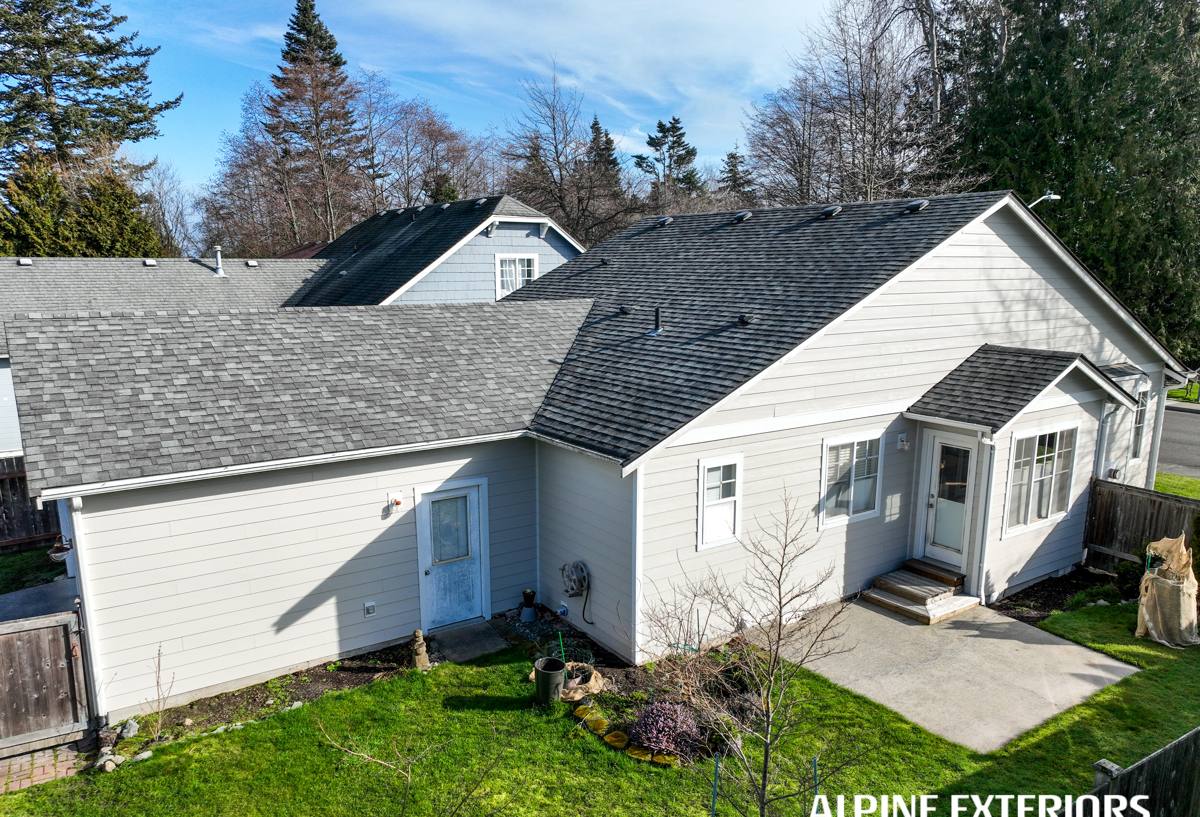
What Meridian's Climate Does to Siding
Wind-Driven Rain
Open farmland and flat terrain around Meridian give storms coming off the Strait of Georgia little to slow them down before they reach a house. That means rain doesn't just fall straight down here — it gets pushed sideways into wall assemblies, which puts real pressure on every seam, lap, and joint in the siding system. Siding that isn't installed with the right laps and clearances, or that absorbs water at the seams instead of shedding it, will eventually let moisture behind the cladding.
Salt-Laden Marine Air
Even set back from the water, Meridian gets enough salt-influenced air carried inland to accelerate corrosion on lower-grade fasteners, trim, and hardware over time. Siding materials that hold up fine in a dry, inland climate can show fastener staining, corroded trim, or premature finish failure years earlier out here.
Moss, Mildew, and Prolonged Moisture
Mild temperatures and near-constant dampness through fall, winter, and spring create one of the longest moss and mildew growth seasons in the country. Shaded elevations, north-facing walls, and anywhere water tends to sit instead of draining away become growth surfaces given enough time. Wood-based siding products are especially vulnerable here, since moss and mildew both feed on organic material and hold moisture against the surface once established.
Temperature Swings and Moisture Cycling
Whatcom County's damp winters and the swing between cold, wet exteriors and heated interiors put siding through repeated cycles of expansion, contraction, and moisture absorption. Products that swell and shrink with moisture content — rather than staying dimensionally stable — are more prone to cracking, warping, and finish failure over time in a climate like this one.
Signs a Meridian Home's Siding Needs Attention
- Visible moss or dark streaking on shaded walls or north-facing elevations
- Soft spots, bubbling, or discoloration that suggest moisture has gotten behind the siding
- Cracked, warped, or delaminating boards, especially on wood-based products
- Paint or finish that's peeling, chalking, or fading faster than expected
- Gaps or separation at seams, corners, or trim where water can work its way in
- A musty smell or visible staining on interior walls that share an exterior wall with problem siding
Why We Only Install James Hardie Fiber Cement
We made a deliberate decision to standardize on James Hardie fiber cement siding and stop installing vinyl, LP SmartSide, primed spruce, cedar, and other fiber cement brands. That wasn't a marketing choice — it came from what we consistently saw play out on exterior work across this climate over years of installs and repair calls.
Wood-based products, including engineered wood siding, depend on an intact factory coating and correct field sealing at every cut edge to keep moisture out. In a climate with this much sustained dampness and moss pressure, any gap in that protection — a missed edge seal, a nick during handling, a spot where caulking has failed — becomes an entry point for moisture, and organic-based siding responds to trapped moisture by swelling, softening, and eventually rotting. Vinyl siding is low-maintenance and inexpensive, but it's a thin material that can warp in temperature swings, crack in cold snaps, and fade unevenly over time, and it isn't a fire-resistant material. Other fiber cement brands make reasonable products, but we've standardized on one system so our crews install it to the same spec on every job, order the exact same trim and accessory components every time, and know precisely how it performs over years in this specific climate — rather than juggling installation details across several product lines.
James Hardie fiber cement is non-combustible, doesn't support moss growth the way organic siding materials do, and holds its factory-applied ColorPlus finish far longer than field-painted alternatives because that finish is baked on under controlled conditions rather than applied on-site. Hardie also engineers specific product lines — its HZ5 designation, for example — for regions with more moisture and temperature swing, which matches what Meridian actually deals with rather than a generic national spec.
Comparing Siding Options for a Climate Like Meridian's
| Siding Type | Moisture Behavior in This Climate | Maintenance Burden | Why We Don't Install It |
|---|---|---|---|
| Vinyl | Doesn't rot, but can warp and crack with temperature swings | Low, but fading and brittleness increase over time | Thin material, not fire-resistant, limited long-term color stability |
| LP SmartSide / engineered wood | Depends entirely on intact factory coating and sealed edges | Moderate to high — edge sealing and caulk maintenance matter | Vulnerable to moisture intrusion if any seal fails in a wet, moss-prone climate |
| Cedar / primed spruce | Absorbs moisture readily, needs regular refinishing | High — repainting or restaining on a recurring cycle | Highest moss and rot vulnerability of any option in this climate |
| Other fiber cement brands | Generally moisture-resistant, non-combustible | Low | We standardized on one system for install consistency and warranty backing |
| James Hardie fiber cement | Engineered for wet, moisture-heavy climates; won't rot or support moss | Low — factory finish holds color for years | What we install |
How Hardie Fiber Cement Fits Whatcom County Specifically
Fiber cement siding is made from cellulose fiber, sand, and cement, which means it doesn't rot, doesn't provide the organic material moss and mildew feed on, and holds up to sustained damp exposure the way wood-based products can't. Hardie's factory-applied ColorPlus finish is baked on rather than sprayed or brushed in the field, so it resists fading, chipping, and peeling far longer than a field-applied paint job — which matters in a climate where UV exposure is lower than a sunbelt state but moisture exposure is much higher. For a Meridian property, that combination of moisture resistance and finish durability is what actually determines how the siding looks and performs ten or twenty years down the road, not just on installation day.
Installation Details That Determine Long-Term Performance
A quality siding product installed poorly will still fail in this climate, so we treat installation detail as seriously as the product choice itself. That means correct fastener placement and spacing per manufacturer spec, proper caulking and sealing at every seam and penetration, adequate clearance at grade and at roof lines so water sheds away from the wall rather than collecting against it, and a weather-resistive barrier installed and lapped correctly behind the siding before the first board goes up.
Common Installation Mistakes We Correct on Older Homes
On repair and re-side calls around Meridian and the surrounding area, the most common source of siding failure isn't the product itself — it's installation shortcuts from years earlier: fasteners driven in the wrong spot, missing or inadequate clearance at the bottom edge, or caulk used to patch a gap that should have been flashed correctly in the first place. Those shortcuts don't usually show up as problems for a year or two, which is part of why they're so common — they just show up eventually, and usually as a bigger repair than it would have been to do correctly the first time.
A Simple Checklist Before Hiring for Siding Work in Meridian
- Ask specifically which siding product they install and why, not just what it costs installed
- Confirm current Washington contractor licensing and active liability insurance
- Get a written scope that separates the manufacturer's product warranty from the contractor's installation warranty
- Ask how they handle fastener spacing, clearance at grade, and sealing at seams and penetrations
- Ask whether they've worked on homes in your specific area before and what they'd expect to see on a home like yours
Why a Local Crew Matters for Siding Work
A contractor who works this part of Whatcom County regularly already understands how wind-driven rain and marine-influenced air behave here compared to a drier, more sheltered inland climate. That understanding shows up in small decisions — how much clearance gets left at grade, how seriously moss growth patterns get taken when planning drainage, which fastener grade gets specified — and those decisions are what determine whether a siding job holds up for one wet winter or several decades. We work siding, roofing, windows, and decks together because water damage rarely respects trade boundaries, and a re-side job done without attention to the roof-to-wall transition or window flashing around it can still fail even with the best siding product on the market.
Our Process
We start with an on-site look at the existing siding, checking for moisture intrusion, moss and mildew patterns, fastener condition, and how the current siding integrates with windows, trim, and roof lines. From there we give a straightforward assessment of what's salvageable versus what genuinely needs replacement, along with a written scope before any work begins. Fastener spacing, clearance, and sealing details are handled to spec on every job, not treated as optional upgrades.
If you're seeing moss buildup, moisture damage, or aging siding on a Meridian property — or you're planning ahead for a re-side and want an honest read on your options — we're happy to take a look. Reach out below for a free, no-pressure estimate.