 Custer
 Siding Built for Blaine's Coastal Climate
Blaine sits right up against the water near the Canadian border, and that location shapes everything about how siding performs there. Homes catch salt-laden air off the bay, take driving rain straight off Pacific storm systems for months at a stretch, and sit under tree cover long enough each year that moss and algae get a real foothold on north- and west-facing walls. Whatcom County's marine climate is mild on temperature but hard on materials — the constant moisture cycle is what actually wears siding down, not heat or cold.
That combination punishes anything that isn't dimensionally stable and moisture-resistant. Wood-based products swell, cup, and rot at the edges. Vinyl chalks and can warp under repeated wet-dry cycling near the water. Fiber cement, installed correctly, is one of the few claddings that holds its shape and finish through that cycle year after year — which is why it's the only product we put on homes in this area.
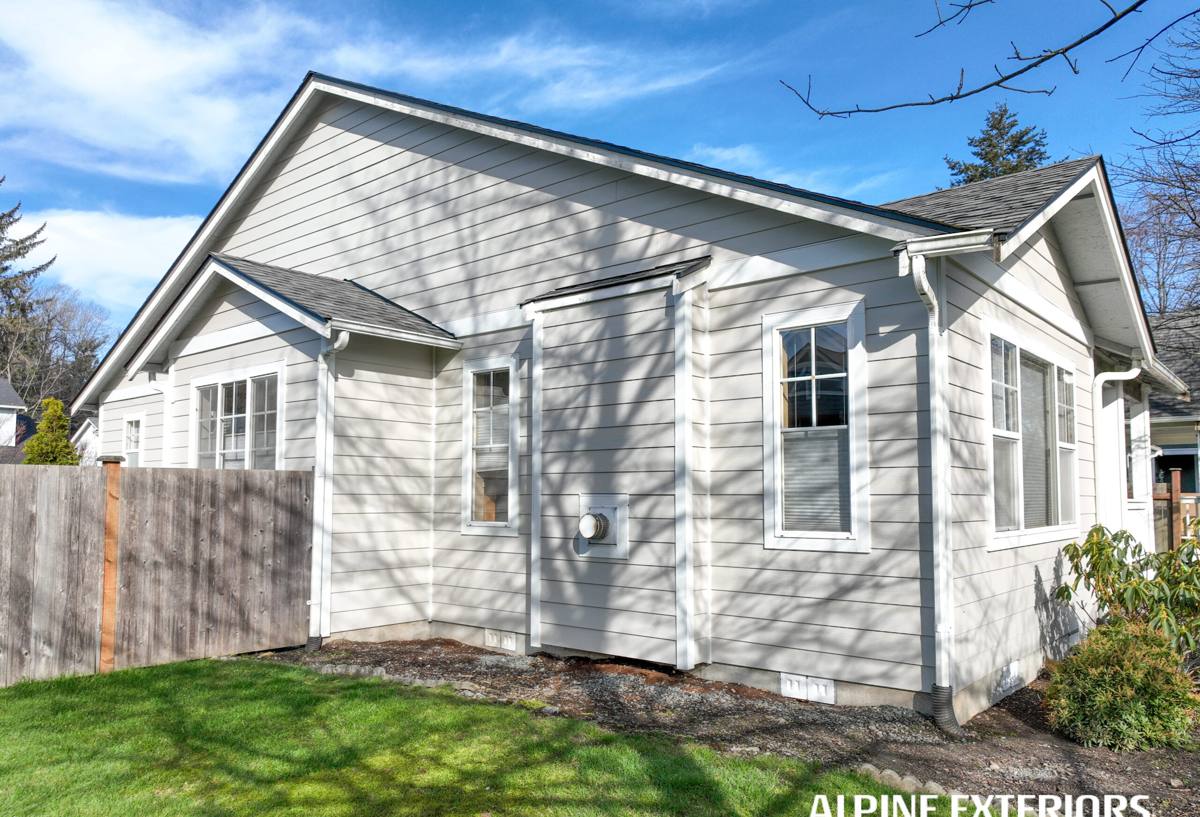
Why We Only Install James Hardie Products Here
We don't install LP SmartSide, vinyl, Cemplank, Allura, or bare cedar or spruce siding, and in a climate like Blaine's the reasons are practical, not brand loyalty. James Hardie's HZ5 product line is engineered specifically for climate zones like the Pacific Northwest, where wind-driven rain and prolonged dampness are the norm rather than the exception. The board itself is non-combustible fiber cement — it doesn't absorb water the way wood-based composites can at cut edges and fastener points, and it won't support rot the way engineered wood products eventually can if a seal fails.
The factory-applied ColorPlus finish also matters more here than it would in a drier climate. A baked-on finish resists the fading and moisture intrusion that field-applied paint is prone to, and it holds up better against the algae and moss growth that's common on shaded, damp walls in this part of the county. Combined with Hardie's transferable warranty, it's the product system we're willing to stand behind on Blaine homes.
What Gets Sacrificed With Other Products
- LP SmartSide: engineered wood strand product — better than raw wood, but still vulnerable at cut edges and seams if caulking and sealing aren't perfectly maintained over time.
- Vinyl: low cost and low maintenance, but it flexes and can distort in sustained wind, and it doesn't hold paint if a homeowner ever wants to change the color.
- Cemplank / Allura: also fiber cement, and reasonable products — we simply standardized on one manufacturer, one warranty structure, and one factory finish system so every install and every warranty claim works the same way.
- Primed spruce or cedar: beautiful, but it's a maintenance commitment — repainting and resealing on a schedule that a marine climate will not let you skip.
What a Correct Install Looks Like in This Climate
Fiber cement siding fails early almost exclusively because of installation mistakes, not the material itself. In a high-moisture area like Blaine, the details that get skipped on a rushed job are exactly the ones that matter most:
- Proper weather-resistive barrier installed and lapped correctly behind the siding, not just stapled up as an afterthought
- Correct flashing at every window, door, and roofline intersection, so water is directed out and away rather than behind the cladding
- Manufacturer-specified clearances at grade, roof lines, and decks — Hardie's own install guide calls for gaps that a lot of crews shortcut to save time
- Corrosion-resistant fasteners driven at the correct depth — overdriven nails crack the board's face and create a moisture entry point that shows up as staining within a year or two
- Caulked and sealed joints at butt seams and trim, using sealants rated for exterior, high-moisture exposure
- Proper fastening pattern and panel gapping so the material can handle normal expansion and contraction without buckling
Skip any one of these and you don't necessarily see a problem in year one. You see it in year four or five, when moisture has been working behind the boards the whole time — by which point the fix is a lot more expensive than doing it right the first time.
Why a Crew That Already Works Blaine Matters
Siding installation isn't identical everywhere in Whatcom County, and a crew that's worked jobs in Blaine specifically knows what to plan for before the first board goes up:
- How to sequence a job around this area's rain patterns so weather barrier isn't left exposed longer than necessary
- Which wall orientations on a typical Blaine lot need extra attention for moss and algae exposure, and how that affects trim and drainage detailing
- Realistic expectations for salt-air exposure on homes closer to the water, and how that factors into fastener and flashing choices
- Local permitting and inspection norms for the jurisdiction, so the job doesn't stall waiting on paperwork nobody anticipated
None of that is exotic knowledge, but it's the difference between a crew that's installing siding in Blaine for the first time and one that already knows what this specific stretch of coastline does to a house over a few winters.
Our Process, Start to Finish
1. Walkthrough and Assessment
We look at your current siding's condition, check for hidden moisture damage at trim, corners, and penetrations, and talk through what your home's exposure to wind, rain, and shade actually looks like.
2. Product and Color Selection
We walk through Hardie's plank profiles, panel and shingle options, and ColorPlus palette so you land on something that fits the home and holds up to the specific conditions on your lot.
3. Prep and Tear-Off
Old siding comes off, sheathing gets inspected for rot or damage underneath — this is often where hidden problems from a prior installation surface — and any needed repairs happen before anything new goes up.
4. Weather Barrier and Flashing
This is the step that determines how the siding performs in ten years, not the first. Barrier, flashing, and drainage details get installed to spec before a single piece of siding is hung.
5. Installation
Boards go up to Hardie's fastening and clearance specifications, with attention to the joints and penetrations that are most common failure points in a wet climate.
6. Final Walkthrough
We review the finished job with you, including care and maintenance basics specific to a marine environment.
Cost Factors for a Blaine Fiber Cement Project
| Factor | Why It Matters Here |
|---|---|
| Home size and wall complexity | More corners, gables, and penetrations mean more flashing and trim work, which drives labor time |
| Tear-off and sheathing condition | Coastal moisture exposure sometimes means hidden rot behind old siding, which adds repair scope |
| Product line and profile | HZ5 plank, panel, and shingle profiles carry different material costs |
| ColorPlus vs. primed product | Factory finish costs more upfront but avoids a repaint cycle that a marine climate makes more frequent |
| Access and site conditions | Waterfront or sloped lots can affect staging, scaffolding, and crew logistics |
We give firm numbers after an in-person assessment — anything quoted before that is a rough range at best.
Signs Your Current Siding Is Losing the Fight
- Persistent moss or dark streaking on shaded or north-facing walls that comes back soon after cleaning
- Soft or spongy spots near the bottom courses or around window trim
- Paint that's peeling or bubbling rather than just fading evenly
- Visible gaps, warping, or cupping at board seams
- Rising energy bills that suggest moisture or air infiltration behind the wall assembly
Any of these on their own isn't necessarily an emergency, but they're worth having looked at before winter's rain season makes the underlying problem worse.
Maintaining Fiber Cement Siding in a Marine Climate
- Rinse siding annually, focusing on shaded or moss-prone walls, using a garden hose rather than a high-pressure washer that can force water behind panels
- Inspect caulking at trim and window joints every couple of years and re-seal where it's cracked or pulled away
- Keep gutters clear so overflow isn't running down the wall face repeatedly
- Trim back vegetation and tree cover that keeps walls shaded and damp longer than necessary
- Watch drainage at grade level, especially after heavy rain events, to make sure water isn't pooling against the base of the siding
If your Blaine home's siding is showing wear from years of salt air, rain, and moss, or you're planning ahead for a replacement, we're happy to walk the property with you and give you a straightforward, no-pressure estimate — no obligation, just an honest look at what your home needs.