 Custer
 Siding for Lynden Homes Has to Work Harder Than People Expect
Lynden sits inland from the Strait of Georgia and close enough to the water that homes here deal with a mix of coastal moisture and valley humidity most siding products were never designed for. Add in the long, grey stretch of fall through spring that Whatcom County is known for, and you've got a climate that quietly tests every seam, joint, and paint layer on a house year after year. Most homeowners don't think about their siding until it starts failing — bubbling paint, soft spots at the bottom courses, moss creeping up from the ground line. By then the damage is usually further along than it looks from the driveway.
This page is about one thing specifically: installing James Hardie fiber cement siding correctly on homes in and around Lynden. Not a general siding overview, not a sales pitch for every product on the market — just what this climate actually requires, what a correct Hardie installation looks like, and how we approach the job.
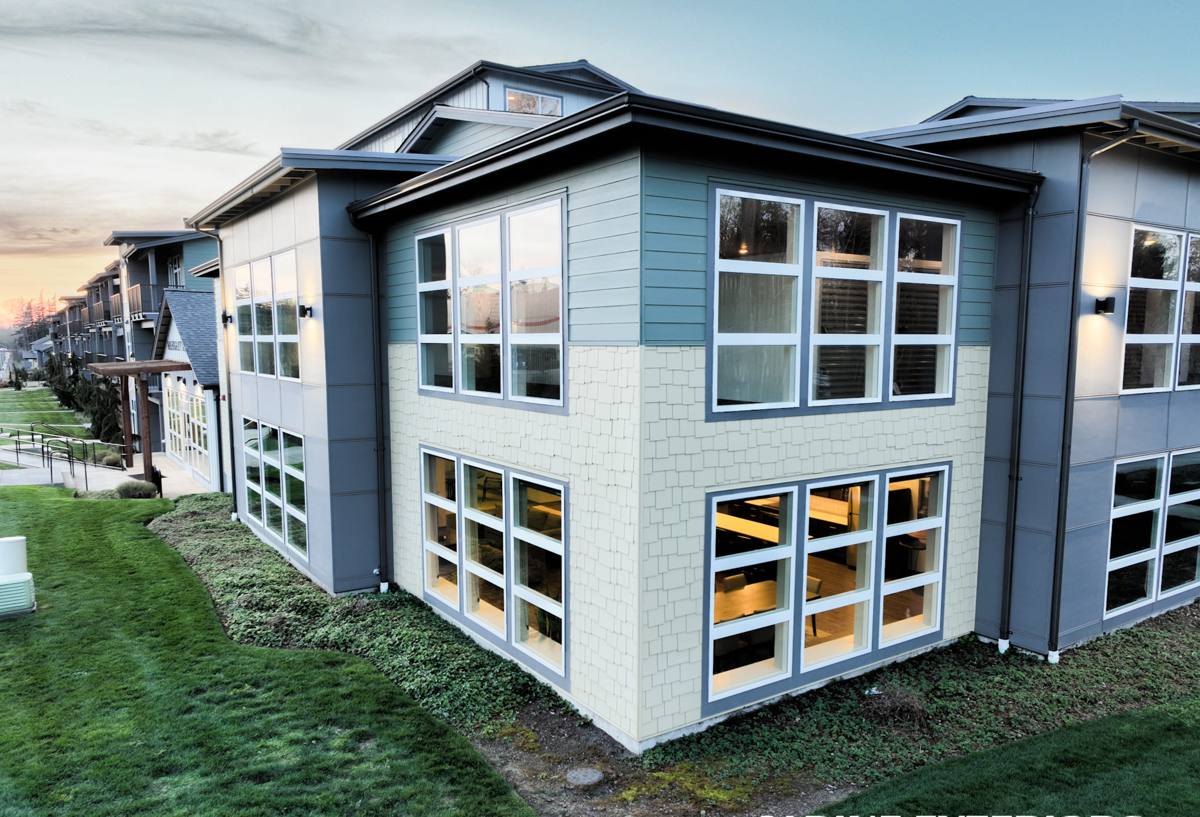
What Salt Air, Driving Rain, and Moss Season Actually Do
Three climate factors do most of the damage to siding in this part of Whatcom County, and they compound each other:
- Salt air: Even homes not directly on the water pick up airborne salt that speeds up corrosion on fasteners and metal flashing, and degrades certain paint and coating systems faster than manufacturers' inland test data suggests.
- Driving rain: Wind-driven rain doesn't just wet a wall surface — it gets pushed sideways and upward into laps, seams, and butt joints that were fine in a straight-down rain. Siding that isn't lapped, caulked, and flashed with that in mind lets water behind the cladding, not just on it.
- Moss season: Long stretches of cool, damp weather with limited direct sun keep north-facing walls, shaded areas, and anything near landscaping perpetually moist. Moss and algae take hold on porous or poorly sealed surfaces and hold moisture against the wall long after the rain stops.
None of this is unique to Lynden — it's the reality across most of Whatcom County — but Lynden's mix of open farmland, tree cover, and proximity to the water means houses here often get exposure from more than one direction at once: wind off open fields on one side, shade and dampness from trees on another.
Why We Standardized on James Hardie
We install James Hardie fiber cement siding exclusively. We don't install vinyl, LP SmartSide, Cemplank, Allura, primed spruce, or cedar, and that's a deliberate professional standard, not a lack of options. Fiber cement as a category handles moisture cycling better than wood-based products, and among fiber cement manufacturers, Hardie's engineering, factory finish, and warranty structure are what we're willing to put our name behind.
Specifically, that means:
- Non-combustible material — fiber cement doesn't feed a fire the way wood-based or vinyl products can.
- ColorPlus factory finish — baked-on color that resists fading and holds up to UV and moisture better than field-applied paint, with touch-up product available for the rare nick or scratch.
- Climate-engineered HZ product lines — Hardie makes region-specific formulations (HZ5 for our climate zone) that are built for freeze-thaw cycling and sustained moisture exposure rather than a one-size-fits-all product.
- A strong, transferable warranty — meaningful because it's backed by a manufacturer with decades in fiber cement, not a newer product still building a track record in wet Pacific Northwest conditions.
We're not going to tell you cedar looks bad or vinyl is worthless — both have real upsides. But cedar demands ongoing maintenance most homeowners underestimate, and vinyl's seams and thermal movement are a poor match for driving rain and long damp seasons. We'd rather install one product correctly than offer five and hope the cheaper ones hold up.
Which Hardie Products Make Sense in This Area
For most Lynden homes, the workhorse product is HardiePlank lap siding in a smooth or cedarmill texture, installed with the correct exposure and lap for our wind-driven rain conditions. HardiePanel vertical siding shows up on accent walls, gables, and some shop or outbuilding projects. HardieTrim boards handle corners, window and door surrounds, and fascia — areas that take disproportionate water exposure and are often where older siding jobs fail first.
Why the HZ5 Formulation Matters Here
Hardie engineers its HZ (HardieZone) products by climate zone specifically because fiber cement performs differently in humid, freeze-prone regions than in hot, dry ones. HZ5 is formulated for our zone — it's not a marketing distinction, it affects how the product handles moisture absorption and temperature swings over decades, not just years.
What a Correct Installation Actually Involves
Fiber cement is only as good as the installation behind it. The material itself is durable, but Hardie's own warranty terms and performance depend on installation to spec — this is where a lot of siding jobs, on any product, quietly go wrong.
- Proper weather-resistive barrier and rainscreen or drainage plane behind the siding, not just house wrap stapled flat to the sheathing
- Correct nail placement and fastener spacing — fiber cement is unforgiving of blow-throughs and overdriven fasteners
- Minimum required clearance between siding and grade, decks, and roof lines so splashback and standing water don't sit against the bottom course
- Properly lapped and sealed butt joints, with the right sealant for a product that expands and contracts with temperature
- Flashing at every window, door, and penetration — installed to shed water outward, not funnel it behind the cladding
- Correct caulking at trim intersections using a sealant rated for the exposure, not a general-purpose product
- Factory-cut and painted edges wherever possible, since field cuts expose raw material that needs to be sealed correctly
Skipping any one of these doesn't usually cause a visible problem in year one. It shows up in year five or eight, as a soft spot at a butt joint or paint failure at a window corner — the areas that took the brunt of the driving rain this climate produces every winter.
Our Process, Start to Finish
1. Site Walk and Assessment
We look at the existing siding and sheathing condition, drainage around the foundation, roofline interactions, and any problem areas — shaded walls, low clearance spots, prior water damage — before we talk product.
2. Scope and Estimate
We write up what the job actually requires: siding, trim, flashing, any sheathing repair, and the specific Hardie products and colors that fit the home. No pressure, no inflated scope.
3. Tear-Off and Substrate Check
Once old siding is off, we check the sheathing underneath for rot or moisture damage — common in homes that have had water working behind the siding for years without visible signs.
4. Weather Barrier and Drainage Plane
This layer matters as much as the visible siding. We install it to actually manage bulk water and let incidental moisture drain and dry, not just check a box.
5. Installation to Manufacturer Spec
Fastening, lapping, flashing, and sealing done to Hardie's published installation requirements — the standard that keeps the warranty intact and the wall assembly performing for decades.
6. Final Walkthrough
We walk the finished job with you, point out anything worth knowing for long-term care, and answer questions before we call it done.
What Drives Cost on a Lynden Siding Project
| Factor | Why It Matters |
|---|---|
| Home size and wall complexity | More corners, gables, and dormers mean more trim work and cutting, which adds labor time |
| Existing siding removal | Tear-off and disposal of old material adds cost versus a bare-sheathing new build |
| Sheathing or framing repair | Water damage found during tear-off has to be repaired before new siding goes on — this is the most common surprise cost |
| Product selection | Lap profile, texture, and trim details vary in material cost within the Hardie lineup |
| Color and finish | ColorPlus factory-finished boards versus field-painted options affect both cost and long-term maintenance |
| Access and site conditions | Tight lots, landscaping, or multi-story walls affect scaffolding and labor time |
We don't quote in broad ranges without seeing the house first — a small single-story home and a two-story with several gables can differ substantially even at similar square footage. What we can promise is a scope that reflects what your specific walls need, not a generic package.
Why Hiring a Crew That Already Works This Area Matters
A crew that's installed Hardie siding across Whatcom County knows what to check for before pulling the first piece of old siding off a Lynden home — where moss buildup tends to hide moisture damage, which wall orientations take the worst of the driving rain, and how much clearance actually holds up against local grade and drainage patterns. That's not something you can fully substitute with a manufacturer's general installation manual. It's the difference between a crew that installs Hardie occasionally and one that installs it to the same standard, on this kind of house, in this kind of weather, repeatedly.
Keeping It Right After Installation
Correctly installed James Hardie siding is genuinely low-maintenance, but "low" isn't "none." An occasional rinse to keep moss and algae from establishing on shaded walls, a visual check of caulking at trim joints every year or two, and prompt attention if you ever notice a soft spot or paint change go a long way. None of this compares to the recurring painting, caulking, and rot-checking that wood siding demands, but a five-minute walk around the house each fall catches small issues before Lynden's wet season turns them into bigger ones.
If you're weighing a siding project on a Lynden home, we're happy to take a look and give you a straightforward, no-pressure estimate — what your walls actually need, what it would cost, and why. Use the form below to get started.