 Custer
 Bellingham sits close enough to Bellingham Bay and the Strait of Georgia that salt-laden air is part of daily life for a lot of homes here, whether you're near the waterfront, up on Alabama Hill, or further out toward the county line. Add Whatcom County's long wet season and the shade-and-moisture combination that lets moss colonize a north-facing wall for months at a time, and you've got a climate that is genuinely hard on exterior siding. If your siding is starting to show it — cupping, soft spots, peeling paint that won't stay put, or moss creeping up from the bottom courses — you're not imagining it. This is what that climate does to siding that wasn't built for it, and it's the reason we treat siding replacement in Bellingham as a different job than siding replacement somewhere dry and inland.
Why Bellingham Siding Wears Out Differently
Three things stack up against exterior siding in this part of Whatcom County, and they compound each other rather than acting alone.
Salt Air
Airborne salt from the bay accelerates corrosion on fasteners, flashing, and any exposed metal trim, and it can degrade certain paint and coating systems faster than manufacturers' inland test data suggests. Siding that looks fine on a spec sheet written for a national average climate doesn't always hold up the same way six blocks from saltwater.
Driving Rain
Storms off the Strait don't just fall straight down — wind-driven rain hits siding at an angle, which means water gets forced into laps, seams, and butt joints that would stay dry in a calmer climate. Every seam, every nail penetration, and every transition between siding and trim is a place water is actively trying to get behind the cladding, not just run down the face of it.
Moss Season
Shaded walls, tree cover, and months of damp weather give moss and algae a long runway to establish on any siding surface that holds moisture at the surface. Beyond the cosmetic issue, moss holds water against the siding face longer than it would otherwise sit there, which is exactly the condition that causes swelling, delamination, or paint failure over time.
None of this means Bellingham homes are doomed to constant siding problems — it means the product and the installation both have to be matched to the conditions, not just to a catalog photo.
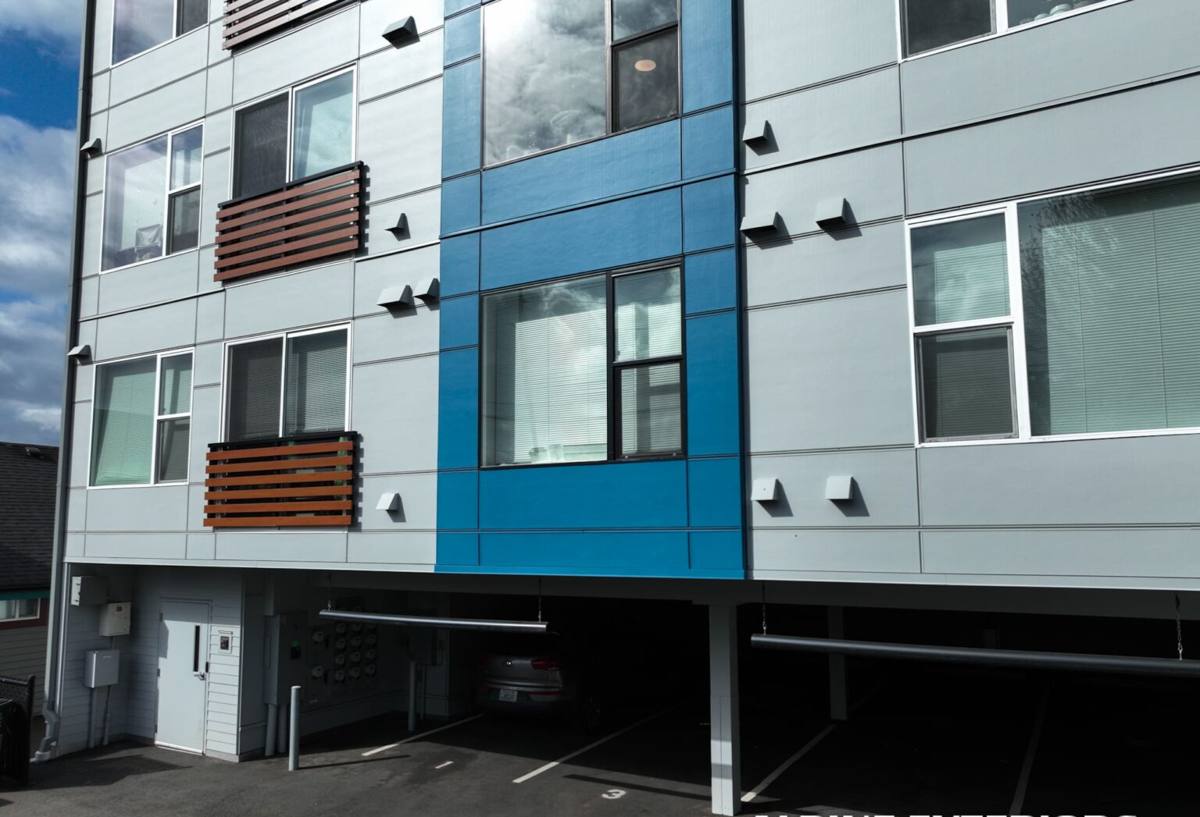
What Correct Siding Replacement Actually Involves
Siding replacement is not just pulling off old boards and nailing up new ones in the same pattern. Done right, it's a full reset of how your wall assembly manages water, and that's especially true in a climate that pushes rain sideways into every gap.
- Tear-off and inspection: removing old siding to check the sheathing underneath for rot, soft spots, or prior water damage that's been hiding behind the cladding.
- Weather-resistive barrier: installing or verifying a proper house wrap or building paper layer that's lapped correctly, shingle-style, so water sheds down and out rather than tracking behind the siding.
- Flashing at every penetration: windows, doors, hose bibs, vents, and any other wall penetration need flashing detailed so driving rain can't find a shortcut in.
- Proper starter strips and clearances: siding needs the right gap off the ground, off decks, and off roof lines to avoid wicking moisture up from below.
- Correct fastening: the right fastener type, spacing, and depth for the specific siding product, not a generic nailing pattern.
- Factory-finished material where possible: a coating applied and cured under factory conditions holds up more consistently in salt air and UV exposure than field-applied paint.
Skip any one of these steps and the new siding can look great for a season or two before the same underlying problems resurface — usually hidden behind the wall where you won't see it until it's expensive.
Why We Only Install James Hardie
We've made a deliberate choice not to install vinyl, LP SmartSide, primed spruce, cedar, or other fiber cement brands like Cemplank or Allura. That's not a knock on every homeowner who has one of those products on their house today — it's a statement about what we're willing to put our name on going forward, specifically because of what this climate does to siding over the long run.
James Hardie fiber cement is non-combustible, which matters given how much of Whatcom County borders forested land and how wildfire smoke and ember exposure has become a bigger regional concern in recent years. It's also engineered in climate-specific HZ formulations built to handle moisture cycling and humidity — which is directly relevant in a place that sees as much sustained wet weather as Bellingham does. The ColorPlus factory finish process bakes color on under controlled conditions, so it isn't as dependent on field weather during installation and tends to hold color and resist fading more consistently than site-applied paint, including in salt-air exposure. Hardie also backs the product with a strong transferable warranty, which carries weight if you ever sell the house.
None of that means other products are without merit — vinyl is inexpensive and low-maintenance in mild climates, wood has real curb appeal, and other fiber cement brands have their own engineering. But for the specific combination of salt air, wind-driven rain, and moss pressure that Bellingham and the rest of Whatcom County deal with, we've concluded Hardie is the product we're comfortable standing behind, and it's the only one we install.
Siding Options and How They Hold Up Locally
| Material | Moisture Behavior in This Climate | Maintenance Burden |
|---|---|---|
| James Hardie fiber cement | Non-combustible, engineered HZ formulations for humid/wet climates, factory finish resists moisture-driven fading | Low — occasional wash, no repainting on a strict cycle |
| Vinyl | Can warp or become brittle with UV and temperature swings; seams are a water entry risk | Low, but limited repair options if damaged |
| Cedar / primed spruce | Absorbs moisture, prone to rot and moss colonization without diligent upkeep | High — regular sealing, painting, and moss treatment |
| Other fiber cement (LP SmartSide, Cemplank, Allura) | Varies by product and formulation; each has its own moisture and installation sensitivities | Moderate, product-dependent |
Signs Bellingham Homeowners Should Watch For
- Moss or algae buildup that keeps returning to the same wall section, even after cleaning
- Paint that's peeling, bubbling, or flaking rather than just fading
- Siding that feels soft, spongy, or visibly cupped when pressed
- Dark staining or streaking below window sills or trim, which often points to a flashing failure
- Visible gaps or separation at seams and corners after a windy, rainy season
Any one of these is worth a look before it turns into a sheathing problem, and in this climate, small issues can move from cosmetic to structural faster than in drier parts of the state.
Our Process for a Bellingham Siding Replacement
We start with an on-site inspection, not a guess from a photo — we want to see the actual condition of the sheathing, the exposure the walls get to prevailing wind and rain, and any shaded areas already dealing with moss. From there we walk through the Hardie product lines and colors that make sense for your home and give you a straightforward scope: what's being torn off, what the weather barrier and flashing plan looks like, and a realistic timeline. We work through Whatcom County's building permit process where required, and we sequence the tear-off and dry-in carefully so your home isn't sitting exposed to rain for longer than necessary — an important detail in a climate where an unplanned wet week can happen at almost any time of year.
Why Local Experience Matters Here
A crew that's used to inland or drier-climate installs can do competent work and still miss the details that matter most near the bay — the extra flashing at a north wall that stays damp longer, the clearance needed where moss pressure is heaviest, or the fastener choice that resists salt-air corrosion better over twenty years. Working Bellingham and the surrounding Custer area regularly means we're not learning these lessons on your house; we've already seen how driving rain finds the gaps and how moss season singles out the walls that don't get enough sun. That local pattern recognition is part of what you're paying for when you hire a crew that already works this specific coastline, not just this state.
What This Means for Your Project
Siding replacement is a significant investment, and in Bellingham's climate it's one where cutting corners on the water management details costs more later than it saves now. A correctly installed James Hardie system — proper weather barrier, flashing, fastening, and factory finish — is built to handle salt air, driving rain, and moss season as a matched set, not as separate problems bolted onto a generic install.
If your siding is showing wear, or you're planning ahead before it becomes a bigger repair, we're happy to take a look and walk you through what we'd recommend for your specific home. Reach out for a free, no-pressure estimate using the form below.