 Custer
 Why Lynden Homes Need Siding Built for This Climate
Lynden sits inland from the salt water of Bellingham Bay and Puget Sound, but the marine air still reaches this far — carried on the prevailing wind and settling into the moisture that hangs over Whatcom County for much of the year. Add in the driving rain that comes sideways off winter storms, the shaded, damp yards common on older Lynden lots, and a moss season that can run from October well into spring, and you have a climate that is genuinely hard on exterior materials. Siding here doesn't just need to look good — it needs to shed water fast, resist swelling and rot, and hold its finish without constant upkeep.
Wood-based products struggle in this environment because they absorb moisture at cut edges and fastener points, then swell, crack, and eventually rot from the inside out. Vinyl holds up better against moisture but softens, fades, and can crack in cold snaps, and it was never designed to compete with the impact and fire performance homeowners increasingly want. James Hardie fiber cement siding was engineered specifically for problems like this — it doesn't absorb water the way wood does, it won't rot, and its factory-applied ColorPlus finish is built to hold color through the kind of gray, wet stretches Lynden sees every year.
What "Correct" Fiber Cement Installation Actually Involves
Fiber cement is only as good as its installation. A huge share of the siding failures we get called out to inspect in Whatcom County aren't product failures — they're installation shortcuts that let water in behind a system that's otherwise doing its job. A correct install includes:
- A drainable weather-resistive barrier installed and lapped correctly, with all penetrations properly flashed before siding ever goes up
- A rainscreen gap (furring strips or a drainage mat) behind the siding so any moisture that does get behind the panels can drain and dry instead of sitting against the sheathing
- Manufacturer-specified fastener placement, spacing, and penetration depth — over-driven or misplaced nails are one of the most common causes of premature siding failure
- Proper clearance at the ground, roofline, decks, and any horizontal surface where water can wick or pool
- Caulked and sealed joints only where Hardie specifies them, using compatible sealants — not as a blanket fix for gaps that shouldn't be there
- Butt joints and corner details planned so water sheds away from seams rather than into them
Every one of these steps matters more in a climate like Lynden's than it would somewhere dry. Skip the rainscreen gap, and moisture that would evaporate quickly in a drier region instead sits against the wall assembly for weeks during a wet Whatcom County winter. That's how you get hidden sheathing rot behind siding that still looks fine from the curb.
Moss, Algae, and the Shade Problem
Lynden's tree cover and long wet season create ideal conditions for moss and algae growth on north-facing walls, under eaves, and anywhere siding stays damp and shaded for extended periods. This is mostly a cosmetic and maintenance issue rather than a structural one, but it's worth planning for:
- Surface texture matters. Smoother Hardie profiles tend to shed spores more easily than deeply textured ones in constantly shaded areas.
- Color choice matters. Darker ColorPlus finishes can show moss growth less visibly than very light colors on shaded elevations, though this is a minor factor compared to sun exposure and airflow.
- Airflow and trim clearance matter. Vegetation trimmed back from walls and proper gutter maintenance reduce the standing moisture that feeds moss in the first place.
None of this means fiber cement is immune to moss — anything exposed to Whatcom County's shade and rain will need occasional washing. The difference is that Hardie's factory finish and non-organic composition don't feed moss growth or degrade from the cleaning process the way a wood substrate can.
James Hardie Product Lines for This Application
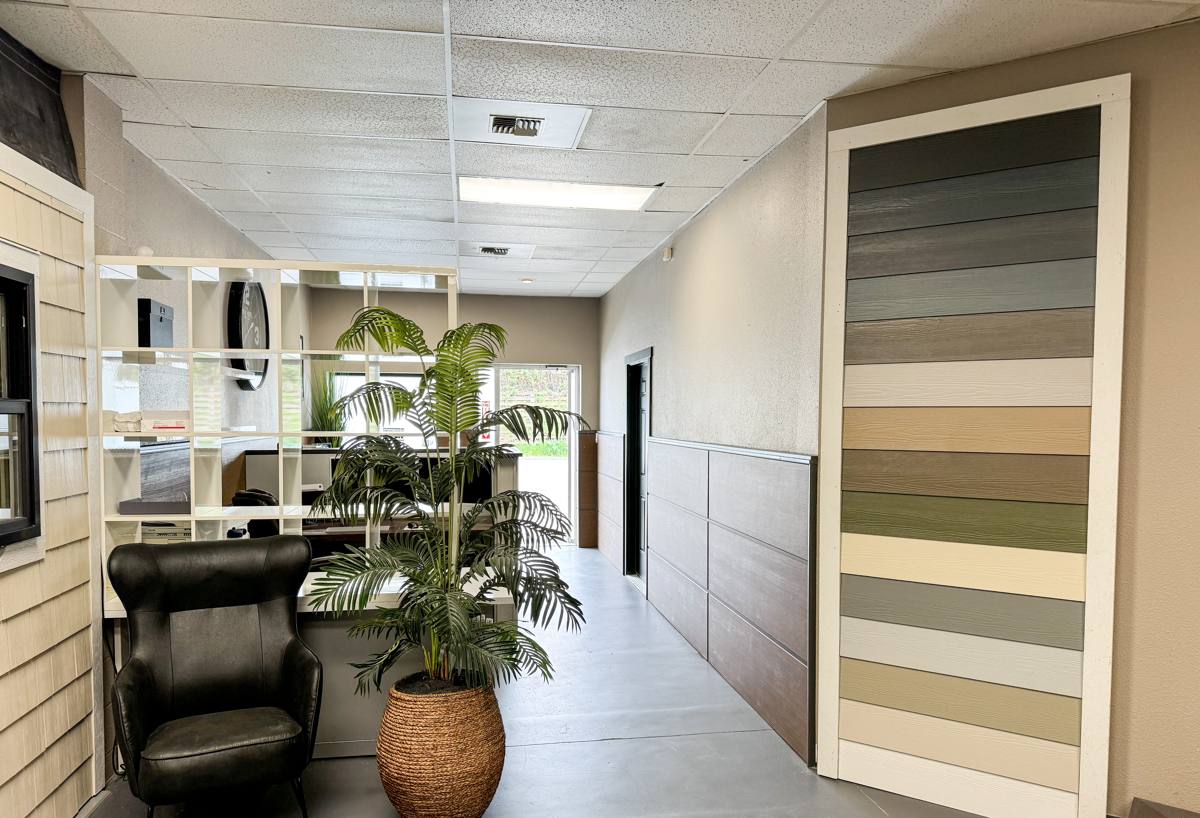
We install James Hardie exclusively, and for Lynden's mix of driving rain and coastal-influenced humidity, we typically steer homeowners toward Hardie's HZ5 climate-engineered formulation, which is built for wetter, harsher regions of the Pacific Northwest. Within that, most Lynden homes land on one of these:
| Product | Look | Best Fit For |
|---|---|---|
| HardiePlank Lap Siding | Traditional horizontal lap, smooth or cedar-textured | Most Lynden homes — farmhouse, craftsman, traditional styles |
| HardiePanel Vertical Siding | Clean vertical panels, often with battens | Modern builds, accent walls, gables, shop-style outbuildings |
| HardieShingle Siding | Staggered or straight-edge shingle profile | Craftsman and cottage-style homes wanting dimensional texture |
| HardieTrim Boards | Corner boards, fascia, window and door trim | Finishing every install to shed water at transitions |
All of these come pre-finished with ColorPlus technology — baked-on color that resists fading and chipping far better than field-applied paint, which matters in a climate where repainting siding every few years is nobody's idea of a good time.
Our Process for Lynden Projects
Every project starts with a walk of the home to assess the existing siding and wall assembly, check for hidden moisture damage (especially around windows, decks, and roof transitions — common trouble spots in this region), and talk through product and color options. From there:
- Written estimate — a clear scope covering removal, any sheathing repair, house wrap, rainscreen, siding, trim, and cleanup, with no vague allowances.
- Prep and tear-off — removal of failing material, inspection of the sheathing underneath, and repair of any rot or damage found before anything new goes on.
- Weather barrier and drainage plane — installed to spec, with every window, door, and penetration properly flashed.
- Siding installation — following James Hardie's fastening, clearance, and joint specifications exactly, not "close enough."
- Trim and detail work — corners, fascia, and transitions finished so water is directed away from the wall, not into it.
- Final walkthrough — we go over the finished work with the homeowner before calling the job done.
Why a Crew That Works Lynden Regularly Matters
Siding installation isn't just about following a manual — it's about knowing how the local weather actually behaves. A crew that works Whatcom County regularly knows which elevations take the worst of the driving rain, which lots hold shade and moisture longest, and how to sequence a job around a wet forecast without leaving a wall assembly exposed overnight. That local pattern recognition is the difference between a siding job that looks right on installation day and one that's still performing correctly ten winters later.
It also means faster, more accurate estimates. We're not guessing at how a product will hold up here — we've seen how Hardie performs on homes throughout the area and can speak plainly about what to expect.
What Lynden Homeowners Should Budget For
Costs vary based on home size, current siding condition, how much sheathing repair is needed, and which Hardie profile and trim package you choose. Rather than quote a number that won't hold up across different homes, here are the factors that actually move the price:
| Factor | Why It Matters |
|---|---|
| Tear-off complexity | Multiple layers of old siding or hidden damage add labor |
| Sheathing condition | Rot found underneath must be repaired before new siding goes on |
| Wall height and access | Two-story walls, steep grades, and tight access increase labor time |
| Product profile | Lap, panel, and shingle profiles have different material and labor costs |
| Trim scope | Full trim replacement adds cost but is often the right call for a clean, water-tight result |
We walk through all of this in person before giving a number, so the estimate reflects your home, not a generic average.
A Quick Homeowner Checklist
Before you call any contractor about siding — us included — it helps to know what you're looking at:
- Are there soft spots, bubbling paint, or visible cracks anywhere on the current siding?
- Is moss or algae concentrated on specific shaded or north-facing walls?
- Do you see staining or damage near window sills, deck ledgers, or roof-to-wall transitions?
- Has the home ever had a moisture or mold issue traced back to the exterior walls?
- Are gutters and downspouts routing water away from the foundation and walls effectively?
Answering these honestly gives any contractor a much clearer starting point — and gives you a better sense of whether you're dealing with a cosmetic issue or something that needs a fuller repair.
If your Lynden home's siding is showing its age or you're planning ahead of the next wet season, we're happy to take a look and give you a straightforward, no-pressure estimate. Use the form below to get started.