 Custer
 Laurel's Climate Puts Real Demands on Exterior Siding
Laurel sits close enough to the water and open farmland north of Custer that houses here take a different kind of weather beating than homes twenty miles inland. Salt-laden air off the Strait works into seams and fastener heads. Driving rain off Georgia Strait storms doesn't just fall straight down — it gets pushed sideways into lap joints and corner boards. And because this part of Whatcom County stays damp and shaded for long stretches of the year, moss and algae get a running start on any siding that holds moisture even a little.
None of that is unusual for northwest Washington. But it does mean the siding on a Laurel home is doing more work than the same product would on a house in a drier climate, and it means small installation shortcuts that might go unnoticed elsewhere show up here in three or four years instead of fifteen.
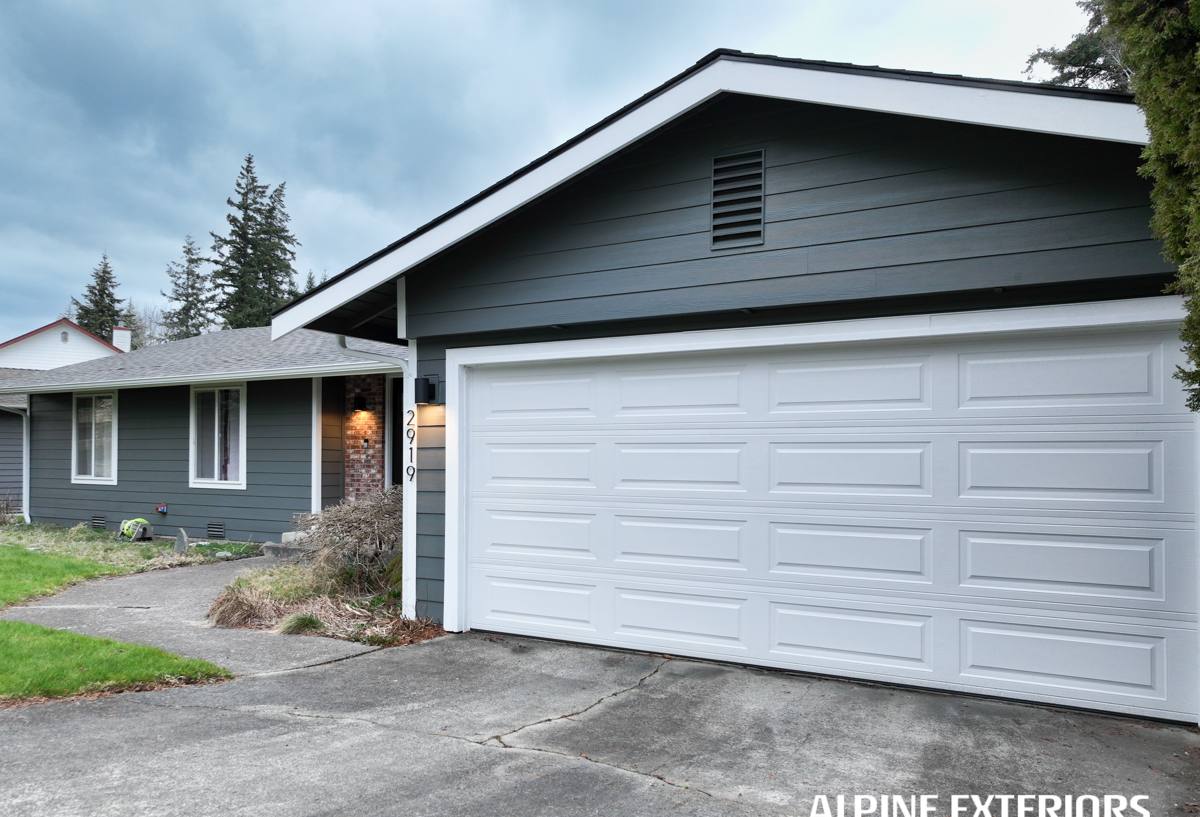
Why We Install Only James Hardie Fiber Cement
We don't carry vinyl, LP SmartSide, cedar, or primed spruce, and that's a deliberate call, not an oversight. Vinyl expands and contracts in temperature swings and can warp or pull away from fastener holes over time, which opens gaps for wind-driven rain. Wood-based and engineered wood products need their cut edges and faces kept sealed against moisture or they swell and rot from the inside out — a maintenance commitment that's easy to fall behind on in a climate this wet. Cedar looks great new but needs regular refinishing to hold up against salt air and constant dampness.
James Hardie fiber cement doesn't have those weak points. It's dimensionally stable across temperature and humidity swings, it's non-combustible, and the ColorPlus factory finish is baked on under controlled conditions rather than field-applied, so it holds color and resists the chalking and peeling that field-painted products eventually show. For a house in Laurel, that combination of dimensional stability and a factory-cured finish is the difference between siding that shrugs off a wet winter and siding that needs attention every couple of years.
What Correct Installation Looks Like on a Laurel Home
James Hardie siding performs the way it's rated to perform only when it goes on correctly. In a climate that throws sustained rain and salt air at a house, the installation details matter more than they would somewhere drier — this is where most of the difference between a 30-year siding job and a 10-year siding job actually comes from.
Flashing and Water Management
Every window, door, and roof-to-wall transition needs proper flashing and a drainage plane behind the siding, not caulk used as a substitute for flashing. Housewrap has to be lapped correctly, taped at seams, and integrated with flashing so water that gets behind the cladding — and some always will, eventually — has a path back out instead of a place to pool.
Fastening and Clearances
Hardie's own installation instructions specify fastener type, spacing, and how far boards need to sit off decks, roofs, and grade. Skipping the minimum clearance at the bottom of a wall is one of the most common corner-cuts we see, and it's exactly the kind of detail that causes wicking and soft trim in a climate that stays wet as long as this one does.
Finish and Caulking
Cut edges need to be primed or sealed per the manufacturer's spec before they go up, and joints need the right caulk applied correctly — not smeared over a gap that should have been flashed instead. Done right, the factory ColorPlus finish is the only finish exposed to weather; done wrong, raw cut edges become the entry point for moisture years before they should.
Matching the Product Line to This Climate
James Hardie makes climate-specific product lines, and picking the right one for a Whatcom County coastal-influenced site is part of doing this correctly rather than just defaulting to whatever's on the truck.
| Product Line | Built For | Why It Fits Laurel |
|---|---|---|
| HardiePlank HZ10 | Wet, temperate coastal climates | Engineered for the Pacific Northwest's moisture exposure and moss/mildew pressure |
| HardieShingle | Accent and full-wall shingle-style siding | Gives older Whatcom County homes a traditional look without wood's upkeep |
| HardiePanel | Vertical board-and-batten style | Common on outbuildings and modern facades; same moisture performance as lap siding |
| HardieTrim | Corner boards, fascia, window trim | Keeps trim dimensionally matched to the siding so joints stay tight |
The HZ10 designation matters more here than in drier parts of the state — it's the version of the product engineered specifically for sustained damp, marine-influenced climates like this one, and it's what we spec by default for Custer-area jobs.
Mistakes We See From Past Installations in This Area
Re-siding jobs and repair calls in this area tend to turn up the same handful of problems, almost always tied back to installation shortcuts rather than the material itself:
- Siding installed tight to grade or a deck surface with no clearance gap, letting splash-back and standing moisture wick into the bottom courses
- Caulk used to bridge gaps that should have had flashing behind them
- Cut ends left unsealed, especially around window returns and corners
- Fastener spacing wider than spec, leading to boards that flex and eventually crack at the nail line in wind
- Housewrap seams left untaped, so wind-driven rain finds its way behind the drainage plane instead of running down it
Every one of these is preventable. None of them are unique to James Hardie as a product — they're installation issues that show up faster in a wet, salt-exposed climate than they would somewhere milder.
Our Process for a Laurel Siding Project
- Site walk and assessment — we look at existing moisture damage, drainage patterns around the foundation, and how the house is currently oriented to prevailing wind and rain.
- Product and color selection — matching the right Hardie line and HZ rating to the exposure that specific wall faces, not a one-size answer for the whole house.
- Tear-off and substrate check — old siding comes off and sheathing gets inspected before anything new goes up, since covering rot instead of finding it is how small problems turn into structural ones.
- Housewrap, flashing, and drainage plane installation — the part that determines how the house performs in a rainstorm five years from now.
- Siding installation to Hardie spec — correct fastening, clearances, and sealed cut edges throughout.
- Final walkthrough — checking caulk lines, trim, and touch-up paint against the original color match.
What It Costs — and What Drives the Number
Every house is different, so a real number only comes from a walk-through, but the factors that move the price are consistent from job to job:
| Factor | Why It Changes the Cost |
|---|---|
| Tear-off complexity | Multiple layers of old siding or extensive rot repair add labor before new siding even starts |
| Wall height and access | Multi-story walls and tight lot lines change staging and scaffolding needs |
| Product line and profile | HardieShingle and custom trim work run higher than standard lap siding |
| Color and finish | Factory ColorPlus finishes cost more up front than field-painted primed siding, but eliminate repainting cycles |
| Detail work | Number of windows, corners, and roof transitions drives flashing and trim labor |
Keeping Hardie Siding Looking Right Through Moss Season
Correctly installed James Hardie siding needs far less upkeep than wood or vinyl, but "less" isn't "none" — especially with the moss and algae pressure common to this part of Whatcom County.
- Rinse siding down once or twice a year, especially on north-facing and shaded walls where moss gets the most persistent foothold
- Keep gutters clear so overflow doesn't run down the siding face and feed algae growth
- Trim back vegetation and tree cover that keeps a wall shaded and damp longer than the rest of the house
- Check caulk lines at windows and trim every couple of years and recaulk any that have cracked or pulled away
- Watch for any soft spots at the bottom courses near grade, which usually mean a clearance or drainage issue rather than a siding failure
Why a Crew That Already Works Laurel Matters
A siding crew that's worked this specific stretch of Whatcom County already knows which walls in Laurel take the worst of the weather off the water, how the local moss and algae pressure behaves through the wet season, and which flashing details actually hold up here versus what a generic installation manual assumes for a milder climate. That's not something you can fully substitute with a general contractor working from a spec sheet for the first time — it comes from having done the work on houses in this same area, in this same weather.
If you're weighing a siding replacement or want a second opinion on an existing installation, we're glad to walk the house with you and give you a straight assessment — no pressure, no upsell, just what the house actually needs. Reach out for a free estimate using the form below.