 Custer
 Siding Installation Built for the Everson Area, Not a Generic Climate
Everson sits inland from the coast but still inside the weather pattern that defines siding performance across Whatcom County: damp air moving off the water, long stretches of driving rain in fall and winter, and a shoulder season where surfaces barely dry out before the next system rolls through. A siding installation done here has to account for that pattern from the first piece of house wrap to the last nail, not just meet a generic building-code minimum written for a drier region.
We install siding for homes in and around Custer and Everson regularly, which means we're not guessing at what this climate does to a wall assembly over ten or twenty years. We've seen what happens when flashing details get skipped, when moisture gets trapped behind the wrong product, and when moss is left to work into seams that were never sealed correctly in the first place. This page is about what a correct siding installation actually involves here, and why the crew doing it matters as much as the material.
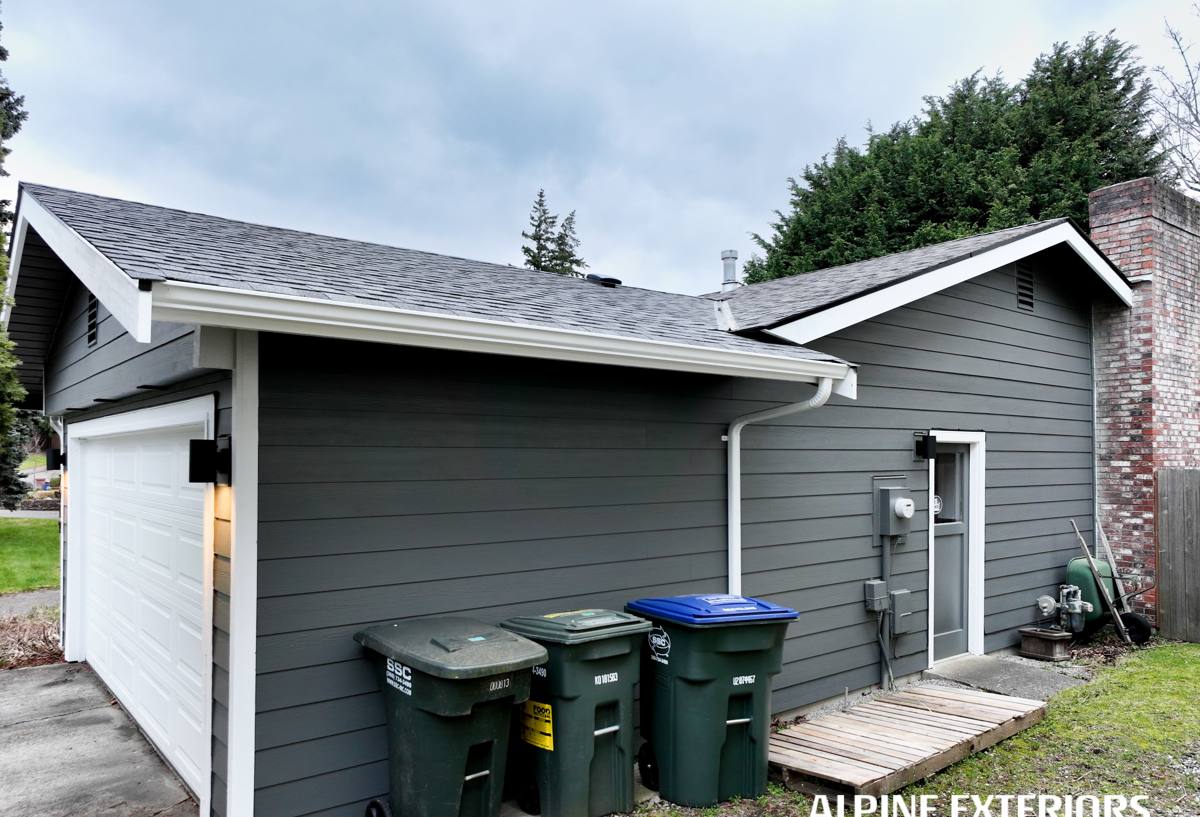
What Salt Air, Driving Rain, and Moss Season Do to a Wall
Three conditions do most of the damage to siding in this part of Whatcom County, and they compound each other:
- Salt-influenced air — even set back from open water, coastal airflow carries fine salt that accelerates corrosion on fasteners, flashing, and any metal trim that isn't rated for it.
- Driving rain — wind-driven rain doesn't just fall straight down; it gets pushed sideways and upward under laps, edges, and trim, which is exactly where poor installation work fails first.
- Extended moss and algae season — long stretches of cool, wet, shaded conditions let organic growth establish on siding, trim, and roof-adjacent surfaces for months at a time rather than a few weeks.
Individually, any one of these is manageable. Together, they punish materials and installation shortcuts that would hold up fine somewhere drier. Siding here needs to shed water aggressively, resist the fasteners corroding before the siding does, and tolerate sustained moisture contact without softening, swelling, or feeding growth.
What a Correct Siding Installation Actually Involves
A siding job is only as good as what's underneath it. The visible panels get all the attention, but the water management system behind them is what determines whether a house stays dry for the next few decades. On every Everson-area installation, that means:
Drainage and Weather-Resistive Barrier
A continuous, correctly lapped weather-resistive barrier goes on before any siding, with all seams, penetrations, and transitions sealed. In a climate with this much wind-driven rain, we also build in a drainage gap where the wall assembly calls for it, so any water that does get behind the cladding has somewhere to go instead of sitting against the sheathing.
Flashing at Every Vulnerable Point
Windows, doors, deck ledgers, roof-to-wall transitions, and any horizontal trim need flashing that directs water outward, not sideways into the wall cavity. This is the single most common place we find prior installation failures on older homes — flashing that was skipped, reused, or installed backward.
Fastener Selection and Placement
Corrosion-resistant fasteners, installed at the manufacturer's specified pattern and depth, matter more here than in drier inland climates. Overdriven or underdriven nails compromise the panel's ability to move with temperature and moisture changes, which shows up years later as cracking or fastener staining.
Proper Clearances
Siding needs clearance from grade, roof lines, decks, and patios so it isn't sitting in standing water or trapped moisture. This is a simple detail that gets overlooked constantly, and it's one of the fastest ways to void a manufacturer's warranty.
Why We Install Only James Hardie Fiber Cement
We don't install vinyl, LP SmartSide, Cemplank, Allura, primed spruce, or cedar. That's a deliberate standard, not a lack of options. Each of those products has legitimate strengths, but none of them holds up to this specific combination of salt-influenced air, sustained wet weather, and heavy moss pressure the way engineered fiber cement does.
Wood-based and wood-composite products need consistent maintenance to keep moisture out of their edges and cut ends — miss a maintenance cycle in a climate this wet, and the clock starts running on rot and swelling. Vinyl handles moisture fine on its own but moves more with temperature swings, can become brittle with age, and doesn't offer the same fire performance. James Hardie fiber cement is non-combustible, dimensionally stable, and engineered specifically for climates like this one through its HZ5 product line, which is formulated for cold, wet regions rather than a one-size-fits-all national spec.
The factory-applied ColorPlus finish is baked on under controlled conditions, which gives it more consistent coverage and better fade resistance than field-applied paint, and it comes with a longer finish warranty than most site-applied coatings can offer. Combined with Hardie's transferable product warranty, that's a siding system built to actually survive a Whatcom County winter cycle after winter cycle, not just look good in the first year.
Our Installation Process, Step by Step
| Step | What Happens | Why It Matters Here |
|---|---|---|
| 1. On-site assessment | Walk the existing siding, check for hidden moisture damage, note trim, window, and roofline transitions | Identifies problem areas driving rain has already exploited |
| 2. Tear-off and sheathing check | Remove old siding, inspect sheathing for rot or soft spots before covering it back up | Prevents sealing existing moisture damage behind new siding |
| 3. Weather-resistive barrier and drainage plane | Install and lap barrier correctly, add drainage gap where called for | Gives any intruding water a path out instead of a trap |
| 4. Flashing installation | Flash all windows, doors, and horizontal transitions | Directly addresses wind-driven rain intrusion points |
| 5. James Hardie panel installation | Install to manufacturer fastener spec and clearances | Preserves the product warranty and long-term performance |
| 6. Trim, caulking, and final inspection | Seal joints correctly, verify clearances and fastener lines | Closes off the last places moss and moisture find a foothold |
Cost Factors for an Everson-Area Siding Project
Every home is different, so we won't quote a number without seeing the house, but the same handful of factors drive cost on nearly every project in this area:
| Factor | Why It Affects Cost |
|---|---|
| Existing siding condition | Hidden rot or sheathing damage found during tear-off adds repair scope before new siding goes on |
| Home size and wall complexity | More corners, gables, and trim transitions mean more flashing and cutting labor |
| Siding profile and color selection | Lap width, trim style, and ColorPlus color all factor into material cost |
| Access and site conditions | Tight lots, slopes, or landscaping close to the house affect staging and labor time |
| Window and door count | Each opening requires flashing and trim detail work |
Why a Crew That Already Works This Area Matters
Siding installation isn't just a product spec — it's a set of judgment calls made on-site, and those calls are better when the crew has already made them on other Whatcom County homes. A crew that regularly works Custer and Everson knows what driving rain does to a west-facing wall, knows which flashing details actually hold up through moss season, and doesn't need to relearn the local weather pattern on your house. That familiarity shows up in fewer callbacks and a wall assembly that's dealt with these exact conditions before, not a theoretical version of them.
It also means straightforward logistics — scheduling around this area's weather windows, sourcing the right Hardie profiles and colors without delay, and being reachable afterward if a question comes up. Hiring local isn't a sentimental preference; it's a practical one.
Before You Get Quotes: A Homeowner's Checklist
- Confirm the contractor plans to inspect and address sheathing condition during tear-off, not just cover it
- Ask specifically how windows, doors, and roof transitions will be flashed
- Verify fastener type and installation pattern match the manufacturer's specification
- Check that quoted clearances from grade, decks, and roofing meet manufacturer minimums
- Ask whether the crew is factory-trained on the specific James Hardie product line being installed
- Get the warranty terms in writing — both the manufacturer's and the installer's workmanship coverage
Living With Your New Siding
James Hardie fiber cement is low-maintenance, but "low" isn't "none." A rinse-down once or twice a year knocks back the moss and algae that this climate will keep trying to establish, especially on shaded north- and west-facing walls. Keep gutters clear so overflow isn't running down the siding face, and keep an eye on caulked joints over the years the way you would with any exterior material. None of this compares to the maintenance burden of a wood-based or wood-composite product in this weather, but it's still worth doing on schedule rather than reactively.
If your Everson-area home has siding that's struggling with the conditions this climate throws at it — or you're planning ahead before it starts — we're glad to take a look and talk through what a correct installation would involve for your specific house. Reach out for a free, no-pressure estimate using the form below.