 Custer
 Semiahmoo Roofs Take a Different Kind of Beating
Semiahmoo sits out on the water, and that changes what a roof has to survive. Homes here face onshore wind, salt-laden air off the strait, and long stretches of driving rain that most inland Whatcom County roofs never see. Add in the region's mild, wet winters that never quite dry a roof out, and you have conditions that quietly wear down materials that would last decades somewhere less exposed. Storm damage in this setting rarely looks dramatic at first. It shows up as a lifted shingle tab, a soft spot near a vent, or a slow stain on a ceiling that started weeks before anyone noticed it.
We work on roofs in and around Custer and Semiahmoo often enough to know the difference between damage that's purely cosmetic and damage that's already let water past the surface. That distinction matters, because the repair that looks fine from the ground is sometimes the one that fails again in the next storm.
What Storm Damage Actually Looks Like Here
Wind Damage
Waterfront exposure means sustained wind loads, not just occasional gusts. Wind doesn't need to tear a whole section off to cause a problem — it more often lifts the seal strip on a run of shingles, cracks the adhesive bond, and leaves tabs that flap in the next blow until they crease, crack, or go missing outright. Once a shingle's seal is broken, it rarely reseals on its own, even after the wind dies down.
Wind-Driven Rain and Wind-Blown Debris
Rain that comes in at an angle off the water can drive under shingle edges, flashing laps, and ridge caps that would shed vertical rain just fine. Combine that with debris — fir and cedar branches, needles, grit — and you get points where water gets a foothold: a lifted tab, a nicked shingle, a flashing edge that's been pried open just enough.
Granule Loss and Surface Wear
Salt air and constant moisture accelerate the breakdown of asphalt shingle granules faster than inland exposure does. Granule loss shows up as bald patches and gritty runoff at downspouts, and it's an early sign that a roof's UV and weather protection is thinning — often well before a storm event pushes it into an active leak.
Hidden Moisture Behind Flashing
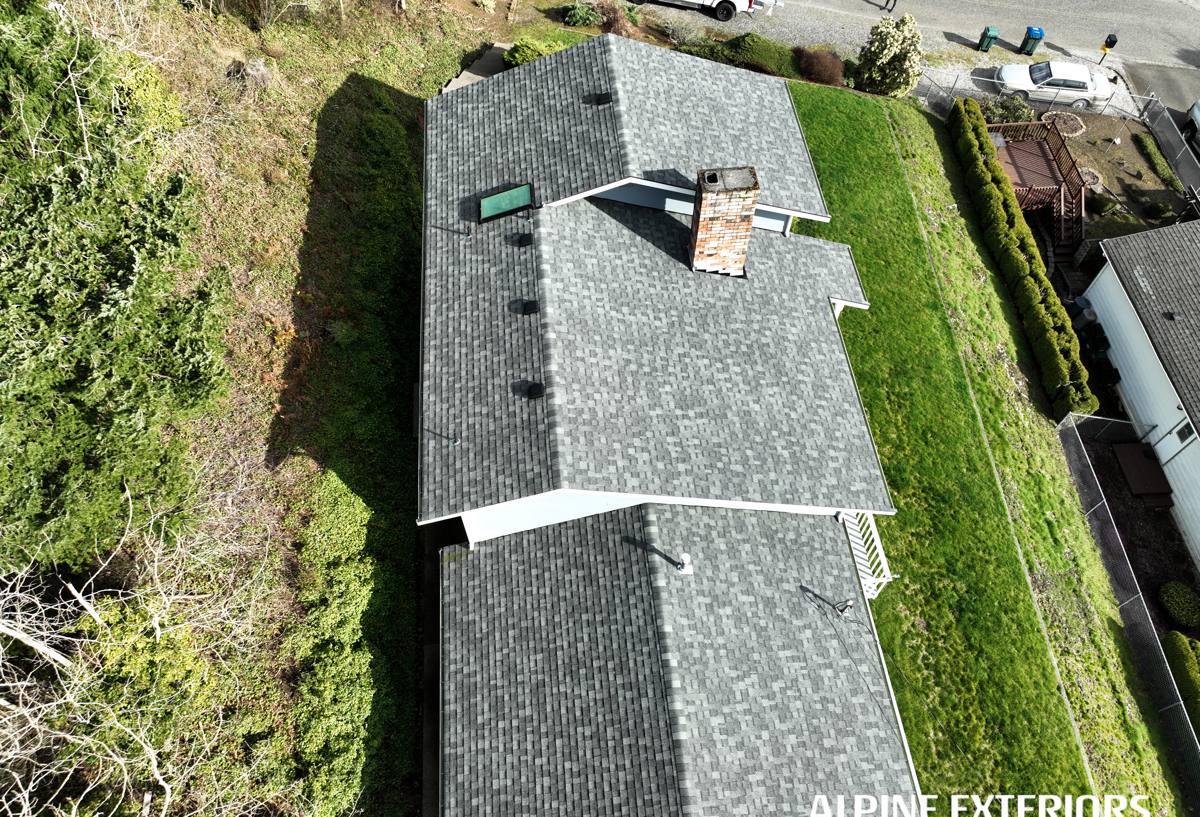
Chimney flashing, skylight curbs, and roof-to-wall transitions are the most common places we find storm damage that isn't visible from the ground. A step flashing lap opened half an inch by wind and settling can let water track down into the wall or attic for months before it shows as a stain inside.
Why Coastal Exposure Changes the Repair, Not Just the Damage
A storm repair on a Semiahmoo roof has to account for the environment it's going back into, not just patch what broke. Fasteners and flashing metals that are fine inland can corrode faster this close to salt air, especially on lower roof planes and near gutters where salt spray settles and doesn't get washed off as often as it would on a steep, exposed slope. We factor that into what we use for repairs here — corrosion-resistant fasteners, flashing metals suited to marine-adjacent exposure, and sealants rated for constant damp cycling rather than occasional wetting.
It also changes how we think about ventilation. A roof deck that stays damp longer because of coastal humidity and shade from surrounding trees is more prone to trapped moisture and, eventually, rot and moss growth underneath the shingles themselves — not just on top of them.
What a Correct Storm Damage Repair Involves
The honest answer is that a proper repair takes longer than a quick patch, because most of the work is in finding the actual extent of the damage before any new material goes down.
Step 1: Full-Roof Inspection, Not Just the Reported Spot
Storm damage travels. Wind that lifted shingles in one area almost always affected an adjacent run too, even if it hasn't leaked yet. We walk the whole roof plane, not just the spot where a stain showed up inside, and check flashing, boots, and ridge lines while we're up there.
Step 2: Deck Assessment
If water has been getting past the shingle layer for any length of time, the decking underneath needs to be checked for soft spots, delamination, or rot before new shingles go on top. Repairing over a compromised deck is the single most common cause of a "repaired" roof leaking again.
Step 3: Matched Material Replacement
We replace damaged shingles, underlayment, and flashing with materials matched as closely as possible to the existing roof in both product line and color, and we integrate new flashing properly into the existing laps rather than sealing over the top of old, failed metal.
Step 4: Sealing and Weatherproofing Details
Every penetration — vent boots, chimney flashing, skylight curbs — gets checked and resealed as part of the repair, since these are the points most likely to have contributed to the original leak.
Step 5: Verification
We check the repair area and surrounding roof plane again before calling the job done, including a look at the attic side where accessible, since that's often the clearest sign of whether a leak path has actually been closed.
| Approach | What It Actually Does | Risk |
|---|---|---|
| Surface patch / caulk over damage | Covers the visible symptom quickly | Leaves deck moisture and failed flashing in place; often leaks again within a season or two |
| Spot shingle replacement only | Replaces what's visibly missing or cracked | Misses adjacent wind-loosened shingles and hidden flashing gaps |
| Full diagnostic repair | Traces the leak path, checks deck condition, replaces matched materials, reseals penetrations | Takes longer up front; addresses the actual cause |
Our Process for Semiahmoo Storm Repairs
- Contact and initial description: we ask what you're seeing — a stain, missing shingles, granules in the gutter — and when it started.
- On-site inspection: a full look at the roof, not just the reported area, including flashing, ventilation, and any accessible attic space.
- Written estimate: a clear explanation of what's damaged, what's causing it, and what the repair involves — no pressure, no scare tactics.
- Repair scheduled around the weather: we work around Whatcom County's rain patterns so materials go down dry and seal properly.
- Final walkthrough: we show you what was done and what to keep an eye on going forward.
Roofing Materials That Hold Up Near the Water
Not every roofing product performs the same way this close to salt air and constant moisture. When a repair calls for new material, we lean toward products with a track record in coastal Pacific Northwest conditions rather than whatever is cheapest to source.
| Material | Coastal Performance | Trade-Off |
|---|---|---|
| Standard 3-tab asphalt | Adequate on sheltered slopes; wears faster under sustained wind and salt exposure | Shorter effective lifespan this close to the water |
| Architectural (laminate) asphalt | Better wind rating and granule retention; our default recommendation for most repairs here | Slightly higher material cost than 3-tab |
| Metal flashing (coastal-rated) | Resists corrosion at laps, chimneys, and valleys far better than standard galvanized | Higher upfront cost, offset by fewer repeat repairs |
Moss, Shade, and Long-Season Growth
Whatcom County's long wet season and the tree cover common around Semiahmoo properties give moss plenty of time to establish on north-facing and shaded roof planes. Moss holds moisture against the shingle surface, lifts tabs as it grows under the edges, and accelerates exactly the kind of granule loss and seal failure that turns a minor storm event into an active leak. Any storm repair we do includes a look at moss growth nearby, because clearing and treating it is often what keeps a fresh repair from being undone within a year or two.
After-Storm Roof Checklist
- Check gutters and downspouts for granule buildup after any significant wind event
- Look for shingle tabs that appear lifted, curled, or missing from the ground
- Note any new ceiling stains, even faint ones, and when they first appeared
- Check attic insulation (if accessible) for damp spots after heavy rain
- Watch for moss thickening on shaded slopes going into fall and winter
- Have flashing around chimneys and skylights checked every year or two, not just after a storm
Why Hiring a Crew That Already Works Semiahmoo Matters
A roof repair crew that mainly works drier, more sheltered inland areas can miss what matters most out here: how fast salt air corrodes standard fasteners, how much longer a shaded coastal roof stays damp after rain, and which flashing details actually hold up to sustained onshore wind season after season. We work in Custer and the surrounding Whatcom County waterfront communities regularly, so the repair we do accounts for what this specific environment will do to it next winter, not just what fixes the immediate leak.
We're also straightforward about scope. If a repair is genuinely all a roof needs, that's what we recommend. If storm damage has gone on long enough that a full roof replacement makes more sense than another round of patching, we'll explain why in plain terms and let you make the call.
Get a Straightforward Look at Your Roof
If a recent storm has you noticing a stain, missing shingles, or granules piling up in the gutter, it's worth having it looked at before the next round of Pacific Northwest weather moves through. We offer free, no-pressure estimates for Semiahmoo and Custer homeowners — just fill out the form below and we'll take a look.