 Custer
 Birch Bay Roofs Take a Different Kind of Beating
Birch Bay sits right where Whatcom County meets open water, and that location does a number on a roof that homes even a few miles inland don't deal with. Wind comes off the water with nothing to slow it down. Salt air rides in on that wind and settles into every exposed fastener, vent, and flashing seam. And because the bay side of Custer stays damp and shaded longer than drier stretches of the county, moss and algae get a head start every fall and don't let go until well into spring. None of this means a roof here is doomed — it means storm damage repair has to account for conditions that a generic repair job written for a drier climate simply doesn't address.
When we get a call after a windstorm or a stretch of driving rain, the first question isn't just "what broke," it's "what's this roof been dealing with for years that made it vulnerable in the first place." A repair that only patches the visible damage without accounting for that history tends to fail again at the next storm.
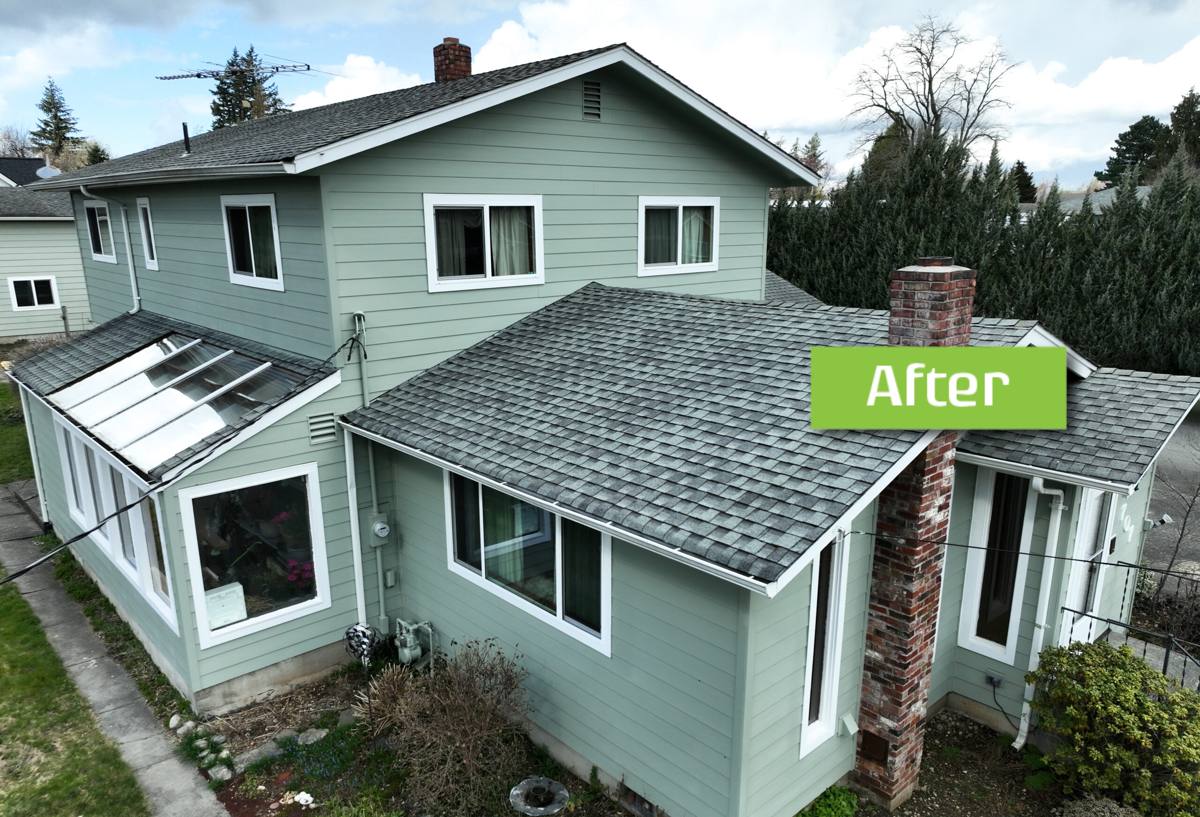
What Storms Actually Do to a Birch Bay Roof
Wind Uplift and Lifted Shingles
Sustained wind off the water gets under shingle tabs, especially on older roofs where the sealant strip has already weakened from age or heat cycling. Once a few shingles lift, the next storm peels more, and water starts finding its way under the field of the roof rather than running off it.
Salt Air and Fastener Corrosion
Standard galvanized nails and flashing hold up fine in a lot of the country. Close to Birch Bay's shoreline, salt-laden air accelerates corrosion on anything that isn't rated for a marine-adjacent environment. We see this most often at nail heads, drip edge, and step flashing around chimneys and dormers — small metal failures that don't look dramatic until they're the reason water is getting into the attic.
Driving Rain at Laps and Penetrations
Wind-driven rain doesn't just fall straight down — it gets pushed sideways and upward under laps, around vent boots, and along valleys. A roof that's watertight in a light rain can still leak in a Birch Bay windstorm if flashing details weren't built for wind-driven water in the first place.
Moss and Trapped Moisture
A long moss season means more roofs holding moisture against the shingle surface for more of the year. Moss doesn't just look bad — it lifts shingle edges, holds water against the roof deck, and speeds up granule loss, all of which make storm damage worse when the next wind event hits.
Signs You Should Have a Roof Checked After a Storm
Most homeowners don't get up on the roof, and they shouldn't. But there are ground-level and attic clues worth checking after any significant wind or rain event in the Birch Bay area:
- Shingle granules collecting in gutters or at downspout outlets
- Shingles that look curled, cracked, or missing from the ground
- Water stains on interior ceilings, especially near chimneys, skylights, or where roof planes meet
- Damp or musty smell in the attic after a storm
- Visible daylight through the roof deck from inside the attic
- Flashing that looks bent, lifted, or separated around vents and chimneys
- Debris — branches, moss clumps, torn shingle pieces — on the roof or in the yard after wind
Any one of these on its own might not mean much. Several together, especially right after a storm, are worth a professional look before the next round of weather comes through.
What an Honest Storm Damage Repair Involves
A proper repair isn't just slapping a patch over the spot that's leaking. It generally follows this sequence:
- Safe temporary protection — tarping exposed areas immediately if the damage is active or if rain is in the forecast, so interior damage doesn't compound while a permanent repair is scheduled.
- Full inspection, not just the reported leak — checking the whole roof plane, not only the spot the homeowner noticed, since wind and salt damage rarely show up in just one place.
- Deck assessment — confirming the plywood or plank decking underneath hasn't taken on moisture damage that needs to be addressed before new roofing goes back down.
- Underlayment and flashing repair or replacement — this is where most repeat leaks come from if it's skipped, especially around chimneys, valleys, and wall-to-roof transitions.
- Matching materials — using shingles and components that match the existing roof as closely as possible so the repair blends in and performs consistently with the surrounding roof.
- Ventilation check — confirming intake and exhaust venting weren't damaged, since poor ventilation traps moisture and accelerates moss growth in this climate.
- Cleanup — removing debris, old materials, and nails from the yard and gutters before we leave.
Our Process for Birch Bay Storm Repairs
We keep this straightforward because homeowners dealing with storm damage are usually already stressed. We come out, walk the roof (or use a lift/drone when steep pitch or safety makes that the smarter choice), and document exactly what we find with photos — useful both for our own repair plan and for an insurance claim if you're filing one. We'll give you a clear, written explanation of what's damaged, what caused it, and what it will take to fix correctly, including what's cosmetic versus what's a real water-intrusion risk.
We're upfront if a repair is the right call versus if the roof is old enough or damaged enough that repair money would be better spent toward a partial or full replacement. We don't pad a repair scope to make a job bigger than it needs to be, and we don't shrink it to win a lower bid at the cost of a leak coming back in a year.
Repair or Replace? Honest Factors to Weigh
| Factor | Leans Toward Repair | Leans Toward Replacement |
|---|---|---|
| Roof age | Under 12-15 years, otherwise sound | Nearing or past expected lifespan for the material |
| Extent of damage | Isolated to one plane or feature | Widespread across multiple roof planes |
| Granule loss / shingle condition elsewhere | Minimal outside the damaged area | Significant wear across the whole roof |
| Decking condition | Dry, solid where inspected | Soft spots or rot found during inspection |
| Moss/algae history | Light, manageable with cleaning | Heavy, recurring, already lifting shingles |
| Insurance coverage | Partial claim covers repair scope | Claim supports full replacement |
We'll walk you through where your roof lands on this before recommending anything.
Materials That Actually Hold Up Near the Water
Not every fastener or flashing product performs the same near Birch Bay's salt air. Our standard on storm repairs in this area is to use corrosion-resistant fasteners and flashing metals rather than the cheapest standard-grade options, because the cost difference upfront is small compared to the cost of redoing a repair in a few years once corrosion sets in. Where a homeowner's existing roof used lower-grade materials, we'll say so plainly and explain the trade-off rather than just matching the original spec without comment — sometimes matching exactly is the right call for appearance and cost, and sometimes it's worth spending a little more on the repair itself even if the rest of the roof stays as-is.
The same logic applies to sealants and underlayment. Products rated for sustained moisture exposure and UV hold up better through a Whatcom County winter than economy-grade versions, and the labor cost to install either one is basically the same — it's almost always worth spending the marginal difference on the better material when we're already up there doing the work.
Why Local Experience with Birch Bay Roofs Matters
A crew that works this specific stretch of coastline regularly knows things a roofer from out of the area has to learn on your roof: which wind directions cause the worst damage on bay-facing slopes, which roof details tend to fail first in this salt air, and how long moss actually takes to become a structural problem versus a cosmetic one here. That familiarity shows up in faster, more accurate diagnosis and repairs that are built for the conditions your roof will keep facing, not just the storm that just happened.
It also matters for timing. Storm damage doesn't wait for convenient scheduling, and a crew that already works in and around Custer and Birch Bay can typically respond faster than one dispatching from farther away, which matters when a tarp is holding back the weather until a permanent repair can happen.
A Note on Insurance Claims
Many storm damage repairs are at least partly covered by homeowners insurance, but coverage depends entirely on your policy and the adjuster's assessment — we're not going to promise an outcome we don't control. What we can do is document damage thoroughly with clear photos and a written scope that gives you and your adjuster an accurate, honest basis for the claim. We'll point out what's storm-caused versus what's pre-existing wear, because that distinction matters to insurers and it matters to you getting a fair result.
If a recent storm has you wondering about your roof's condition, we're happy to take a look and give you a straight answer — no pressure, no inflated scope, just an honest assessment and a free estimate for whatever repair actually makes sense.