 Custer
 Why Sandy Point's Waterfront Climate Is Hard on Siding
Sandy Point sits close enough to the water that homes here take a different kind of weathering than a house a few miles inland in Custer. Salt-laden air off the water works on fasteners, trim, and any exposed wood fiber year-round, not just during storms. Add in the driving, wind-pushed rain that comes through Whatcom County in the fall and winter, and you have moisture that doesn't just fall on a wall — it gets pushed sideways into every seam, joint, and gap that isn't detailed correctly.
Then there's shade. Many Sandy Point lots have mature trees or sit close to neighboring homes, which means walls that stay damp longer after a storm and get less direct sun to dry out. That combination — salt air, sideways rain, and slow-drying shade — is exactly what feeds a moss and algae season that, in this part of Washington, can run eight months or longer. Siding here isn't just a look. It's a system that has to shed water, resist salt exposure, and stand up to constant damp without rotting, swelling, or feeding growth.
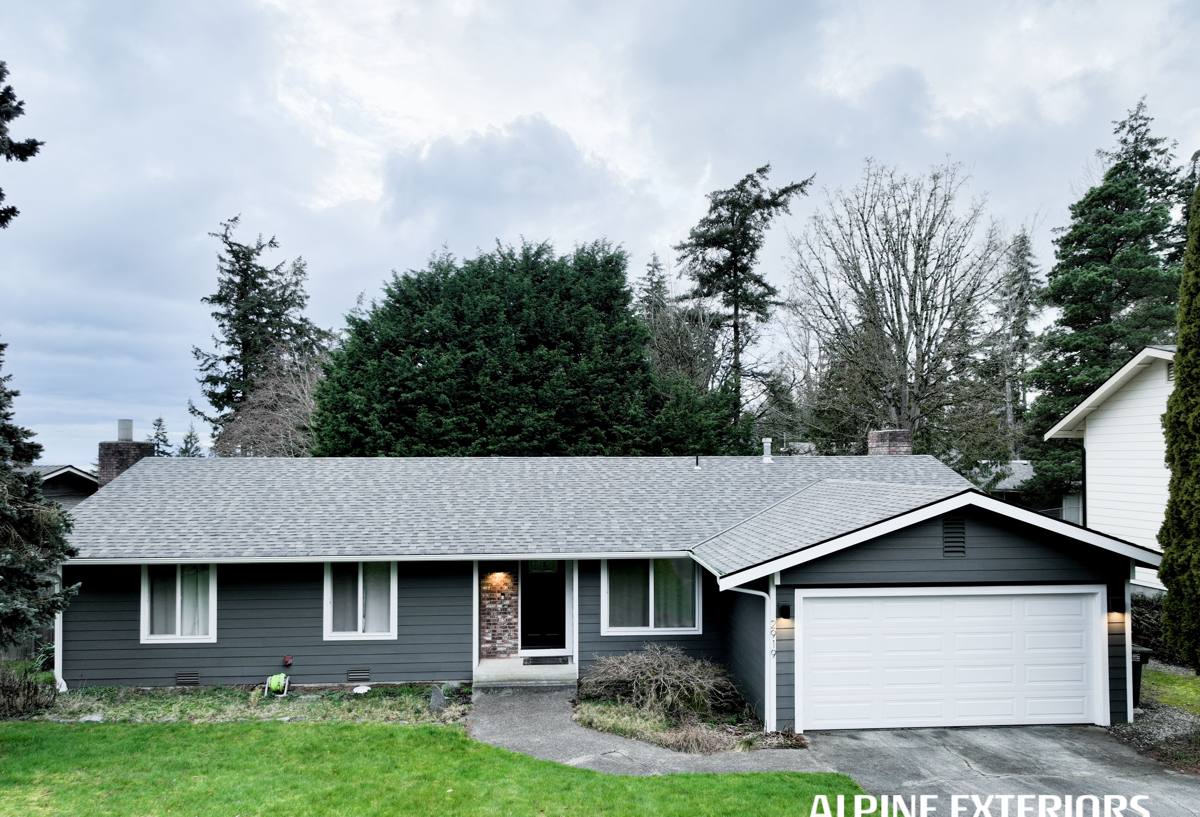
What Board & Batten Actually Adds to a Sandy Point Home
Board and batten is a vertical siding pattern: wide flat panels or boards installed with narrower strips (battens) covering the seams between them. It reads as clean, strong vertical lines with real shadow depth, which suits a lot of the waterfront and craftsman-style architecture found around Sandy Point — especially on gable ends, dormers, and as an accent alongside horizontal lap siding on the rest of the house.
Where it works best
- Gable peaks and dormers, where vertical lines break up a tall wall plane
- Full exterior treatments on modern farmhouse or coastal-style homes
- Accent bands — porch gables, entry surrounds, garage faces — paired with lap siding elsewhere
- Shed and outbuilding exteriors that need a durable, low-maintenance finish
The trade-off homeowners should understand up front: board and batten has more vertical seams per square foot of wall than lap siding, and every one of those seams is a place water can try to get behind the cladding if it isn't installed correctly. That makes material choice and installation detail more important here than on almost any other siding style.
Why We Install Board & Batten Only in James Hardie Fiber Cement
We don't install vinyl, LP SmartSide, cedar, primed spruce, Cemplank, or Allura on any home, including board and batten projects — and in a marine environment like Sandy Point, the reasons matter even more than usual.
Vinyl board and batten
Vinyl looks the part from a distance, but it's a thin extruded plastic panel that moves with temperature. In direct sun it can warp or oil-can; in cold snaps it gets brittle and can crack on impact. The vertical battens are typically snapped-on trim pieces, not a monolithic board, so the seam count — and the number of small gaps that salt-laden wind can drive moisture into — is even higher than with lap vinyl.
LP SmartSide and other wood-based composites
LP SmartSide is engineered wood — strand board with a resin-treated surface. It performs fine in a lot of climates when installed and maintained perfectly, but it has a wood core, and wood cores swell, delaminate at cut edges, and lose their factory treatment if moisture gets behind the panel or sits in an unsealed cut. On a wall taking regular salt spray and wind-driven rain, that's not a risk we're willing to put our name behind.
Cedar and primed spruce
Real wood board and batten looks beautiful, but it's an ongoing maintenance commitment — refinishing, caulking, and watching for rot at the battens and sills — that most homeowners underestimate until they're five years in. In a salt-air, high-moss environment, that maintenance cycle only gets shorter.
Cemplank and Allura (other fiber cement brands)
These are legitimate fiber cement products, and fiber cement as a category is the right call for this climate. We standardized on James Hardie specifically for consistency: a factory-applied ColorPlus finish that's baked on rather than field-painted, a product line (HZ5) engineered for wetter, harsher climates, and a transferable warranty backed by one manufacturer whose installation specs we build every job around. Sticking with one system means every fastener, batten spacing, and flashing detail on your house follows the same tested manufacturer instructions — nothing improvised.
What a Correct Board & Batten Installation Involves
Board and batten fails, when it fails, almost always at the install — not the material. Here's what has to happen for it to perform the way it's designed to:
Rainscreen gap
Furring strips (or a purpose-built rainscreen product) behind the boards create a drainage and drying gap between the siding and the water-resistive barrier. Without it, any moisture that does get past the surface has nowhere to go and sits against the wall sheathing — which is how you get hidden rot behind siding that looks fine from the driveway.
Board layout and batten spacing
Panel width, batten placement, and the gap left for expansion all follow James Hardie's published spec, not a rough guess. Battens have to land over the seam correctly and be fastened into structural framing or properly blocked furring — not just into the panel itself.
Fastening pattern
Corrosion-resistant fasteners, driven at the correct spacing and depth (not overdriven, not underdriven), at every stud and at panel edges. Overdriven fasteners crack the board's fiber cement edge; underdriven ones back out over time and open a gap for water.
Flashing and penetrations
Windows, doors, hose bibs, light fixtures, and vents all interrupt the wall plane, and each one needs proper flashing integrated with the water-resistive barrier before the siding goes on — not caulk applied after the fact as a substitute for flashing.
Sealants and touch-up
Any field cuts get sealed per manufacturer spec, and only James Hardie-approved caulk and touch-up paint get used so the ColorPlus finish keeps its warranty coverage and color match.
Our Process for a Sandy Point Project
- On-site assessment — we look at which elevations take the most direct wind and salt exposure, check for existing moisture damage behind current siding, and confirm the substrate is sound before quoting anything.
- Tear-off and inspection — old siding comes off and we inspect the sheathing and framing underneath for rot or prior water damage before anything new goes up.
- Water-resistive barrier and rainscreen install — the weather barrier gets repaired or replaced as needed, and furring strips go up to create the drainage gap.
- Board and batten install to spec — panels, battens, and fasteners installed to James Hardie's published instructions, with extra attention to flashing at every window, door, and penetration.
- Final detail and walkthrough — caulking, touch-up, cleanup, and a walkthrough so you know exactly what was done and why.
Cost Factors on a Board & Batten Job
Every Sandy Point property is different, so instead of a flat number, here's what actually drives the price up or down on a board and batten project:
| Cost Factor | Why It Matters |
|---|---|
| Wall prep condition | Rotted sheathing or a failed water barrier found during tear-off adds repair work before new siding can go on |
| Rainscreen system | Furring strips and drainage detailing add labor and material but are non-negotiable for board and batten in this climate |
| Full-house vs. accent use | Board and batten as a full exterior costs more overall than using it as a gable or accent detail alongside lap siding |
| Number of penetrations | Every window, vent, and fixture needs individual flashing work, so a more complex facade takes more labor |
| Site access | Tight waterfront lots, limited staging space, or difficult material delivery can affect labor time |
Keep this checklist handy when comparing quotes
- Does the quote include a rainscreen or drainage gap, or just direct-to-sheathing installation?
- Is the fiber cement James Hardie, and is the crew certified or experienced with their install spec?
- Are flashing details at windows and penetrations spelled out, or left vague?
- Does the warranty reference the manufacturer's product warranty plus a workmanship warranty from the installer?
- Has the contractor worked waterfront or near-water properties in Whatcom County before?
Living With Board & Batten in a Salt-Air, Moss-Prone Yard
James Hardie's factory-applied finish means you're not repainting board and batten every few years the way you would cedar, but a coastal property still needs a light annual maintenance routine to get the full lifespan out of the siding:
- Rinse salt residue off exterior walls with a garden hose a few times a year, especially on wind-exposed elevations
- Keep gutters clear so overflow doesn't run down the wall face and feed moss growth at the base of the siding
- Trim back vegetation and tree limbs that keep a wall shaded and damp longer than the rest of the house
- Check caulking at trim and penetrations annually and have any cracked sealant redone before wet season
- Have a professional look at any soft spots, staining, or bubbling paint promptly rather than waiting
Why Hiring a Crew That Already Works Sandy Point Matters
A lot of the difference between board and batten that lasts twenty-plus years and board and batten that needs repairs in five comes down to details that aren't visible in a sales quote: how the rainscreen was built, which walls got extra flashing attention because they face the worst of the weather, and whether the crew understands that a waterfront lot near Custer gets weathered differently than a house a few miles inland. A crew that's worked other homes in this area already knows which elevations typically need the most attention, how to schedule around the wetter stretches of the year, and how to work efficiently on the tighter lots common to waterfront communities.
That local pattern-recognition is worth more than it sounds like on paper — it's the difference between a generic install and one that's actually built for where your house sits.
If you're weighing board and batten for a home in Sandy Point, we're happy to walk the property, look at your specific exposure, and give you a straight, no-pressure estimate — just fill out the form below.