 Custer
 Why Decks in Meridian Wear Out Faster Than the Manual Says
Every decking product sold in a big-box store comes with a lifespan estimate written for average conditions somewhere in the middle of the country. Meridian isn't average. Sitting out past Custer near the water, homes here deal with a combination of salt-laden air, long stretches of driving rain, and a moss season that can run half the year. None of that shows up in a manufacturer's warranty chart, but all of it shows up in how fast a deck actually fails.
Salt air speeds up corrosion on anything metal — nails, screws, joist hangers, railing brackets. Driving rain doesn't just fall straight down here; wind pushes it sideways and up under railings, into ledger board connections, and into any gap where end grain is exposed. And moss doesn't just look bad on a deck surface — it holds moisture against the wood or composite cap, keeps boards from ever fully drying between storms, and turns a deck slick and dangerous long before it looks structurally unsound.
A deck built the same way you'd build one in a dry inland climate will show problems in Whatcom County years before it should. A deck replacement done right for this specific area accounts for all three of those stressors from the framing up, not just the decking surface.
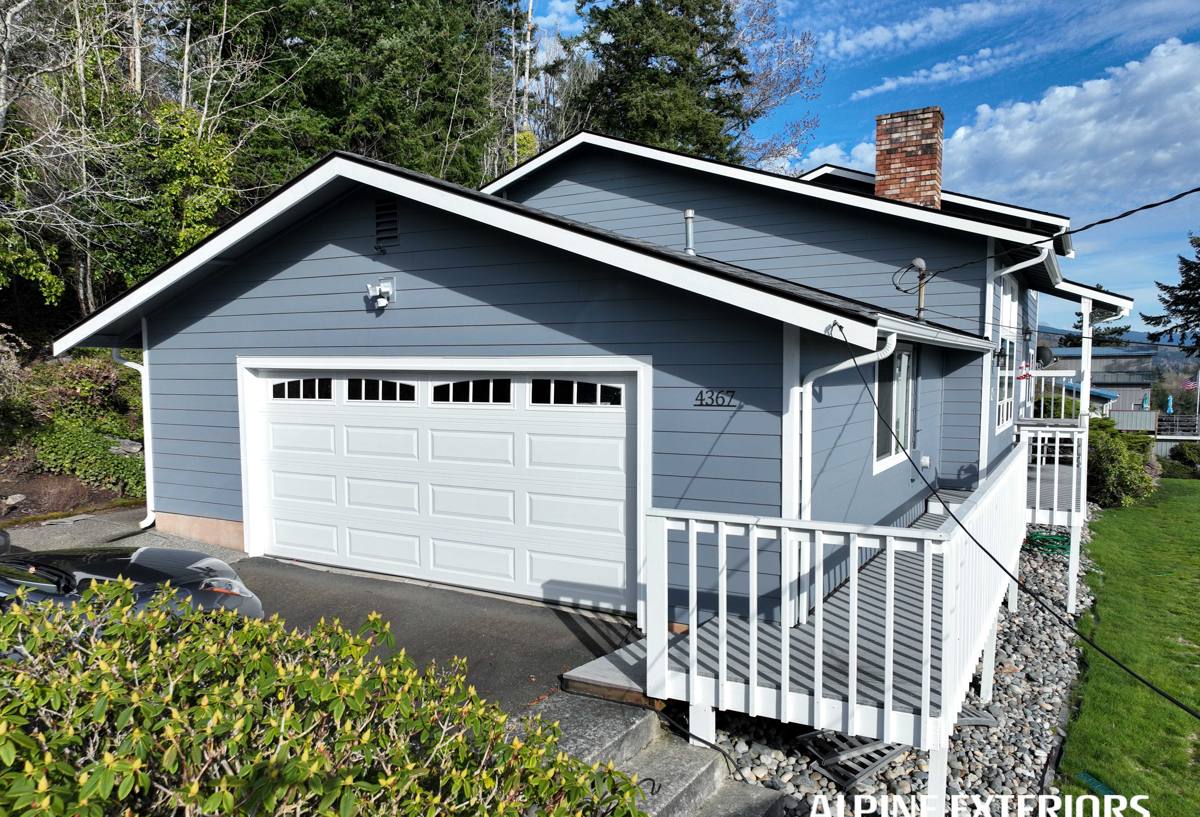
Signs a Meridian Deck Needs Replacing, Not Just Patching
Homeowners often call us wanting a few boards swapped, and sometimes that's genuinely all that's needed. But there's a point where board-by-board repair is just delaying a bigger, more expensive failure. Here's what tells us a full replacement is the honest recommendation:
- Soft or spongy spots underfoot, especially near the house or stair landing
- Rust staining or streaking around fastener heads across multiple boards
- The ledger board (where the deck meets the house) shows dark staining, gaps, or gives when pried gently
- Railing posts that flex or wobble more than a small amount when pushed
- Persistent moss or black-green staining that returns within weeks of cleaning
- Widening or splintering gaps between boards, or boards that cup and hold standing water
- Footings or posts you can visibly see have shifted, tilted, or settled unevenly
Any one of these on its own might be a repair. Two or three together, especially involving the ledger board or framing, usually means the structure underneath has been absorbing moisture longer than the surface has been showing it.
What a Correct Deck Replacement Actually Involves
Ledger Board and Flashing
This is the single most important connection on an attached deck, and it's the one most likely to be done wrong or done cheap. In a climate with this much wind-driven rain, the ledger needs proper flashing that directs water away from the house sheathing, not just a bead of caulk and a hope. We check the house's water-resistive barrier at this connection every time — it's often the actual source of rot people assume is a "deck problem" but is really a wall problem.
Framing and Footings
Joist spacing, beam sizing, and footing depth all need to match the actual load and soil conditions on your lot, not just whatever the last deck used. Footings need to be sized and set below the frost line and on undisturbed or properly compacted soil — this part of the job is invisible once the deck is finished, which is exactly why it's the part most likely to get shortcut by a crew that isn't planning to stand behind the work long-term.
Fasteners and Hardware
In a coastal, salt-air environment, standard galvanized fasteners corrode noticeably faster than they would twenty miles inland. We use stainless steel or high-grade coated fasteners rated for coastal and ground-contact use, along with joist hangers and structural hardware rated for the same exposure. It costs more up front. It's also the difference between hardware that's still solid in fifteen years and hardware that's rust-streaked and weakening in five.
Decking Material and Drainage
Board spacing, airflow underneath the deck, and slope away from the house all affect how fast a surface dries out between rains — which directly affects how much moss and mildew take hold. We set gapping and slope with this climate in mind, not just a generic install spec.
Railings and Stairs
Code requirements exist for a reason, especially guard height and baluster spacing, and they get enforced through inspection. Beyond meeting code, railing posts need solid blocking behind them — a railing that passes inspection today but was fastened into thin decking rather than framing will loosen within a season or two of coastal wind loading.
Choosing Decking Material for Salt Air and Moss
There's no single "best" material for every homeowner — budget, maintenance tolerance, and appearance preference all factor in. What matters is choosing with this specific climate in mind rather than a generic recommendation.
| Material | Moisture & Rot Resistance | Moss/Mildew Resistance | Maintenance | Typical Lifespan |
|---|---|---|---|---|
| Pressure-treated wood | Good if properly sealed and maintained | Needs regular cleaning; moss takes hold in grain and gaps | Annual cleaning, periodic sealing/staining | 10–15 years in this climate |
| Cedar | Naturally decay-resistant, but softer surface holds moisture | Moderate; needs cleaning to prevent staining | Sealing/staining every 1–2 years | 12–20 years with upkeep |
| Composite (capped) | Very good; core resists rot, cap sheds water | Good; smoother surface sheds moss more easily than wood | Occasional wash, no sealing/staining | 25+ years |
| PVC/cellular | Excellent; no organic material to rot | Very good; least prone to moss adhesion | Lowest of all options | 25–30+ years |
For homeowners set on a natural wood look, we'll install it correctly and honestly explain the maintenance schedule it needs to hold up here — that's a fair trade-off, not a flaw in the material. For homeowners who want to spend less time on upkeep and more time using the deck, a capped composite or PVC product generally makes more sense in a salt-air, high-moss environment, and we'll walk through real cost and appearance differences rather than push one option.
Our Deck Replacement Process
- On-site assessment. We look at the ledger connection, framing, footings, and the house's flashing at the attachment point — not just the surface boards — so the estimate reflects what's actually there.
- Honest scope and estimate. You get a clear breakdown of what's structural, what's cosmetic, and what your material options cost, with no pressure to upsell beyond what the deck needs.
- Permitting. Most deck replacements in Whatcom County require a permit, especially anything attached to the house or above a certain height. We handle the paperwork and schedule inspections so it's not on you to figure out.
- Demolition and disposal. Old decking, framing, and hardware are removed and hauled off; we check the house wall behind the ledger for hidden moisture damage before anything new goes up.
- Framing, flashing, and footings. This is the part that determines whether the deck lasts fifteen years or thirty, and it's inspected before decking goes down.
- Decking, railings, and stairs installed to code. Fasteners and hardware are rated for coastal exposure throughout, not just at visible connections.
- Final walkthrough. We go over the finished deck with you, plus a straightforward maintenance rundown for whatever material you chose.
Permits and Code in Whatcom County
Deck replacement isn't always a like-for-like swap in the eyes of the county — depending on the scope, you may need a permit and inspection even if the footprint doesn't change, particularly for anything structural like the ledger, framing, or footings. Guard height and baluster spacing requirements apply regardless of the material you choose. We build to pass inspection the first time, because a failed inspection costs you time and us credibility — neither is worth cutting a corner over.
Why Hiring a Crew That Already Works Meridian Matters
A deck replacement done by a crew unfamiliar with this stretch of Whatcom County tends to make the same mistakes: standard fasteners instead of coastal-rated hardware, flashing details built for a drier climate, and decking gap spacing that doesn't account for how slowly things dry out here. A crew that's worked Meridian and the surrounding Custer area repeatedly already knows which details actually matter locally — the ledger flashing that keeps wind-driven rain out, the fastener grade that won't be rust-streaked in five years, and the board spacing that keeps moss from taking hold as fast. That local knowledge doesn't show up as a line item on an estimate, but it shows up in how the deck performs a decade from now.
Keeping a New Deck Performing Once It's Installed
Even the right materials and correct installation still benefit from basic upkeep in this climate. A rinse or light scrub once or twice a year keeps moss from establishing, especially in shaded corners and under railings where airflow is limited. Check that gutters and downspouts near the deck aren't dumping extra water onto or under it. If you chose wood, keep to the sealing schedule rather than stretching it — it's far cheaper to reseal on time than to replace boards that were left unprotected through a wet winter.
If your deck in Meridian is showing any of the wear signs above, or you'd just like a straight answer on whether it needs replacing or can be repaired, we're happy to take a look. Use the form below to request a free, no-pressure estimate — we'll tell you honestly what we find.