 Custer
 Marietta Sits Right Where the Weather Tests Siding Hardest
Marietta is close enough to open water that homes here take on a version of Whatcom County's climate most inland neighborhoods don't deal with. Salt-laden air moves in off the bay, wind-driven rain hits siding sideways instead of straight down, and the long, gray moss season that defines a Pacific Northwest winter here runs longer than it does even a few miles inland. Siding that isn't built and installed for that combination shows it early: chalky finishes, swollen edges, green-black streaking along shaded walls, and caulk lines that give up years before they should.
We're a Custer-based crew and Marietta is inside our regular service area, not a stretch job we take once and never see again. That matters more than it sounds like it should, because a lot of what separates a siding job that holds up here from one that doesn't isn't the brand on the label — it's whether the person installing it understands what this specific stretch of coastline does to a wall over ten winters.
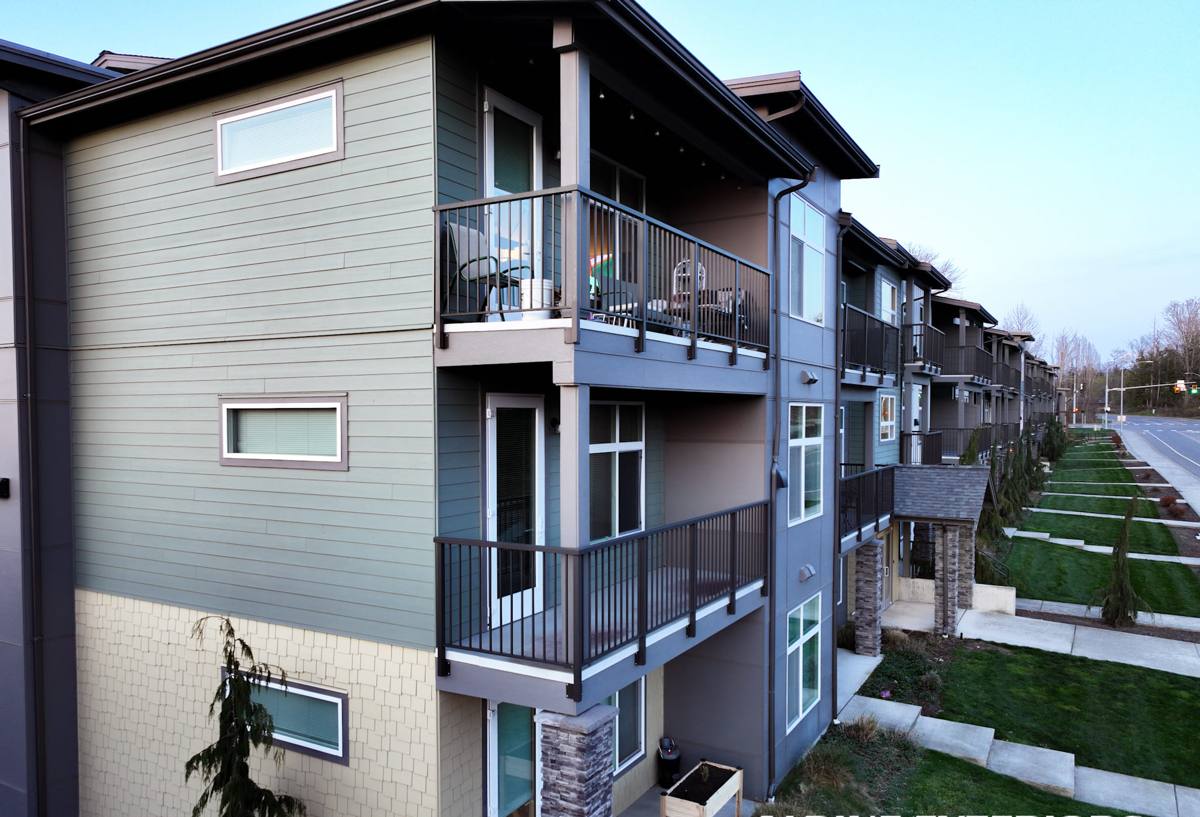
Why We Only Install James Hardie Fiber Cement
We don't install vinyl, LP SmartSide, Cemplank, Allura, primed spruce, or cedar. That's not a marketing line — it's a standard we hold because of jobs we've seen fail in this exact climate. Vinyl expands and contracts hard in temperature swings and gets brittle in cold snaps; wood-based composite panels rely on integrated coatings and sealed edges that are unforgiving of installation mistakes and slow moisture exposure; cedar looks great on day one but demands a maintenance schedule most homeowners can't keep up with once the coastal moss season sets in.
James Hardie fiber cement is cement, sand, and cellulose fiber — it doesn't feed mold or moss the way wood does, it doesn't warp or rot, and it's non-combustible. Hardie also builds region-specific product engineering into its HZ5 line, which is formulated for the wetter, more humid climate zones the Pacific Northwest falls into. That's the version we spec for Marietta and the rest of our Custer-area jobs.
What HZ5 Actually Changes
HZ5 isn't a different look — it's the same plank, lap, and shingle profiles homeowners already recognize, engineered with moisture resistance suited to high-humidity, high-rainfall regions. Combined with the factory-applied ColorPlus finish, which is baked on under controlled conditions rather than field-painted, you get a finish that resists the fading and chalking that salt air and UV accelerate on site-painted siding.
What a Correct Marietta Installation Actually Involves
Hardie siding is only as good as the water management behind it. In a low-lying, marine-influenced area like this, that's not a small detail — it's the difference between siding that lasts three decades and siding that traps moisture behind the wall within five years.
Flashing and Drainage Come First
Before a single plank goes up, we're looking at window and door flashing, house wrap integrity, and a proper drainage plane. Fiber cement siding needs a way for incidental moisture to get out from behind it, especially on walls that take the brunt of wind-driven rain. We install with a rainscreen or ventilated gap where the wall assembly calls for it, not because it's optional in this climate — because it's the single biggest factor in whether the assembly stays dry.
Fastening and Clearances
Hardie specifies exact nailing patterns, fastener types, and clearances above grade, decks, and roof lines — and those specs exist for a reason. Too little clearance above a walkway or roof surface lets splash-back and standing moisture sit against the bottom edge of the siding, which is exactly the kind of slow damage that's hard to spot until a board starts failing. We hold those clearances on every job, not just the ones where it's convenient.
Joints, Caulking, and Color Match
Every butt joint, corner, and penetration gets sealed with a caulk formulated to move with the material and matched to the ColorPlus finish so seams don't stand out as a different shade in five years. Sloppy caulk work is one of the most common shortcuts we see on re-siding jobs we're called in to fix — it looks fine at handoff and fails quietly over a couple of winters.
Our Process for a Marietta Project
- On-site walk and assessment — we look at your current siding, wall assembly, moisture history, and any problem areas (north-facing walls, low clearances, shaded corners prone to moss) before quoting anything.
- Scope and product selection — plank profile, exposure, and color are chosen based on your home's exposure and how it sits relative to prevailing wind and rain direction.
- Tear-off and wall inspection — old siding comes off and we inspect sheathing and house wrap for hidden rot or moisture damage before closing anything back up.
- House wrap, flashing, and rainscreen installation — the water management layer goes in correctly, every time, regardless of whether it's visible in the finished product.
- Hardie installation to manufacturer spec — correct fastening, clearances, and joint treatment throughout.
- Final walkthrough — we go over caulking, trim, and finish details with you before calling the job done.
How Product Choices Compare in Marietta's Climate
| Material | Salt Air Behavior | Moisture/Moss Resistance | Typical Maintenance |
|---|---|---|---|
| James Hardie (HZ5, ColorPlus) | Factory finish resists fading and chalking | Fiber cement doesn't feed mold/moss growth | Occasional wash; no repainting cycle needed |
| Vinyl | Can become brittle with UV and temperature cycling | Doesn't rot, but seams and gaps can trap moisture | Low, but prone to cracking/warping over time |
| LP SmartSide / wood composite | Coating wears; edges vulnerable if not sealed | Engineered wood is moisture-sensitive at cut edges and seams | Edge sealing and coating touch-up over time |
| Cedar | Natural material, weathers and grays without upkeep | Feeds moss/mildew readily in wet, shaded conditions | Regular staining/sealing on a recurring schedule |
What Drives Cost on a Marietta Siding Job
Every home is different, but the same handful of factors move the price up or down on most jobs we quote in this area.
| Factor | Why It Matters Here |
|---|---|
| Wall exposure | Sides facing prevailing wind and rain need more attention to flashing and drainage detail |
| Existing wall condition | Hidden moisture damage found at tear-off adds repair scope before new siding goes on |
| Home size and complexity | Corners, dormers, and trim detail all add labor beyond flat wall square footage |
| Plank profile and exposure width | Different lap widths and textures carry different material costs |
| Access and site conditions | Setbacks, landscaping, and staging area affect labor time |
We give a written estimate after the walk-through, broken down clearly enough that you know what you're paying for — not a one-line number.
Living With Hardie Siding in a Marine Climate
One of the real advantages of switching to James Hardie in an area like Marietta is how little upkeep it demands compared to wood or site-painted alternatives. That doesn't mean zero maintenance — it means the maintenance that matters is simple and infrequent.
- Rinse siding down once or twice a year to clear salt residue and organic buildup, especially on shaded or north-facing walls
- Keep gutters clear so overflow doesn't run down the face of the siding repeatedly during heavy rain
- Trim back vegetation and landscaping that holds moisture against lower courses
- Check caulk lines at joints and trim every couple of years and have any gaps resealed before winter
- Watch for moss or algae starting in shaded corners and address it early rather than letting it establish
Because ColorPlus is factory-applied, you're not on a repainting schedule the way you would be with site-finished materials — that alone removes one of the biggest recurring costs of siding ownership in a wet climate.
Why a Crew That Already Works Marietta Matters
Whatcom County's coastal edge isn't uniform — a wall that needs a rainscreen gap on one property might get by without one a mile inland, and knowing which is which comes from having actually worked on homes in this specific stretch, not from a general installation manual. Working out of Custer means we're not learning this area's wind exposure, drainage patterns, and moss pressure for the first time on your house. We've already made the adjustments this coastline calls for on other jobs nearby, and we bring that experience to every estimate and every install here.
It also means we're not disappearing after the invoice clears. If a caulk line needs a look in year four or you have a question about a section that's picking up moss faster than the rest of the house, you're calling a crew that's local and still working in your neighborhood — not chasing down an installer who did one job in the area and moved on.
If you're considering new siding for a home in Marietta or anywhere else in the Custer service area, we'll walk the property, look at how your home is actually exposed to the weather, and give you a straightforward, no-pressure estimate for a correctly installed James Hardie system — just fill out the form below to get started.