 Custer
 Siding Installation Built for Lynden's Climate
Homes in and around Lynden sit in one of the wetter, greener corners of Washington. Whatcom County gets a steady diet of driving rain off the Pacific, cool damp air that lingers for months at a time, and a moss season that can start creeping across north-facing walls before winter even settles in. Add in the salt-tinged air that moves inland from the Strait of Georgia and the Puget Sound lowlands, and you have a climate that is genuinely hard on exterior siding — not because any single storm is dramatic, but because the moisture never really stops.
Siding installation in this area is not the same job as siding installation in a dry inland climate. The material has to shed water reliably, resist swelling and rot at every seam, and hold its finish through months of grey, damp weather without feeding the moss and algae that thrive here. Get the product or the installation wrong, and problems show up slowly — a soft spot behind a downspout, a stretch of siding that stays damp two days after everyone else's yard has dried out, moss lines that keep coming back no matter how many times you scrub them off. This page covers what a correct siding installation looks like for a Lynden-area home, and why we only install one product system to do it.
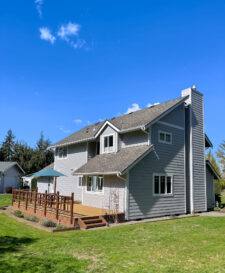
What Correct Installation Actually Involves
Siding is a system, not a single product. The board or panel on the outside is only as good as everything behind it. A correct installation in this climate means getting several layers right, in the right order, every time:
- Weather-resistive barrier: a properly lapped and sealed water/air barrier behind the siding, installed so water is directed out and down, never trapped.
- Flashing at every penetration: windows, doors, hose bibs, light fixtures, and vents all need flashing detailed so water can't work its way behind the cladding.
- Rainscreen gap or drainage plane: a small air space behind the siding lets any moisture that does get in dry out instead of sitting against the sheathing.
- Correct fastening: nail placement, spacing, and depth matter more with fiber cement than with lighter materials — over-driven or under-driven fasteners are a common source of long-term problems.
- Proper joints and caulking: butt joints, corners, and trim need to be sealed with products rated for exterior movement and UV exposure, not general-purpose caulk.
Skip or rush any one of these steps and the siding itself almost doesn't matter — water will find the gap. This is why we treat installation quality as equal in importance to the product choice, and why we don't subcontract the work out to whoever is available that week.
Why We Install James Hardie — and Nothing Else
We are a James Hardie-only contractor. We don't install vinyl, LP SmartSide, Cemplank, Allura, primed spruce, or cedar, and that's a deliberate standard, not a lack of options. Here's the honest reasoning:
Fiber cement is a blend of cement, sand, and cellulose fibers, engineered to be dimensionally stable in wet-dry cycles. Unlike wood-based products, it doesn't absorb water into its core and swell, which matters enormously in a climate where siding can stay damp for days at a stretch. Unlike vinyl, it's non-combustible and holds its shape in heat rather than warping or melting. James Hardie also builds region-specific "HZ" formulations engineered for moisture-heavy climates like the Pacific Northwest, which is a level of climate-specific engineering most competing products don't offer.
The factory-applied ColorPlus finish is another piece of it. Field-painted siding — and that includes primed wood and some fiber cement competitors — depends on the installer's paint job holding up outdoors for years. ColorPlus is baked on at the factory under controlled conditions, backed by its own finish warranty, and it resists the fading and peeling that shows up fastest on south- and west-facing walls here. Combined with Hardie's transferable product warranty, it gives homeowners a longer, more predictable service life with less maintenance — which is the whole point of re-siding a house in a climate like this one.
None of this means other products are junk. Vinyl is inexpensive and easy to install. Cedar looks great when it's new. Primed wood is familiar and affordable up front. But each comes with a real trade-off — vinyl's brittleness and seams, cedar's ongoing maintenance and moisture sensitivity, primed wood's dependence on paint upkeep — that we're not willing to install on a home in this climate and stand behind for the long term. That's why James Hardie is the only system we put on houses.
How Siding Options Compare in a Whatcom County Climate
| Material | Moisture behavior | Maintenance | Typical lifespan here |
|---|---|---|---|
| James Hardie fiber cement | Dimensionally stable; engineered HZ lines for wet climates | Low — factory finish, occasional wash | 30+ years with correct install |
| Vinyl | Doesn't absorb water but can trap moisture behind it if not vented properly; brittle in cold | Low, but color fades and panels can warp | 15–25 years |
| Cedar | Absorbs and releases moisture constantly; prone to rot without upkeep | High — refinishing every few years | 15–25 years with diligent maintenance |
| Primed spruce/wood composite | Vulnerable at cut edges and seams if primer/paint isn't perfect | Moderate to high — paint upkeep required | 10–20 years |
These are general ranges, not guarantees — actual lifespan always depends on installation quality, orientation, and upkeep. But the pattern holds across the region: materials that resist moisture at the core, rather than relying on a surface coating to keep water out, hold up better through a Whatcom County winter after Whatcom County winter.
Signs a Lynden-Area Home Needs New Siding
Because moisture damage develops slowly, homeowners often live with early warning signs for a while before calling anyone. Common signs we see on homes in this area include:
- Persistent moss or algae streaking that returns within weeks of cleaning
- Soft or spongy spots when you press on the siding, especially near the ground or below windows
- Paint that's peeling, bubbling, or chalking faster than the rest of the house
- Visible gaps, warping, or cupping in wood or composite boards
- Rising energy bills that suggest the wall assembly behind the siding isn't performing
- Musty smells or discoloration on interior walls near exterior corners
Any one of these on its own isn't necessarily an emergency, but they're worth a proper inspection rather than a quick patch. In this climate, small gaps rarely stay small.
Our Installation Process
1. On-site assessment
We walk the exterior, check for existing moisture damage, evaluate the current water/air barrier where accessible, and look at drainage around the foundation and roofline — all of which affect how the new siding will perform.
2. Tear-off and sheathing check
Old siding comes off and the sheathing underneath gets inspected. Any rot, soft spots, or damaged sheathing is addressed before anything new goes up — covering a problem instead of fixing it just moves the failure a few years down the road.
3. Weather barrier and rainscreen
A new weather-resistive barrier is installed and properly lapped, with a rainscreen gap where the assembly calls for it, so any moisture that does get behind the siding has somewhere to go.
4. Flashing details
Every window, door, and penetration gets flashed correctly — this is where most long-term leaks originate if it's rushed, and it's the step we spend the most care on.
5. James Hardie installation to spec
Boards or panels are installed following James Hardie's fastening, clearance, and joint specifications, which is also what keeps the manufacturer warranty intact.
6. Final walkthrough
We review the finished job with the homeowner, point out anything worth knowing for future maintenance, and confirm everything is sealed and finished cleanly.
What Drives the Cost of a Siding Job in This Area
| Factor | Why it matters here |
|---|---|
| Extent of hidden damage | Rot or moisture damage found during tear-off adds repair scope before new siding goes up |
| Home size and wall complexity | More corners, dormers, and trim details mean more flashing and cutting labor |
| Siding profile and color | Lap width, texture, and ColorPlus color selection affect material cost |
| Access and site conditions | Tight lots, slopes, or landscaping close to the house can add labor time |
| Trim and detail work | Window trim, corner boards, and fascia work are often bundled with a full re-side |
We don't quote broad numbers on a page like this because every home is different — but we'll walk your property and give you a clear, itemized estimate before any work starts.
What to Ask Before Hiring a Siding Contractor
- Are they a certified/factory-trained installer for the product they're proposing?
- Will they inspect and repair sheathing damage before installing new siding, not just cover it?
- Do they detail flashing at every window, door, and penetration — and can they explain how?
- Is a rainscreen or drainage gap part of their standard installation, not an upcharge?
- Do they carry current liability insurance and workers' comp coverage?
- Will the manufacturer's warranty stay valid based on how they install the product?
- Do they have experience with homes in this specific climate, not just siding in general?
Why a Crew That Already Works This Area Matters
Siding failures in Whatcom County rarely come from one bad decision — they come from a dozen small details that don't account for how much moisture the wall assembly has to manage year-round. A crew that installs siding across many different climates might do fine work in general and still miss the details that matter specifically here: how aggressively to vent a rainscreen, how much clearance to leave at grade given how wet the ground stays, or which orientations on a given lot need extra attention for moss and algae. Working this area regularly means those decisions aren't guesswork — they're habit, built from doing the same job, in the same climate, over and over.
It also means being reachable after the job is done. Siding is a long-term investment, and a local crew is the one who's still around in five or ten years if a question comes up about maintenance, a warranty item, or a repair after a storm.
Get an Estimate for Your Lynden-Area Home
If your siding is showing its age — or you're planning ahead before it becomes a bigger problem — we're happy to take a look. We'll assess your home's specific exposure, walk you through what a correct James Hardie installation involves for your property, and give you a straightforward, no-pressure estimate. Fill out the form below to get started.