 Custer
 Building Decks for the Nooksack Area, Not Just Near It
Nooksack sits inland from the coast but still catches the same weather pattern that defines exterior work across this part of Whatcom County: salt-tinged air pushed in off the Salish Sea, rain that arrives sideways more often than straight down, and long stretches of the year where shaded surfaces simply don't dry out. A deck built here isn't a summer furniture platform. It's an outdoor structure that spends most months of the year wet, and it needs to be engineered and built with that reality in mind from the footings up.
We work this specific area regularly, which matters more for deck building than most homeowners expect. A crew that only sees a property once, for one job, tends to build to a generic standard and move on. A crew that keeps coming back to the same roads and the same soil conditions learns which lots drain fast and which stay soggy through spring, which tree lines throw shade that never fully lifts, and which fastener and flashing details actually hold up here versus which ones look fine on install day and fail in year four.
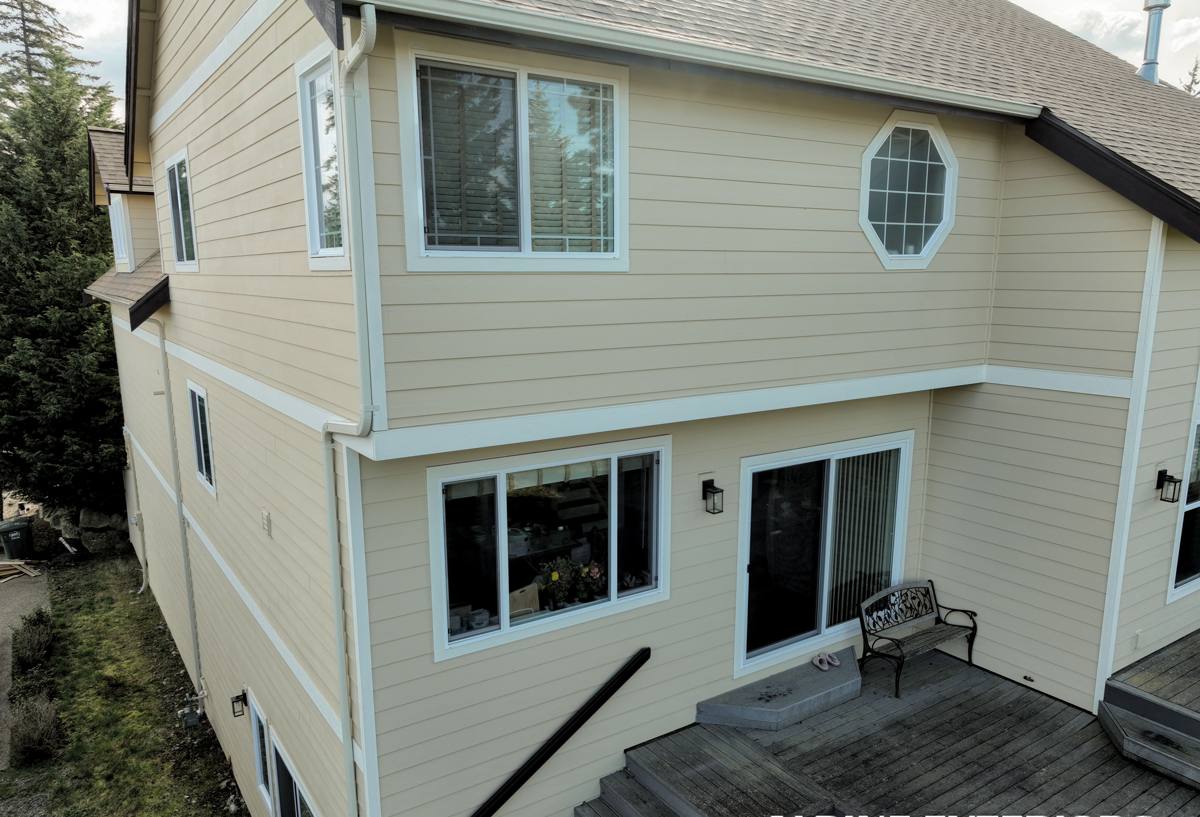
What Nooksack's Climate Actually Does to a Deck
Driving Rain and Ledger Connections
Most deck failures don't start with the decking boards — they start at the ledger board, where the deck attaches to the house. Driving rain pushed by wind doesn't just fall on a deck, it gets forced sideways into any gap at that connection point. Without correct flashing and a proper water-resistive barrier detail behind the ledger, moisture works its way into the rim joist and wall framing over years, often invisibly, until rot shows up as soft or spongy decking near the house or a deck that's developed a subtle lean.
Salt Air and Metal Hardware
Salt-laden air doesn't stay at the coastline — it travels inland on winter storms and settles on any exposed metal. Standard galvanized fasteners and hardware corrode faster in this environment than product literature written for a dry inland climate would suggest. Hangers, hidden fasteners, bolts, and structural screws all need to be rated for the exposure they'll actually see here, not just the minimum code requirement for a generic build.
Moss, Shade, and Standing Moisture
A long moss season is as much about shade and airflow as it is about rainfall totals. Decks tucked under tree cover or built tight against a house wall with poor airflow underneath stay damp far longer after a storm than an open, well-ventilated deck does. That extended dampness is exactly what moss, algae, and eventually rot need to take hold — on the decking surface, in board gaps, and in the framing below if the substructure isn't built to shed water and dry out between rain events.
What a Correctly Built Deck Looks Like Out Here
A deck that's going to hold up around Nooksack for its full service life isn't built differently in any exotic way — it's built to the same fundamentals every deck should follow, just without the shortcuts that a drier climate might forgive.
- Footings sized and set below frost depth per Whatcom County code, on soil that's been checked for drainage, not just eyeballed
- A properly flashed ledger connection with a water-resistive barrier detail and flashing that directs water away from the house framing, not just a caulked-over lag bolt line
- Structural hardware — joist hangers, post bases, structural screws — rated for the corrosive exposure this area actually sees
- Board spacing and joist layout that allow for real airflow and drainage underneath, not tight, trapped gaps that hold moisture
- Decking material choice matched to the site's actual sun and shade exposure, since a heavily shaded deck has different moisture demands than an open one
- Stair and railing connections built to the same moisture-resistant standard as the deck itself, since these get overlooked more than any other component
Decking Material Options for This Climate
There isn't one universally correct decking material — there's a correct material for a given site's shade, budget, and maintenance appetite. Here's how the common options actually compare for a property in this area.
| Material | Moisture Behavior Here | Maintenance Demand | Typical Lifespan |
|---|---|---|---|
| Pressure-treated lumber | Absorbs and releases moisture; needs a functioning finish to resist checking and warping | Regular — sealing or staining every 1–3 years | 15–25 years with upkeep |
| Cedar | Naturally moisture-resistant but still a wood product; shaded boards hold dampness longer | Moderate to high — periodic cleaning and refinishing | 15–20 years with upkeep |
| Composite decking | Doesn't absorb water like solid wood, but shaded boards still need airflow underneath to shed moisture and resist surface growth | Low — occasional cleaning, no sealing or staining | 25–30+ years, manufacturer-dependent |
| PVC decking | Fully moisture-resistant surface; performs consistently regardless of sun exposure | Lowest — cleaning only | 25–30+ years |
Composite and PVC decking generally make the most sense for shaded, tree-covered lots in this area simply because they remove the ongoing moisture-and-finish maintenance cycle that solid wood demands in a climate that doesn't give wood much chance to dry out. That said, a well-built and consistently maintained wood deck can still perform well here — it just asks more of the homeowner over time, and we'll say so plainly rather than push a product that doesn't fit how a homeowner actually wants to spend their weekends.
What We Don't Recommend for Deep-Shade Lots
On heavily shaded properties with limited afternoon sun, we generally steer homeowners away from lower-grade composite products with minimal cap-stock protection. It's not that the material fails outright — it's that thinner-cap composites can be more prone to surface moisture retention and staining in low-airflow, low-sun conditions, which shows up faster on a shaded Nooksack lot than it would on an open, sun-exposed deck elsewhere. That's a maintenance and appearance trade-off worth understanding before material is ordered, not after.
Framing and Substructure — Where Most Long-Term Problems Start
The decking surface is what a homeowner sees and touches, but the substructure underneath is what determines whether the deck is still sound in fifteen years. Joists, beams, and posts need to be sized correctly for the span and load, connected with hardware rated for this climate's corrosion exposure, and laid out to allow water to actually drain and airflow to actually move underneath the deck. On sloped or poorly draining lots, that sometimes means adjusting post height or grading near the footings so water doesn't pool against posts or under low-clearance framing after a storm.
We also pay close attention to joist hanger installation specifically, because it's one of the most common places we find shortcuts on decks we're called to repair or replace — hangers nailed with the wrong fastener type, installed at the wrong angle, or simply under-nailed. It's not visible once the decking goes down, and it's exactly the kind of detail that only shows up as a problem years later, often as a soft or bouncy spot in the deck.
How Our Process Works
1. On-Site Assessment
We walk the actual property — checking sun and shade exposure, drainage patterns, existing structure condition if this is a rebuild or repair, and the ledger connection point at the house. This is where site-specific decisions about material and framing get made, not guessed at from a phone call.
2. Design and Permitting
Deck size, layout, footing placement, and structural details get worked out based on the site conditions, and we handle the permitting process with Whatcom County so the finished structure is inspected and code-compliant, not something that creates problems at resale.
3. Footings and Framing
Footings go in below frost depth on properly assessed soil, and framing goes up with corrosion-rated hardware and connections built for this area's moisture exposure, including correct ledger flashing at the house.
4. Decking, Railing, and Stairs
Decking material — whichever option fits the site and the homeowner's maintenance preference — goes down with spacing that allows drainage and airflow, and railing and stair connections are built to the same standard as the rest of the structure.
5. Final Walkthrough
We walk the finished deck with the homeowner, cover basic maintenance expectations for whatever material was used, and make sure everything meets the standard we'd want on our own property.
Why It Matters That We Already Work Nooksack
A deck built by a crew unfamiliar with this specific area is still likely to follow code — but code is a minimum, not a guarantee of long-term performance in a difficult climate. A crew that already works Nooksack and the surrounding Custer area knows which lots have drainage issues before the first shovel goes in, has already seen which hardware and flashing details hold up through a full wet season here and which don't, and isn't learning this area's climate behavior on your project. That familiarity shows up years later as a deck that's still solid, not one that needed a warranty call.
It also matters for accountability. A local crew is easy to reach if a question comes up two years after the build, and has a reputation in this specific community worth protecting — not just a review score from a job three counties away.
Maintaining a Deck in This Climate
Whatever material you choose, a few habits go a long way in an area with this much sustained moisture and moss pressure:
- Clear leaves and debris from board gaps regularly, especially on shaded decks where organic buildup holds moisture against the surface
- Check and clean any drainage channels or gaps at the ledger and framing so water isn't pooling against the house
- Inspect railing and stair connections annually for looseness, since these see repeated stress and are easy to overlook
- Clean moss and algae gently rather than pressure-washing aggressively, which can force water into board seams or damage a finish
- For wood decks, keep the sealing or staining schedule on track — gaps in that schedule are when moisture damage gets a foothold
If you're planning a new deck, a rebuild, or a repair on a property in Nooksack or elsewhere around Custer, we're happy to walk the site and give you a straight read on what it needs and what it'll cost. Reach out using the form below for a free, no-pressure estimate.
```