 Custer
 Point Roberts Is a Different Climate Than "Just Coastal Whatcom County"
Point Roberts sits on the tip of a peninsula, surrounded on three sides by water, cut off from the rest of Whatcom County by the international border. That geography matters for siding. Homes here take on salt-laden air off Boundary Bay and the Strait of Georgia almost year-round, get hit with driving, wind-blown rain instead of the softer vertical rain more common a few miles inland, and sit under tree canopy and marine humidity that keeps north- and west-facing walls damp long after a storm passes. That combination — salt, wind-driven moisture, and shade-fed moss — is harder on exterior materials than a typical Whatcom County lot, and it shows up fastest on whatever's cladding the house.
We're not guessing at this from a spec sheet. Custer Siding works Point Roberts regularly, and the patterns repeat: siding failing first at corners and butt joints where wind-driven rain gets pushed hardest, moss colonizing shaded siding faces and holding moisture against the substrate, and fasteners or trim corroding faster than they would on a drier, more sheltered lot. None of that is unusual for the location — it's just what the environment does to a home's exterior, and it's exactly what the siding system and the installation need to be built to handle.
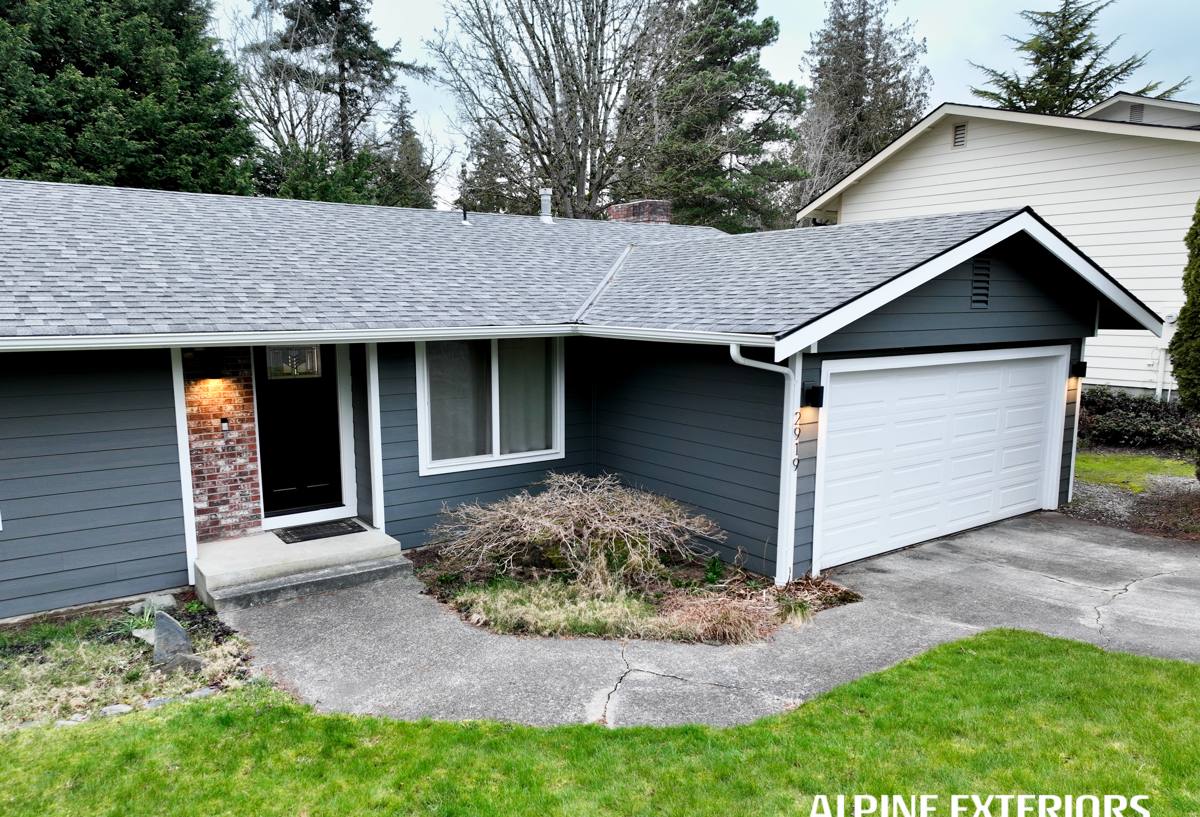
Why We Only Install James Hardie Here
We don't install vinyl, LP SmartSide, primed spruce, cedar, or other fiber cement brands, and Point Roberts is one of the clearer examples of why. Vinyl softens, warps, and becomes brittle under sustained UV and temperature swings, and its seams give wind-driven salt spray an easy path behind the panel. Wood siding — cedar or primed spruce — needs a maintenance schedule (recoating, caulking, moss treatment) that most homeowners can't keep up with in a marine climate, and once moisture gets past a compromised coating, wood rot moves fast in a location that stays damp this much of the year. LP SmartSide is an engineered wood product, which means it shares wood's core vulnerability: if the factory coating or field-applied paint fails at a cut edge, fastener hole, or joint, moisture gets into the wood strand core and the clock starts.
James Hardie fiber cement is non-combustible cement, sand, and cellulose fiber — it doesn't rot, it doesn't attract insects, and it doesn't rely on an intact paint film to keep water out of a wood substrate. The ColorPlus factory finish is baked on under controlled conditions and backed by a real finish warranty, which matters in a location where field-applied paint gets less of a chance to cure properly given the humidity. That's the whole reason we standardized on one product line instead of offering a menu of options — we'd rather install the one system we trust on every home than sell a homeowner something we know will need more attention than they're likely to give it.
HZ5 Versus Standard HardiePlank
James Hardie engineers its HZ (HardieZone) product lines by climate zone, and Point Roberts falls into the wetter, harsher end of that spectrum. HZ5 is formulated with moisture and freeze-thaw resistance suited to the Pacific Northwest's wet winters and salt exposure, which is a meaningfully different product than the HZ10 line built for hot, dry, termite-prone regions of the country. Installing the wrong HZ line, or installing correctly-specified material with the wrong flashing and clearances, is how you end up with a product that's rated for the climate on paper but not performing that way on the wall.
What a Correct Install Involves on a Point Roberts Home
The material is only half the equation. Most siding failures we see — on any brand, not just Hardie — trace back to installation shortcuts, not the product itself. On a marine-exposed home, a few details matter more than they would somewhere drier:
- Weather-resistive barrier installed continuously and lapped correctly, with all penetrations (vents, hose bibs, light fixtures) properly flashed before siding goes on.
- Ground clearance — Hardie specifies a minimum clearance from grade, decks, and roof lines. On low-lying or damp Point Roberts lots, we don't treat that minimum as optional.
- Cut edges sealed — every field cut needs to be primed and painted before installation, not left raw. A raw cut edge exposed to driving rain is where moisture starts working into fiber cement.
- Fastener spacing and type — corrosion-resistant fasteners driven per Hardie's schedule, not gunned in wherever's convenient, especially given the salt content in the air here.
- Butt joint and corner detailing — the exact spots we see wind-driven rain attack hardest on older siding jobs. Proper caulking, flashing, or Z-flashing behind joints keeps water from getting behind the plane of the wall.
- Rainscreen or drainage gap where conditions call for it, giving any incidental moisture a way to drain and the wall a chance to dry instead of staying saturated.
Skip any one of these and you can end up with a Hardie install that still fails early — which is why the installer matters as much as the product line you choose.
The Logistics of Getting a Crew to Point Roberts
Point Roberts is a U.S. exclave — the practical route in from the rest of Whatcom County runs through Canada. That's not a small detail for a siding job. It affects scheduling, material delivery, and how realistic it is for a contractor to show up for a punch-list item or a warranty callback without treating it as a special trip. A crew that doesn't already work the peninsula regularly has to build border logistics into every visit, which tends to show up as delays, rescheduled days, or corners cut to minimize trips. We already run jobs in Point Roberts, so material staging, scheduling, and follow-up visits are built into how we plan the work — not an afterthought.
Our Process, Start to Finish
- Walkthrough and assessment — we look at current siding condition, moisture staining, moss patterns, trim and flashing condition, and note which elevations are taking the worst weather exposure.
- Written estimate — HZ5 HardiePlank or panel selection, trim package, color, and a clear scope of what's included: house wrap, flashing, fastening, and cleanup.
- Material staging — factoring in the exclave logistics so the job isn't waiting on a delivery that has to cross the border twice.
- Tear-off and substrate check — removing old siding is when hidden moisture damage shows up; we address any rot or sheathing issues before new material goes up, not after.
- Weather barrier and flashing — the step that determines how the wall performs for the next 30-plus years, done before a single piece of siding is hung.
- Installation to spec — clearances, fastening, sealed cut edges, and joint detailing as described above.
- Final walkthrough — checking caulk lines, touch-up paint at any field cuts, and confirming everything meets Hardie's installation requirements for warranty coverage.
What Drives Cost on a Job Like This
| Factor | Why It Matters in Point Roberts |
|---|---|
| Home size and elevation count | More wall area and more corners/joints means more detailing where wind-driven rain is the biggest risk. |
| Substrate condition | Marine humidity and past moisture intrusion sometimes mean sheathing repair is needed before siding goes on. |
| Trim and accessory scope | Corner boards, window trim, and fascia detailing add labor but are where a lot of water intrusion starts if skipped. |
| Product line and profile | HZ5 plank versus panel siding, lap width, and texture all affect material cost. |
| Access and logistics | Exclave delivery and scheduling factor into project timeline, though we plan around this rather than passing it on as surprise cost. |
We'll walk through actual numbers for your home during the estimate — broad ranges without seeing the house aren't useful to you, and we'd rather give you a real figure than a marketing number.
Living With Hardie Siding in a Salt-Air, Moss-Prone Climate
Fiber cement doesn't rot or feed moss the way wood does, but nothing is maintenance-free in this environment. A short annual routine keeps a correctly installed Hardie exterior performing the way it's built to:
- Rinse siding once or twice a year to clear salt residue, especially on elevations facing open water.
- Keep gutters clear so overflow doesn't run down the wall face and feed moss growth.
- Trim back vegetation and tree limbs that shade siding and keep it from drying out after rain.
- Check caulk lines at trim and joints every year or two and re-caulk if it's cracked or pulling away.
- Address any moss growth early with a gentle wash rather than letting it establish and hold moisture against the surface.
Why a Local Point Roberts Crew Is the Right Call
A siding job is only as good as the details nobody sees once it's painted — the flashing behind the J-channel, the clearance at the base of the wall, the sealed cut edge at every corner. Those are the details that either hold up to years of Whatcom County storms and salt air or fail quietly until a homeowner notices staining or soft trim. Hiring a crew that already understands Point Roberts' exposure, already plans around its logistics, and only installs one product system it stands behind is how you get a siding job built for the location it's actually on — not a generic install that happens to be in Point Roberts.
If you're weighing a siding project on your Point Roberts home, we're glad to come take a look and give you a straightforward, no-pressure estimate — use the form below to get started.