 Custer
 Why Nooksack Siding Has to Work Harder
Homes around Nooksack sit in a tough spot climate-wise. You're close enough to the water to pick up salt-laden air off the Strait of Georgia and Semiahmoo Bay, far enough inland to catch the wind-driven rain that rolls off the Cascades foothills, and shaded enough by the region's tree cover to grow moss on just about anything that stays damp for more than a few days. That combination — salt, moisture, and shade — is a harder test for exterior siding than most of western Washington sees, and it's why so many homes in this part of Whatcom County show premature paint failure, swollen trim, and green-black staining on siding that's barely a decade old.
Fiber cement siding, installed correctly, handles all three of those stressors better than almost any other cladding option on the market. But "installed correctly" is doing a lot of work in that sentence. A lot of siding failure we see in this area isn't a material problem — it's a detailing problem. Wrong fasteners, missed flashing, tight-butted joints with no room to breathe. We'll walk through what actually matters for a Nooksack-area home below.
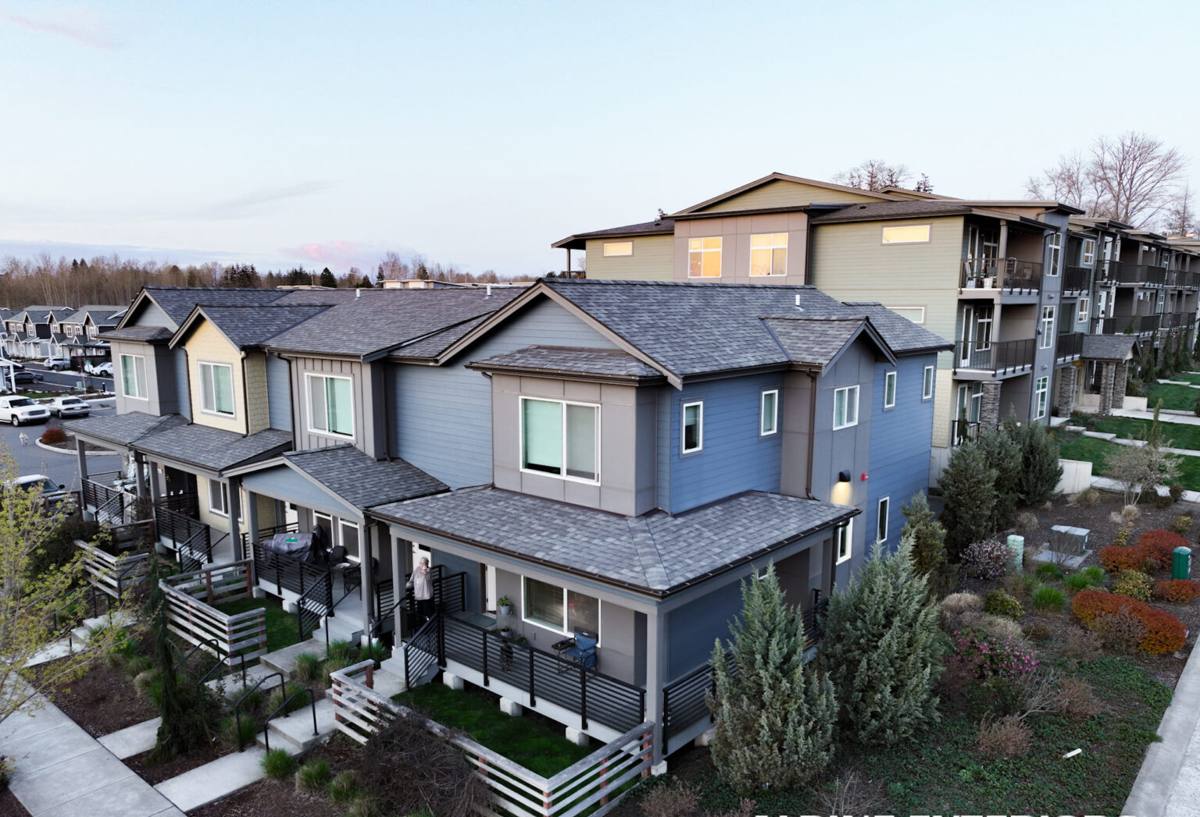
What Nooksack's Climate Actually Does to Siding
Salt Air and Metal Fasteners
Salt in the air accelerates corrosion on anything metal — nail heads, trim flashing, hose bib penetrations. Once a fastener starts to rust, it weeps down the face of the siding and stains it, and eventually it loses holding strength. This matters more the closer a home sits to open water or exposed wind corridors, but even a few miles inland, Whatcom County's marine air reaches most properties to some degree.
Driving Rain and Wind-Loaded Walls
Rain that falls straight down is relatively easy to shed. Rain that comes in sideways — which is the norm here for a good chunk of the year — gets pushed up under laps, into seams, and behind poorly caulked trim. A wall assembly built for driving rain needs a real drainage plane behind the siding, not just water-resistant siding face.
Moss, Shade, and Prolonged Dampness
Moss doesn't damage siding directly, but it holds moisture against the surface far longer than open air would, which is exactly what accelerates rot in wood-based products and paint failure in anything with a weak factory finish. Homes with mature tree cover or north-facing walls that rarely see direct sun are the most exposed to this.
Why We Install James Hardie and Nothing Else
We standardized on James Hardie fiber cement siding for every job we take on, including here in Nooksack, and we don't install vinyl, LP SmartSide, primed spruce, cedar, or off-brand fiber cement like Cemplank or Allura. That's not a marketing position — it's a decision based on what actually holds up in this climate over decades, not just years.
- Non-combustible core — fiber cement doesn't feed a fire the way wood-based products can, which matters for insurance and for peace of mind.
- ColorPlus factory finish — baked-on, not field-applied, so it resists the fading and chalking that hits site-painted siding hardest in coastal, high-UV-cycling climates.
- Engineered for moisture — Hardie's HZ5 product line is formulated specifically for climates that see freeze-thaw cycling and sustained wet weather, which describes Whatcom County well.
- Dimensionally stable — it doesn't swell, cup, or split the way wood and wood-composite sidings can when they take on repeated moisture.
- Real transferable warranty — backed by the manufacturer, not just the installer, and it stays with the house if it sells.
Other products get some of this right. Vinyl is cheap and low-maintenance but it's a petroleum product that can warp in direct heat reflection and it isn't rated for the same wind and impact resistance. LP SmartSide is a wood-strand product — better than raw cedar in some respects, but still wood-based, which means it's more vulnerable to the sustained dampness that's common here if a detail is ever missed. Cedar and primed spruce look great on day one but demand a maintenance schedule most homeowners don't keep up with, and once the finish fails, moisture gets into real wood fast. We'd rather put one product on every house and stand behind it fully than offer five options and hope the cheaper ones hold up.
What a Correct Fiber Cement Job Looks Like Here
The Drainage Plane Comes First
Before a single piece of siding goes up, the wall needs a continuous water-resistive barrier with properly lapped and taped seams, and a rainscreen gap where the wall assembly calls for one. This is what actually protects the sheathing behind the siding — the siding itself is the second line of defense, not the only one.
Flashing at Every Penetration
Windows, doors, hose bibs, light fixtures, deck ledgers — every point where something interrupts the wall plane is a place water can get behind the siding if it isn't flashed correctly. In a driving-rain climate, this is where most long-term failures start, and it's the detail that separates a fast job from a correct one.
Fastener and Gap Spec
James Hardie has published fastening and clearance specifications for a reason — correct nail placement, minimum gaps at butt joints, and proper clearance from grade, roofing, and decking all affect how the siding performs over 20-plus years, not just how it looks on install day. We follow Hardie's spec sheet, not shortcuts.
Caulk and Paint Where It Belongs
ColorPlus siding is factory-finished, so field painting is minimal — mainly cut edges and touch-ups. Over-caulking is a common mistake that traps moisture instead of shedding it; joints need to be sealed where Hardie specifies and left open where the system is designed to drain or breathe.
Common Fiber Cement Installation Mistakes We Correct
| Mistake | Why It Matters in Nooksack's Climate |
|---|---|
| Butt joints installed tight with no gap | No room for expansion; joints crack and let driving rain behind the siding |
| Face-nailing through overlaps at the wrong height | Voids the manufacturer warranty and can crack the board over time |
| Missing or under-lapped flashing at windows | Direct path for wind-driven rain to reach the sheathing |
| Siding installed too close to grade or roofing | Keeps the bottom edge wet, which is exactly where moss and rot start first |
| Standard fasteners instead of corrosion-resistant ones | Salt air corrodes them faster, leading to rust streaks and loosened boards |
Our Process for a Nooksack Project
Assessment and Inspection
We start by looking at the existing siding and the wall assembly underneath it, not just the surface. On homes with moss staining or soft spots, we're checking whether the sheathing itself has taken on moisture before we ever talk about new siding.
Removal and Wall Prep
Old siding comes off, the sheathing gets inspected and repaired where needed, and the water-resistive barrier and rainscreen go in correctly — this is the step that determines how the house performs for the next several decades, so we don't rush it.
Hardie Installation to Spec
Boards are hung to James Hardie's fastening, clearance, and flashing requirements, with attention to the details that matter most in this climate — joint gaps, penetration flashing, and grade clearance.
Final Walkthrough
We walk the finished job with the homeowner, checking trim lines, caulking, and touch-up paint before calling it done.
Why Local Experience in Whatcom County Matters
A crew that mostly works drier, inland climates can install fiber cement siding technically correctly and still miss the details that matter specifically here — how much clearance to leave near grade given how wet the ground stays, where moss pressure is heaviest based on tree cover and sun exposure, and how much salt exposure a given property actually gets based on its distance from open water. Working Custer, Nooksack, and the surrounding Whatcom County area regularly means we've seen how these homes actually age, not just how they look on install day.
We also know the practical side: permitting expectations in the county, how weather windows work for a multi-day tear-off in a rainy season, and how to sequence a job so a home isn't sitting exposed when a front rolls through.
What to Ask Before Hiring Anyone for Siding Work
- Are you installing James Hardie fiber cement specifically, or a substitute product marketed as similar?
- Will you follow Hardie's published fastening and clearance specifications, and can you show me the spec sheet?
- What's the plan for the water-resistive barrier and rainscreen behind the siding?
- How will penetrations — windows, doors, fixtures — be flashed?
- What does the manufacturer warranty cover, and is it transferable if I sell the house?
- Have you worked on homes in this specific area, and do you understand the moss and moisture patterns here?
Cost Factors for a Nooksack-Area Project
Every home is different, so we won't quote a number without seeing the house, but a few things consistently move the price on projects in this area:
| Factor | Impact |
|---|---|
| Extent of hidden sheathing damage from prior moisture | Repairs add labor and material before new siding can go on |
| Home size and wall complexity (gables, dormers, trim detail) | More cuts, more flashing points, more labor hours |
| Siding profile and ColorPlus color selection | Some profiles and finishes carry different material costs |
| Access and site conditions | Tight lots, slopes, or landscaping can add setup time |
| Tear-off and disposal of existing siding | Varies by material type and how much is salvageable versus hauled |
If your Nooksack-area home is showing moss staining, peeling paint, or soft trim, it's worth having someone look before it turns into a sheathing repair. We're happy to come take a look and put together a free, no-pressure estimate — no obligation, just a straight answer on what your home actually needs.