 Custer
 Laurel's Climate Is Harder on Siding Than It Looks
Laurel sits in the part of Whatcom County where the marine air off the water meets everything moving down from the north Cascades foothills, and that combination is rougher on a home's exterior than most people realize until they're dealing with the damage. It isn't one dramatic storm that wrecks siding out here — it's the slow, steady combination of salt-laden air, wind-driven rain, and a moss season that runs most of the year. Siding that isn't built and installed for that combination looks fine for a few years, then starts failing all at once.
Salt Air
Homes near the water in this part of Whatcom County take on a fine film of salt that most people never notice until they see what it does to fasteners, flashing, and paint over time. Salt speeds up corrosion in anything metal and pulls moisture into porous materials faster than plain rain does. Siding, trim, and the fasteners holding them on all need to be rated for that exposure, not just for general Pacific Northwest weather.
Driving Rain
Rain here rarely falls straight down. Wind off the water pushes it sideways into wall assemblies, which means the parts of a siding system that most homeowners never think about — the drainage plane behind the siding, the flashing above windows and doors, the gap at the bottom of the wall — end up doing more work than the siding itself. A product that looks good but doesn't manage that water correctly will trap it against the wall instead of shedding it.
A Long Moss Season
Shade, moisture, and cool temperatures for most of the year add up to a moss and algae season that can run eight or nine months in this part of the county. Moss holds water against whatever it's growing on, and on the wrong siding material that constant damp contact leads to swelling, soft spots, and paint failure. On the right material, it's a surface cleaning issue and nothing more.
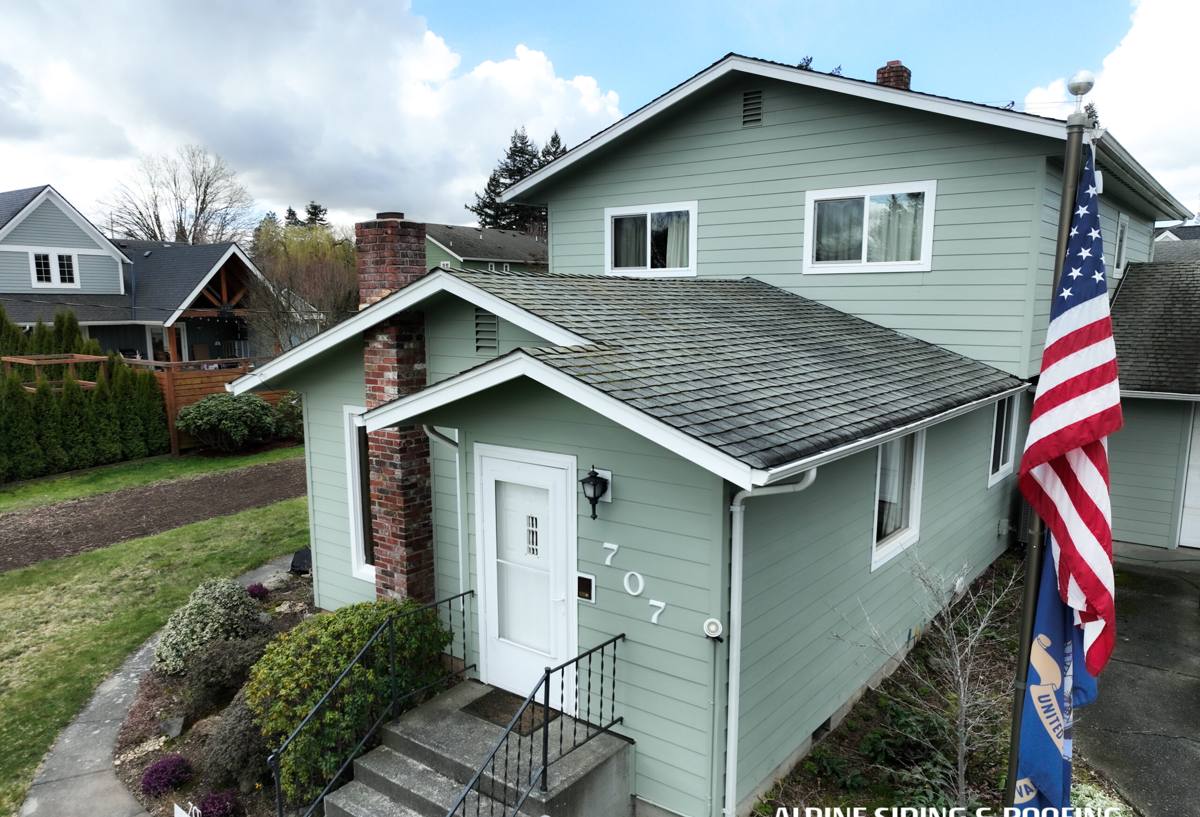
What Fiber Cement Siding Has to Get Right in Laurel
Fiber cement is a good starting point for this climate because it's dimensionally stable and doesn't absorb water the way wood-based products do. But "fiber cement" isn't one product — it's a category, and how a specific board is engineered and finished matters as much as the material itself. For a Laurel home, the siding needs to hold its factory finish under near-constant humidity, resist moisture wicking at cut edges and joints, and stay stable through repeated wet-dry cycling without cupping or checking. It also needs a finish that can be washed down regularly to knock back moss and algae growth without stripping paint.
This is exactly where a lot of fiber cement installations go wrong — not because the board itself is bad, but because it was installed like a generic siding product instead of a moisture-management system. In a drier climate, sloppy caulking or a skipped clearance gap might not show up for a decade. Here, it shows up in two or three wet seasons.
Why We Install Only James Hardie in This Area
We standardized on James Hardie fiber cement for every job we take on, including the ones in Laurel, and we don't install LP SmartSide, vinyl, Cemplank, Allura, or bare cedar or spruce products instead. That's not a marketing position — it's a decision based on what holds up in this climate with the least maintenance and the fewest callbacks.
Hardie's HZ product lines are engineered specifically for climate zones like this one, with a formulation built to resist moisture damage in wetter, milder regions rather than the freeze-thaw conditions siding faces elsewhere in the country. The ColorPlus factory finish is baked on under controlled conditions, which gives it better color retention and adhesion in salt air and constant damp than a field-applied paint job can match. Hardie also backs the product with a strong, transferable warranty on both the substrate and the finish, which matters on a coastal property where the siding is working harder than it would inland. We'd rather stand behind one product we know performs here than offer a menu of options and hope each one holds up.
What a Correct Installation Actually Involves
The board is only part of the system. A correct fiber cement job in Laurel's climate includes several details that don't show up in a driveway estimate but determine whether the siding lasts twenty years or needs rework in five:
- A properly lapped weather-resistant barrier behind the siding, with all seams and penetrations sealed before the first board goes up
- Rigid flashing — not just caulk — above every window, door, and horizontal trim transition
- A minimum clearance gap at the bottom of the wall and where siding meets roofing, decks, or grade, so water has somewhere to go
- Fasteners rated for the exposure, driven at the correct depth and spacing per manufacturer specs, not just "close enough"
- Factory-cut and factory-primed edges used wherever possible, with any field cuts sealed before installation
- Caulk used only where the manufacturer calls for it — not as a substitute for correct flashing and gapping
Every one of those details is inspectable, and every one of them is invisible once the job looks finished. That's exactly why a homeowner has to trust the crew doing the work, not just the brand on the board.
Our Process for a Laurel Siding Project
We run the same process on every Laurel home because the climate factors don't change from one property to the next, even if the house does.
- Walk-through and assessment. We look at the existing siding, sheathing, and trim for moisture damage, check window and door flashing, and identify problem areas — north-facing walls, shaded sections, and spots exposed to prevailing wind and rain.
- Tear-off and substrate check. Once the old siding is off, we inspect the sheathing underneath. Soft or damaged sheathing gets repaired before anything new goes on — covering a moisture problem with new siding just delays it.
- Weather barrier and flashing. This is the step that determines how the whole wall performs. We install and inspect the drainage plane and flashing details before a single piece of siding goes up.
- Hardie installation to spec. Boards, fasteners, gaps, and joints are installed per James Hardie's published installation guidelines for this climate zone — not a generalized method used everywhere regardless of region.
- Final walk-through. We check caulking, trim, and paint lines and go over basic care with the homeowner before we consider the job done.
What Affects the Cost of a Laurel Fiber Cement Project
Every home is different, so we don't quote pricing without seeing the property, but these are the factors that move the number most in this area:
| Factor | Why It Matters |
|---|---|
| Home size and wall complexity | More corners, gables, and trim transitions mean more cutting, flashing, and labor time |
| Condition of existing siding and sheathing | Moisture damage found during tear-off has to be repaired before new siding goes on |
| Siding profile chosen | Lap siding, shingle-style panels, and board-and-batten all install differently and price differently |
| Access and site conditions | Multi-story sections, tight setbacks, or landscaping close to the walls affect labor and staging |
| Trim and detail work | Window and door trim, corner boards, and fascia detailing add material and installation time |
| Color and finish | Factory ColorPlus finishes cost more upfront than field-painted primed board but need far less maintenance in this climate |
Living With Fiber Cement Through a Salt-Air, Moss-Heavy Year
A correctly installed Hardie system in this climate is genuinely low-maintenance, but "low-maintenance" doesn't mean "no maintenance." A little attention a couple of times a year keeps it performing the way it's supposed to:
- Rinse the siding down once or twice a year, more often on shaded or north-facing walls where moss and algae take hold fastest
- Keep gutters clear so overflow doesn't run down the wall face and sit against the siding
- Trim back plants and shrubs so the siding gets airflow and isn't holding damp foliage against it
- Check caulk joints at trim and penetrations annually and have any gaps addressed before the next wet season
- Look at south and west walls for early color fade and north walls for moss buildup — they age differently in this climate and both are easy to catch early
None of that requires special products or a professional visit every time — it's the same kind of upkeep any exterior surface needs near the water, just done consistently instead of skipped for a few years.
Why a Crew That Already Works Laurel Matters
Installation quality is the single biggest factor in how long fiber cement siding lasts, and installation quality comes from experience with the specific conditions a house sits in. A crew that's already worked on homes in and around Laurel knows which walls in this area tend to hold moisture, how far the salt exposure reaches inland from the water, and how the moss season here compares to a drier neighborhood twenty minutes away. That's knowledge that shows up in small decisions on the job — where to add extra flashing attention, which fastener spacing to tighten up, which walls need a closer look before the old siding comes off — and those small decisions are what separate a siding job that lasts two decades from one that needs attention again in five years.
It also means faster, more accurate estimates. We're not guessing at how this climate treats a house — we're working from what we've already seen on similar homes nearby, in this same stretch of Whatcom County.
If you're weighing a siding replacement or repair in Laurel, we're glad to take a look and give you a straight, no-pressure estimate — what your home actually needs, what it would cost to do it right, and why. There's a form below to get that started.