 Custer
 Deck Repair Built for Meridian's Weather, Not Just Its Boards
A deck in the Meridian area of Custer doesn't fail the way a deck fails in a dry climate. Out here, the damage is slow and mostly hidden: salt-laden air off the nearby water works into fasteners and connectors, driving rain drives moisture sideways into joints that were never meant to get wet from that angle, and a moss season that can stretch from October well into April keeps every horizontal surface damp for months at a time. By the time a homeowner notices a soft board or a rail that flexes more than it used to, the problem underneath is usually further along than it looks from the top.
That's the case for treating deck repair as a Whatcom County-specific job rather than a generic one. The framing, the fasteners, the finish schedule, and even the order of operations on a repair all change when you're building for a coastal, wet-winter climate instead of a dry one. This page covers what that actually means for a Meridian-area deck, what a correct repair involves, and how we approach the work when we're called out to this specific part of Custer.
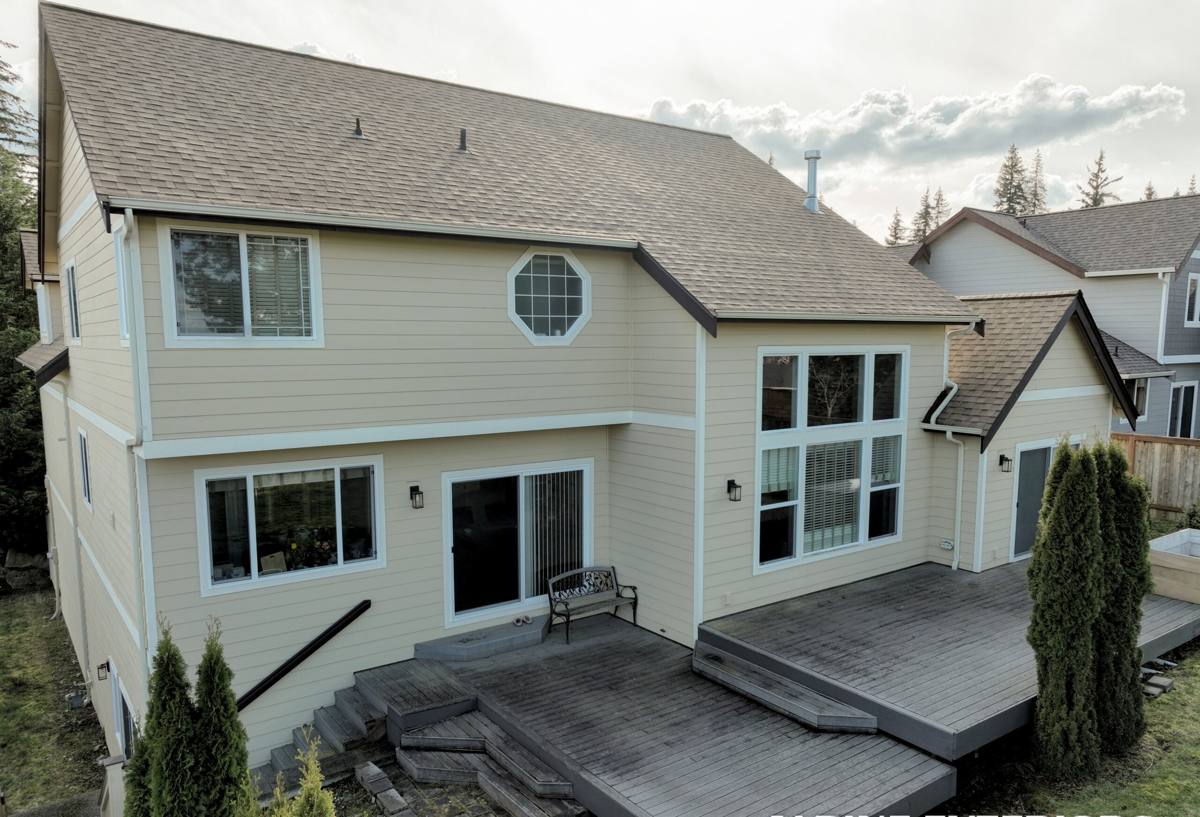
What Salt Air, Rain, and Moss Actually Do to a Deck
Salt air and metal fatigue
Proximity to salt water accelerates corrosion in anything metal — nails, screws, joist hangers, post bases, and bolts. Corroded fasteners lose grip strength long before they look obviously rusted through, which is why a deck can feel solid underfoot right up until a connection point actually gives. Galvanized hardware that would last decades inland can start showing pitting and rust bleed in a fraction of that time this close to the coast.
Driving rain and hidden rot
Wind-driven rain doesn't just fall on a deck, it gets pushed under railings, into ledger board connections, and behind fascia trim. The ledger board — where the deck attaches to the house — is the single most common failure point we find, because it's the hardest area to keep dry and the hardest to inspect without pulling boards. Once moisture gets trapped there, rot spreads quietly behind the decking, often for a year or more before it surfaces as a soft spot or a spongy step.
Moss, algae, and surface breakdown
A long moss season means extended periods where a deck surface simply doesn't dry out between rain events. Moss and algae hold moisture against the wood (or against the fastener heads on composite boards), which speeds up surface rot on wood decking and can stain or degrade the surface layer on composite. It's also a genuine slip hazard on stairs and ramps, which matters as much as the structural side of the repair.
Common Repair Calls We See in This Part of Custer
- Soft or spongy decking boards, usually near the house or around planters and hose bibs where water sits longest
- Ledger board separation or rot where the deck meets the wall
- Rusted or failing joist hangers and post connectors
- Wobbly or leaning railings from post rot at the base
- Stair stringer rot, especially on the bottom two or three steps
- Moss buildup causing slick surfaces and accelerated board wear
- Fastener pop or streaking (rust bleed) on older wood decks
Most of these show up first as a small, localized issue. The mistake we see homeowners make isn't ignoring the deck entirely — it's assuming a repair only needs to fix the visible symptom (a loose board, a wobbly rail) without checking whether the same moisture and corrosion problem is present at the next connection point over.
What an Honest Deck Repair Actually Involves
A correct repair isn't just swapping bad boards for new ones. It's a sequence:
- Find the actual source of moisture, not just the damaged wood. A soft board near the house is often a symptom of a ledger flashing problem, not a board problem.
- Probe surrounding structure — joists, beams, posts, and connectors near the failure point — since rot rarely stays confined to one board.
- Replace hardware, not just wood, when fasteners show corrosion. Reusing rusted hangers or bolts on new lumber just resets the clock on the same failure.
- Re-flash and re-seal any connection to the house before closing it back up, since this is the point most likely to leak again if it's not addressed properly the first time.
- Match or upgrade materials appropriately for a coastal, high-moisture site rather than defaulting to whatever matches the existing deck exactly.
Skipping steps 1 and 2 is the most common shortcut in the trade, and it's why some decks get "repaired" two or three times in a decade for what's really the same underlying moisture problem recurring in a new spot.
Repair or Replace: How We Help You Decide
Not every deck with damage needs to be torn out. The decision usually comes down to how much of the structural framing (as opposed to just the surface decking) is affected, and how old the deck already is relative to its expected service life in this climate.
| Situation | Repair usually makes sense | Replacement usually makes sense |
|---|---|---|
| Damage location | Isolated to a few boards or one rail section | Multiple framing members (joists, beams) affected |
| Deck age | Under 15-20 years, structure otherwise sound | Original structure near or past its practical service life |
| Ledger condition | Solid, dry, properly flashed | Rotted or improperly flashed at the house connection |
| Fastener condition | Localized corrosion, easily replaced | Widespread corrosion throughout the structure |
| Cost outlook | Lower upfront cost, targeted fix | Higher upfront cost, resets the service-life clock |
Broad, honest ranges: a small, targeted repair (a rail section, a handful of boards, a stair stringer) is typically the least expensive option, while a repair that involves reworking the ledger connection and several structural members costs meaningfully more because of the labor involved in properly re-flashing and re-securing that area. A full deck replacement is the largest investment but resets everything to code-current hardware and flashing. We'll give you a straight answer on which category your deck falls into after we've actually looked at it, not before.
How We Handle a Job in the Meridian Area
We already work this part of Custer regularly, and the process reflects that:
- Walk-through inspection — we probe suspect boards, check ledger and post connections, and look at drainage and grading around the deck, not just the deck itself.
- Written scope and honest estimate — you get a clear breakdown of what's being repaired and why, with repair vs. replace laid out plainly if both are reasonable options.
- Weather-aware scheduling — we plan structural work around dry stretches where possible, since opening up a ledger connection during a heavy rain week just invites the same problem back.
- Corrosion-appropriate hardware — fasteners and connectors sized for a coastal environment, not whatever's cheapest at the local supply house.
- Proper re-flashing at every connection point we open, even if that wasn't the original complaint.
- Cleanup and a final walk-through so you know exactly what was done and what to watch going forward.
Material Choices That Actually Hold Up Here
Wood decking
Pressure-treated and cedar decking both remain reasonable choices for repairs, provided the finish schedule accounts for how much of the year the surface stays wet. In a long moss season, a wood deck that isn't cleaned and refinished on a regular cycle will show surface breakdown faster than the same wood would inland. We're upfront that wood decking here is a maintenance commitment, not a "set it and forget it" surface.
Composite decking
Composite boards resist rot and don't need refinishing, which appeals to a lot of homeowners dealing with a long wet season. The trade-off is that composite can still trap moisture against fastener heads and substructure if it's not installed with proper spacing and drainage, and lower-grade composite can be more prone to moss and algae staining than solid wood. Our standard is to use manufacturer-specified hidden fasteners and clips, and to make sure the substructure underneath drains properly — composite doesn't fix a bad drainage plan, it just hides the symptoms longer.
Hardware and fasteners
This is where we don't cut corners regardless of decking material. In a salt-air environment, we default to fasteners and connectors rated for corrosive exposure rather than standard galvanized hardware, because the cost difference is small relative to the labor cost of redoing a connection point in a few years.
Homeowner Maintenance Checklist Between Repairs
A repaired deck still needs upkeep to get its full service life out of Custer's climate:
- Clear leaves and debris from between boards and off ledger flashing at least twice a year
- Treat or clean moss and algae buildup before it stains or saturates the surface, especially on stairs
- Check railing posts for movement at the base once a year
- Look for rust streaking around fastener heads, which signals corrosion starting underneath
- Confirm gutters and downspouts near the deck aren't dumping extra water onto or under it
- Reseal or refinish wood decking on the schedule the product actually calls for, not just when it looks faded
Why a Crew That Already Works Meridian Matters
Deck repair in this specific corner of Whatcom County isn't identical to deck repair twenty miles inland, and a crew that already works the Meridian area day to day has a feel for which connection points fail first here, how far moss and algae typically progress before a homeowner calls, and what hardware actually holds up given the salt exposure. That local pattern recognition shortens the inspection, sharpens the estimate, and generally means fewer surprises once we open things up. It also means we're realistic about scheduling around the rainier stretches of the year rather than promising a timeline the weather won't allow.
If you're seeing a soft board, a loose rail, or just want an honest read on how much service life is left in a deck in the Meridian area, we're glad to come take a look. The estimate is free, there's no pressure attached to it, and you'll get a straight answer on whether you're looking at a targeted repair or something bigger — just fill out the form below.