 Custer
 Composite Decking for Bellingham Homes
If you live in or around Bellingham, you already know what the marine climate does to an outdoor deck. Salt-laden air off the bay, long stretches of driving rain, and a moss season that seems to start earlier every year all work against wood surfaces that were never really built for this environment. Composite decking, installed correctly, is one of the few outdoor flooring choices that holds up to all three at once without demanding constant upkeep from the homeowner.
This page is specifically about composite decking for the Bellingham area — not a generic overview of decking materials. We work in Whatcom County regularly, and the way we frame, ventilate, and fasten a deck here is shaped directly by what this climate does to a structure over time.
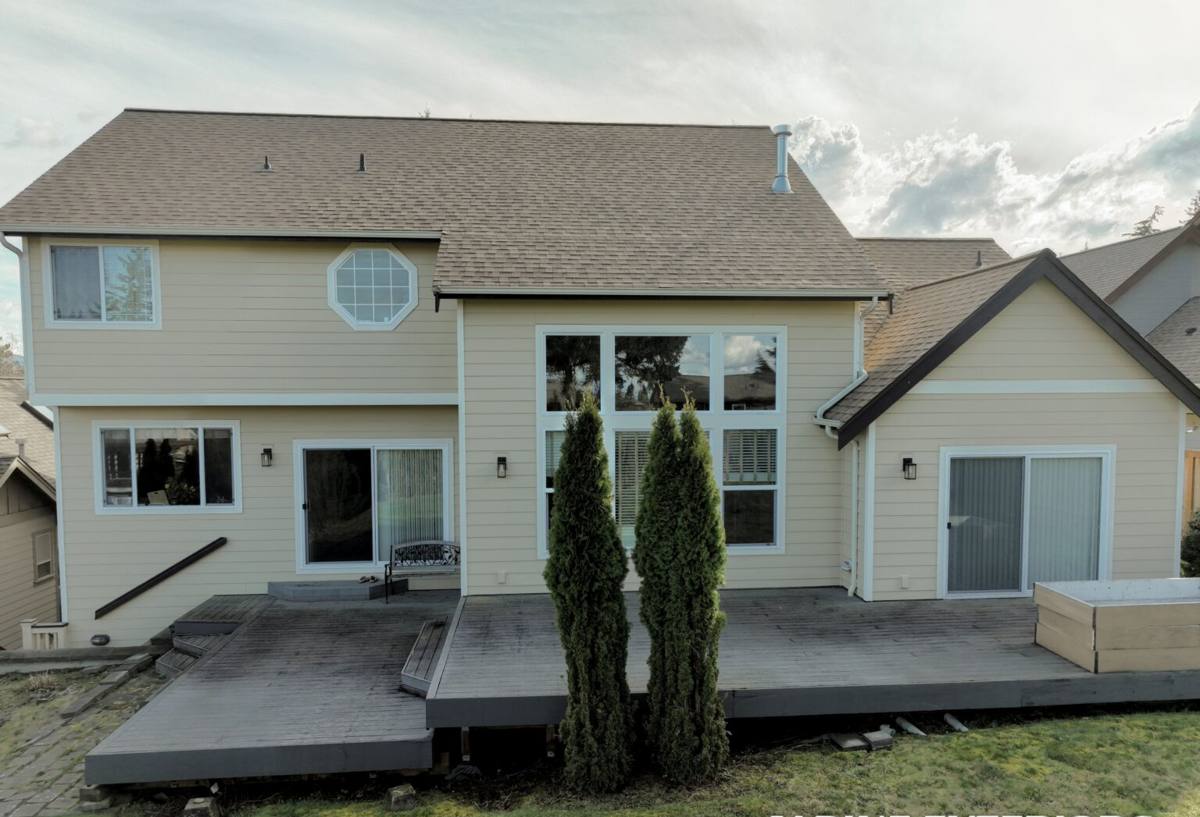
What This Climate Actually Does to a Deck
Three things drive most of the deck problems we see in the Bellingham area, and they compound each other.
Salt Air
Proximity to Bellingham Bay and the Strait of Georgia means airborne salt settles on every exterior surface, including fasteners, flashing, and railing hardware. Over years, salt exposure accelerates corrosion in lower-grade metal components — screws, brackets, and post connectors — long before the decking surface itself shows wear. A deck can look fine on top while its hidden hardware is quietly failing underneath.
Driving Rain
Whatcom County doesn't just get a lot of rain — it gets a lot of rain pushed sideways by wind coming off the water. That matters for decking because water doesn't just fall on a deck, it gets driven into board gaps, fastener holes, and any spot where two materials meet. A deck built without attention to drainage and water shedding will trap moisture in places a homeowner never sees until rot or mold shows up.
Moss Season
Cool, damp, shaded conditions for much of the year make moss and algae growth almost inevitable on any outdoor surface that stays wet. On wood decking, moss growth isn't just cosmetic — it holds moisture against the board surface and speeds up decay. On composite decking, moss is mostly a surface issue, but board selection and surface texture still affect how easily it takes hold and how easily it comes off.
Why Composite Makes Sense in This Environment
We install both wood and composite decking, and we're upfront with Bellingham-area homeowners about the trade-offs. Composite isn't automatically the right choice for every project or budget, but in a climate this wet and this salty, it solves problems that wood decking simply can't solve on its own.
| Factor | Wood Decking | Composite Decking |
|---|---|---|
| Moisture absorption | Absorbs and releases moisture repeatedly, driving warping and checking | Minimal absorption with capped boards; dimensionally stable |
| Moss and algae | Moisture retention speeds rot under moss growth | Surface growth only; doesn't feed structural decay |
| Annual maintenance | Sanding, staining, or sealing on a recurring cycle | Periodic washing; no sealing or staining required |
| Splintering / graying | Common as finish wears down | Cap stock resists graying and splintering |
| Upfront cost | Generally lower material cost | Higher material cost, lower lifetime maintenance cost |
| Fastener corrosion risk | Same regardless of decking material | Same regardless of decking material |
That last row matters more than most homeowners realize: composite decking doesn't fix a corrosion problem in the substructure. The hardware underneath still needs to be rated for a coastal, high-moisture environment regardless of what's on top.
What a Correct Composite Install Involves Here
Composite boards are forgiving on the surface, but the work that determines whether a deck lasts fifteen years or shows problems in five happens underneath and around the edges — and that work is where installs cut corners.
Framing and Fastener Grade
We use fasteners and structural hardware rated for coastal exposure, not standard-grade galvanized product. In a salt-air environment, the difference between a corrosion-resistant fastener and a standard one is the difference between hardware that lasts the life of the deck and hardware that needs to be replaced in a decade.
Joist Protection
Composite board manufacturers publish specific guidance on joist tape and flashing, and we follow it rather than treating it as optional. Joist tape keeps water from wicking into the top of framing lumber where fasteners penetrate — a common failure point in wet climates even when the decking on top is composite.
Ventilation and Drainage
Air needs to move underneath a deck for moisture to actually leave the structure instead of sitting trapped against framing. We plan gap spacing, skirting, and ground clearance with that airflow in mind, especially on lower decks close to grade where drainage is naturally slower.
Board Spacing and Expansion
Composite boards expand and contract with temperature more than most homeowners expect. Gapping them correctly at install — accounting for both drainage and material movement — prevents buckling and uneven surfaces later.
Railing and Post Hardware
Railings take direct wind and rain exposure and often get overlooked in favor of the decking surface. We spec post connectors and railing hardware to the same coastal-durability standard as the deck itself.
How Our Process Works
For Bellingham-area composite decking projects, our process is straightforward and we walk homeowners through it before any work starts:
- On-site assessment — we look at existing structure (if replacing a deck), drainage, sun/shade exposure, and any moss or moisture issues already present.
- Board and framing recommendation — we recommend a composite line and structural approach based on that specific site, not a one-size answer.
- Written estimate — a clear scope and price range before any commitment.
- Framing and structural work — including joist protection, coastal-rated fasteners, and ventilation planning.
- Composite installation — board layout, correct gapping, and hidden or exposed fastening depending on the product line chosen.
- Final walkthrough — we go over care basics specific to composite decking in a wet, moss-prone climate before we consider the job done.
Choosing the Right Composite Board for This Climate
Not all composite decking performs the same way in a Bellingham winter. A few factors we walk through with homeowners:
Capped vs. Uncapped Boards
Fully capped composite boards have a protective shell around the core that resists moisture absorption and staining far better than uncapped or early-generation composite products. In a climate this wet, we generally steer homeowners toward capped boards — the extra durability is worth it given how much water this region sees.
Surface Texture
Heavily embossed wood-grain textures look great when new but can hold more grime and moss spores in the grain pattern. Smoother or more subtly textured boards tend to be easier to keep clean through a Whatcom County winter, though they trade off some of that natural wood look.
Grooved vs. Solid-Edge Boards
Grooved boards allow hidden fastening for a clean surface look, but the grooves themselves can collect debris and moisture if drainage and gapping aren't handled correctly at install. Solid-edge boards are simpler to keep clean but show face fasteners. We'll talk through which fits your project and your maintenance preferences.
Color Considerations
Darker composite boards absorb more heat and tend to dry faster after rain, which can mean less time for moss spores to establish. Lighter boards stay cooler underfoot in summer but hold surface moisture slightly longer. Neither is wrong — it's a genuine trade-off worth thinking through for your specific deck's sun exposure.
Maintaining a Composite Deck Through Moss Season
Composite decking is genuinely low-maintenance compared to wood, but "low-maintenance" doesn't mean "no maintenance," especially in this climate. A simple seasonal routine keeps a composite deck looking and performing the way it should:
- Sweep debris (leaves, needles, seed pods) off the deck regularly through fall — trapped organic matter is what feeds early moss growth
- Wash the surface with a soft-bristle broom and mild soap-and-water solution once or twice a year, more often in heavily shaded areas
- Avoid pressure washing at close range or high PSI — it can damage the cap layer on composite boards
- Check that gaps between boards stay clear so water continues to drain rather than pooling
- Inspect visible fasteners, post bases, and railing hardware annually for early signs of corrosion
- Trim back overhanging vegetation where possible to reduce shade and speed drying time after rain
Cost Factors for a Bellingham-Area Composite Deck
Every deck is different, but the following factors are what typically move the price up or down on composite decking projects in this area:
| Factor | Effect on Cost |
|---|---|
| Deck size and shape (straight runs vs. multiple angles/levels) | Complex shapes and multi-level decks increase labor time |
| Composite product line chosen | Capped, premium lines cost more upfront than base-tier composite |
| Existing structure condition | Full tear-off and reframing costs more than decking over sound existing framing |
| Height and railing requirements | Taller decks need code-compliant railing systems, adding material and labor |
| Site access | Difficult access for material delivery or equipment can add time |
| Ground clearance and drainage work | Low-clearance decks may need extra grading or ventilation work |
We give a written, itemized estimate before any work begins so you know exactly what's driving the cost on your specific project.
Why a Crew That Already Works Bellingham Matters
Decking crews who mostly work drier inland climates tend to build to a generic standard — one that doesn't account for salt air corroding standard hardware or driving rain finding its way into gaps that would stay dry elsewhere. Working regularly in and around Custer and Bellingham means we're not guessing at how this climate treats a deck over time; we're building around what we've already seen it do. That shows up in the fastener grade we default to, the joist protection we don't skip, and the ventilation planning we treat as standard rather than upsell.
It also means we're a known, reachable local crew if a question comes up two or five years after installation — not a company that worked one job in the area and moved on.
Get a Free, No-Pressure Estimate
If you're weighing composite decking for a home in the Bellingham area, we're happy to take a look at your site, talk through board options suited to this climate, and give you a straightforward written estimate — no pressure, no obligation. Use the form below to get started.