 Custer
 Why Siding Wears Differently Right at Cherry Point
Cherry Point sits out on the water, and that changes what a wall system has to put up with compared to a home even a few miles inland in Custer. Salt-laden air off the water rides in on the prevailing wind and settles on everything it touches — fasteners, flashing, caulk lines, and painted or coated surfaces. Salt is hygroscopic, meaning it pulls moisture out of the air and holds it against whatever it lands on, which is exactly the wrong thing to have happening on the outside of a wood-framed house. Add in driving rain that comes in sideways during winter storms, and water gets pushed into laps, seams, and butt joints that would stay dry in a calmer setting.
Then there's moss. Whatcom County's long wet season keeps shaded and north-facing walls damp for months at a stretch, and moss and algae take hold anywhere that dampness lingers. On old wood or wood-composite siding, that sustained moisture is what starts rot from the outside in. On any siding, moss holds water against the surface longer than the material was ever meant to tolerate, which accelerates finish failure and, eventually, damage to what's underneath.
None of this means Cherry Point homes are doomed to constant siding trouble. It means repairs done here need to account for salt exposure, wind-driven moisture, and a moss season that runs longer than it does a few miles inland — and a lot of repair work that looks fine on the day it's finished doesn't hold up because those factors weren't built into the fix.
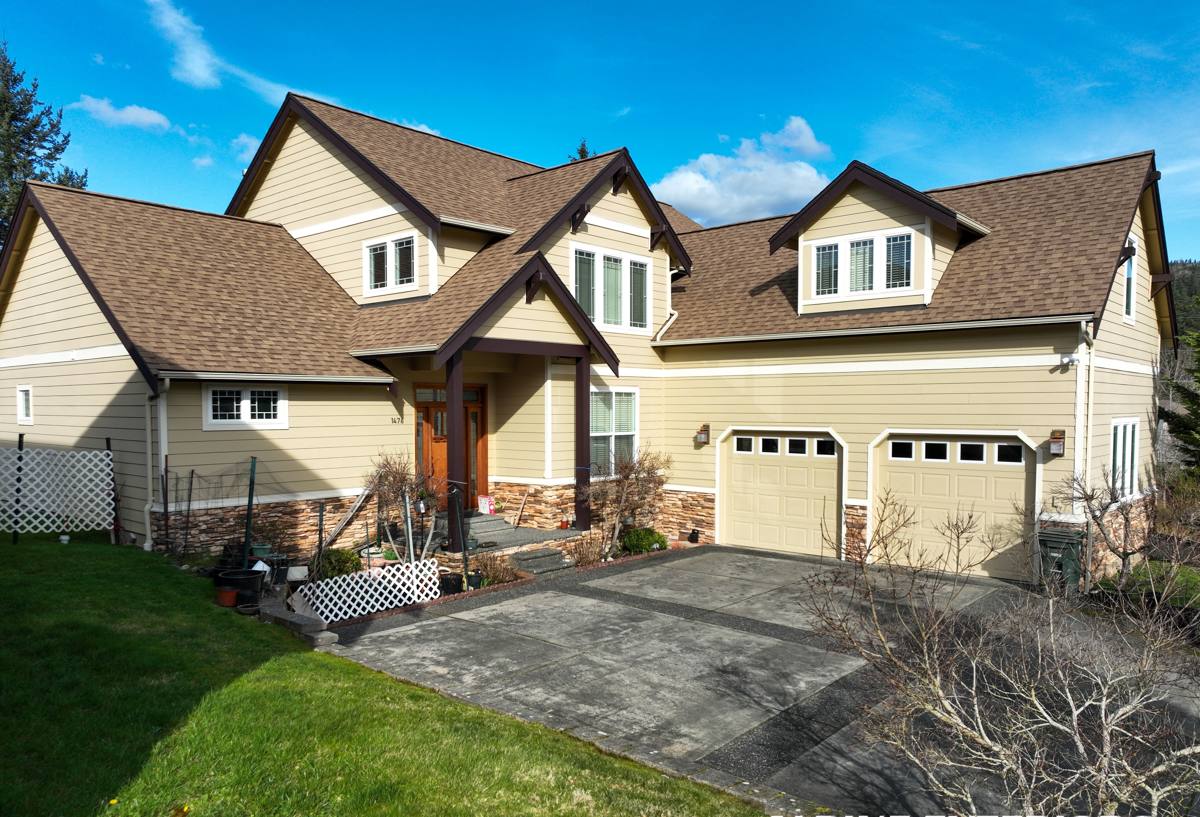
Signs a Cherry Point Home Actually Needs Siding Repair
Some damage is obvious. Some isn't visible until you know where to look, especially on a home that's taken a few winters of wind off the water. Here's what we check for, and what should prompt a call:
- Cracking or buckling at butt joints, corners, or anywhere two pieces of siding meet
- Soft or spongy spots when pressed by hand — a sign moisture has reached the substrate underneath
- Peeling, bubbling, or chalky paint, particularly on north- and west-facing walls that stay wet longest
- Moss or algae staining that comes back quickly after cleaning, especially near the roofline or under overhangs
- Gaps or separation at trim, window casings, and door flashing
- Rust streaking below fasteners or metal flashing — a telltale sign of salt-air corrosion
- Swelling or delamination on older wood or engineered wood panel siding
Any one of these can start as a small, inexpensive fix. Left alone through another wet season, most of them don't stay small.
What a Correct Repair Actually Involves
Diagnosis before demolition
The visible crack or stain is rarely the whole story. Before we replace a single board, we check how far moisture has traveled — whether it's sitting on the surface, has soaked into the siding itself, or has already reached the sheathing and framing behind it. That determines whether this is a targeted repair or something bigger, and it's the step that gets skipped most often in a rushed patch job.
Matching material, not just matching color
A repair that looks right on installation day but behaves differently than the siding around it will fail differently too — expanding, absorbing moisture, or weathering at a different rate. That mismatch shows up as a visible seam or a repeat failure within a season or two, right where the patch meets the original wall.
Flashing and sealant, done properly
Most siding failures we find in this area trace back to a flashing detail or a sealant joint that failed first, and the siding damage is the downstream result. A repair that doesn't correct the underlying water path — around a window, at a butt joint, at a penetration for a vent or fixture — is a cosmetic fix on top of an active leak. It will look fine for a while and then fail again in the same spot.
Fastening that accounts for salt exposure
Fastener choice matters more here than it does further inland. Corrosion-resistant fasteners, set and sealed correctly, matter on every Cherry Point job — cutting a corner here is one of the more common reasons a "repaired" section starts showing rust streaks again within a year or two.
Repair or Replace? What Actually Drives That Decision
Not every damaged section needs a full re-side, and not every crack is worth patching. The honest answer depends on a handful of factors, not on how the siding happens to look from the street.
| Factor | Repair Usually Makes Sense | Replacement Should Be Considered |
|---|---|---|
| Extent of damage | Isolated to one or two sections or wall faces | Recurring across multiple walls or the whole exterior |
| Underlying sheathing | Dry, sound, no rot found on inspection | Soft, stained, or already showing rot |
| Age and material | Newer fiber cement with a healthy factory finish | Old wood, hardboard, or failing engineered siding nearing end of life |
| Moss/staining pattern | Surface-level, responds to cleaning and spot repair | Persistent, tied to a chronic moisture source behind the wall |
| Cost over time | One-time fix addresses the actual cause | Repeated repairs to the same areas year after year |
When the sheathing is sound and the damage is contained, a targeted repair is the right call and the more cost-effective one. When we find rot spreading behind multiple sections, or a home is patched every year or two in the same spots, we'll say so plainly rather than keep billing for repeat repairs that don't solve the underlying problem.
Why We Repair with James Hardie Fiber Cement — Not Whatever's on Hand
We install James Hardie fiber cement exclusively, and that includes repair work. When a section needs to come out and be replaced, we don't fill the gap with vinyl trim pieces, unprimed wood, or whatever composite happens to be a close color match — because those materials don't move, absorb moisture, or weather the same way as what's already on the wall, and in a climate with this much salt air and rain, that mismatch becomes a maintenance problem of its own. Hardie's fiber cement is engineered to handle wet coastal climates, its ColorPlus factory finish is baked on rather than field-painted, and using the same product system for a repair as for a full install means the fix actually behaves like the wall around it instead of becoming the next weak point.
How We Handle a Cherry Point Repair Job
- On-site inspection — we look at the damage itself, the flashing and sealant nearby, and check for hidden moisture with a moisture meter where warranted
- Honest scope — we tell you plainly whether this is a contained repair or a sign of a bigger issue, before any work starts
- Removal and substrate check — damaged siding comes off, sheathing and framing underneath get inspected and, if needed, repaired first
- Correct flashing and water management — any failed flashing or sealant detail gets fixed as part of the job, not left in place under new siding
- Matched Hardie fiber cement installation — replacement boards installed to manufacturer spec, with proper gapping, fastening, and sealant
- Final check — we walk the repair with you before we call it done
Best Time of Year to Handle Cherry Point Siding Repairs
Timing matters more here than homeowners often expect. The stretch between late spring and early fall is generally the driest window in Whatcom County, which makes it the best time to open up a wall section, let sheathing dry out if needed, and get new material properly sealed before the wet season sets back in. Repairs made right before or during the heaviest winter storms are harder to do well — sealants and finishes need dry conditions to cure properly, and a rushed cold-weather patch is more likely to need attention again the following year.
That doesn't mean a repair has to wait months if something is actively letting water in. An active leak or a section that's clearly failing gets addressed as soon as it's found, regardless of season — the goal is just to avoid scheduling routine, non-urgent repair work for the worst weather window of the year if it can reasonably wait a few weeks for a better one.
Why a Crew That Already Works Cherry Point Matters
A lot of siding damage in this area follows patterns that aren't obvious unless you've worked on enough homes right along this stretch of coastline. Which wall faces take the worst of the wind-driven rain in a given storm track. How much longer moss holds on north-facing walls under tree cover here compared to a more open, inland lot. Which fastener and flashing shortcuts show up as rust streaks or leaks first in salt air, and which hold up. That's the kind of thing you learn from doing the work locally and repeatedly, not from a one-off job.
It also means fewer surprises for you. A crew that already knows what Cherry Point's exposure does to a wall system isn't guessing at scope or discovering mid-job that the damage runs deeper than expected — they've seen the pattern before and inspect for it up front.
Maintaining Siding Between Repairs
A correct repair should be the last time that section needs attention for years, but a little routine care extends that further, especially this close to the water:
- Rinse off salt residue and moss buildup on shaded or north-facing walls a couple of times a year
- Keep gutters and downspouts clear so runoff doesn't wash directly down the siding face
- Trim back vegetation that keeps a wall section shaded and damp longer than the rest of the house
- Have caulk and sealant joints checked periodically — they're usually the first thing to fail, well before the siding itself
- Walk the exterior after major windstorms and note anything that looks newly cracked, lifted, or displaced
If you're seeing cracking, staining, soft spots, or repeat moss trouble on a Cherry Point home, we're glad to take a look and give you a straight answer — repair, replacement, or nothing urgent at all. Reach out for a free, no-pressure estimate using the form below.