 Custer
 Blaine Roofs Take a Different Kind of Beating
Blaine sits right on the water along Semiahmoo Bay and Drayton Harbor, at the top of Whatcom County where Pacific weather systems come ashore with little to slow them down. A roof here isn't just shedding rain like a roof forty miles inland — it's absorbing salt-laden air off the bay, taking wind-driven rain sideways during winter storms, and sitting under a moss season that can run eight or nine months out of the year. Storm damage in Blaine is rarely just "a few shingles came off." It's usually that plus months of moisture and salt exposure that made the roof more vulnerable in the first place.
Salt Air and Fasteners
Homes close to the shoreline deal with airborne salt that accelerates corrosion on exposed metal — nail heads, flashing, drip edge, and gutter hardware all age faster here than they would on a roof set back from the water. A repair that ignores this and uses standard-grade fasteners or flashing can look fine for a season or two, then start failing exactly where the storm damage happened the first time.
Wind-Driven Rain
Storms coming off the water tend to drive rain at an angle rather than straight down, which pushes water up under shingle tabs, along ridge caps, and into any gap in flashing that a calm-weather rain would never find. This is why storm damage often shows up as a leak somewhere other than where the visible damage is — water travels along the underlayment or decking before it drips through the ceiling.
The Long Moss Season
Whatcom County's mild, wet climate is close to ideal for moss growth, especially on north-facing slopes and any section shaded by conifers. Moss holds moisture against the shingle surface, lifts tabs as it grows, and gives wind something to grab onto during a storm. A roof with an established moss problem is more likely to lose shingles in a wind event than a clean one — which means storm damage and moss control are connected, not separate issues.
What Storm Damage Actually Looks Like Here
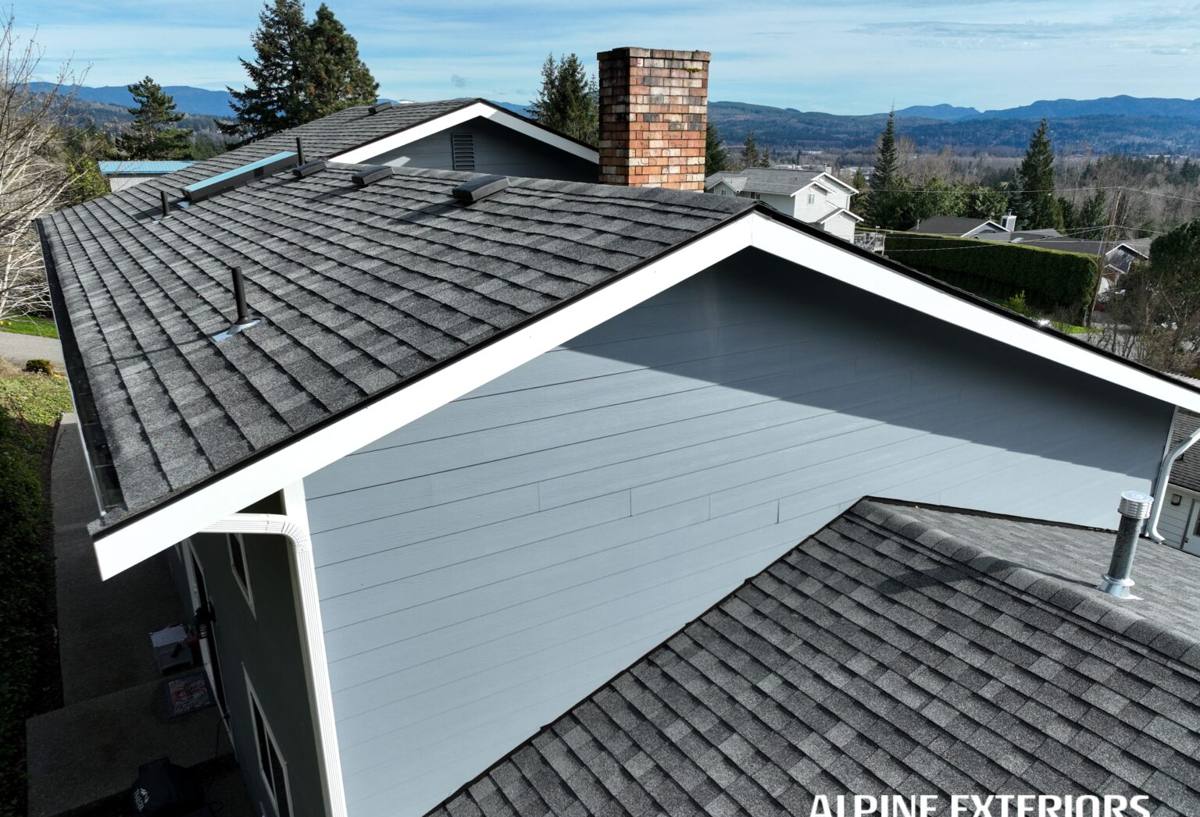
Not all storm damage is obvious from the ground. On Blaine roofs we typically see a mix of the following after a wind or heavy rain event:
- Lifted or torn shingle tabs, usually starting at roof edges and ridges where wind uplift is strongest
- Missing or cracked ridge cap shingles
- Flashing pulled loose or bent around chimneys, skylights, and vent penetrations
- Granule loss from shingles being flexed and abraded in high wind, visible as grit in gutters
- Punctures or bruising from branches or debris, common under mature trees
- Soft or discolored decking felt from underneath in the attic, a sign water already got past the surface
- Gutter and downspout separation from wind load or ice weight
Some of this is visible with binoculars from the ground; the rest only shows up on the roof surface or from inside the attic. That's why a proper storm inspection covers both.
What a Correct Repair Actually Involves
A storm damage repair done right isn't just replacing what's obviously missing. It starts with figuring out how far the damage actually extends, because wind and water rarely stop at the edge of what you can see from the driveway.
Inspection Before Anything Gets Touched
This means checking the decking underneath damaged shingles for soft spots or moisture staining, tracing flashing lines for separation, and checking the attic side for water intrusion that hasn't reached the ceiling yet. Skipping this step is how a "quick fix" ends up needing to be redone within a year.
Matching Materials, Not Just Covering the Hole
Shingles fade and granules wear unevenly over time, so a patch using new material next to weathered material can be a visible color mismatch — and more importantly, a functional mismatch if the surrounding shingles are already brittle and near end of life. Part of an honest repair is telling you when a patch will hold versus when the surrounding roof section should be replaced along with the damaged area.
Flashing and Underlayment Get the Same Attention as Shingles
Most leaks that follow a storm trace back to flashing and underlayment, not the shingles themselves. Reflashing a valley or chimney correctly — with proper laps and corrosion-resistant metal — matters more for long-term water resistance than the shingle work sitting on top of it.
Repair vs. Replacement: How We Help You Decide
Not every storm-damaged section needs a full roof replacement, and not every roof should be patched forever. The decision usually comes down to a few honest factors:
| Factor | Leans Toward Repair | Leans Toward Replacement |
|---|---|---|
| Age of existing roof | Roof is under 10-12 years old | Roof is near or past its expected service life |
| Extent of damage | Localized to one slope or section | Spread across multiple slopes or the whole roof |
| Decking condition | Solid, dry decking under the damage | Soft, delaminated, or repeatedly wet decking |
| Moss and shading history | Minimal moss, good sun exposure | Heavy moss growth compromising surrounding shingles |
| Material availability | Close shingle match still obtainable | Shingle line discontinued or badly weathered elsewhere |
We walk you through where your roof falls on this before recommending anything — a repair that's honestly the right call costs you less and holds up fine; a repair that's papering over a bigger problem just delays a bigger bill.
Our Process for Blaine Storm Calls
- Initial call and photos. If it's safe to do so, a few ground-level photos of the damage help us prepare before we're on site.
- On-site inspection. We check the roof surface, flashing, and attic side, and walk you through exactly what we find — good or bad.
- Written scope and estimate. You get a clear breakdown of what needs repair, what's optional, and what it costs, before any work starts.
- Repair work. Matching materials, correct flashing detail, and fastener choices suited to a coastal Whatcom County property.
- Final walkthrough. We show you the completed work and point out anything worth keeping an eye on going forward.
Insurance and Storm Damage Claims
Many storm repairs in this area go through homeowner's insurance, and we're glad to document damage with photos and a written scope that you can hand to an adjuster. What we won't do is inflate a scope of work to pad a claim or list damage that isn't there — that approach can jeopardize your claim and isn't worth the risk to you or to us. An honest, well-documented estimate tends to move through the claims process faster than an inflated one anyway.
Materials We Choose for Coastal Conditions
For repairs on homes exposed to salt air and driving rain, we default to corrosion-resistant fasteners and flashing metal rather than the lowest-cost standard option — the difference in material cost is small compared to the cost of redoing flashing work in five years instead of fifteen. We also pay close attention to underlayment quality in valleys and eaves, since that's the layer doing the real work when wind pushes water up under the shingle surface. None of this is about any one brand being bad; it's about matching the product to what this specific climate does to a roof over time.
After the Repair: Keeping Moss and Moisture From Coming Back
A storm repair holds up longer when it's not fighting moss and standing water on top of everything else. A few habits make a real difference in Blaine's climate:
- Keep gutters and downspouts clear so wind-driven rain has somewhere to go
- Trim back branches that overhang the roof, both for debris and for shade that feeds moss
- Have shaded, north-facing sections checked for moss growth at least once a year
- Address small flashing issues before the next storm season rather than after the next leak
Why a Crew That Already Works Blaine Matters
A roofer who works this stretch of Whatcom County regularly already knows what wind-driven rain off the water does to flashing, what moss looks like in its early stages on a north slope, and which fastener choices hold up near the salt air versus which ones don't. That's the difference between a repair that's technically finished and one that's actually built for where it sits. Being based in Custer also means we're not driving in from out of the area after a storm — when a lot of roofs need attention at once, being local matters for how quickly we can get to you.
If you've got storm damage on your Blaine roof, or you just want an honest opinion on what a recent storm did to it, we're happy to take a look. There's a free, no-pressure estimate form below — reach out and we'll get you scheduled.