 Custer
 Why Laurel Roofs Wear Differently Than Roofs Inland
Laurel sits close enough to the water and to the open fields of Whatcom County that its homes take on a specific mix of weather stress most inland roofing crews rarely have to think about. Salt-laden air moves through on the wind, driving rain comes in sideways during fall and winter storms, and the shaded, moisture-heavy stretches of the year give moss and algae months at a time to get established on a roof deck. None of this is dramatic on its own. It's the combination, repeated year after year, that shortens the life of a roofing system that wasn't built or installed with these conditions in mind.
Asphalt shingles remain one of the most practical roofing choices for this area when they're specified and installed correctly. The problem isn't the material — it's that a roof assembly designed for a drier climate, or installed by a crew unfamiliar with coastal Whatcom County, tends to fail in specific, predictable ways here: granule loss from constant moisture cycling, moss lifting shingle edges, and fastener corrosion from salt exposure. A roof built for Laurel needs to account for all three from day one.
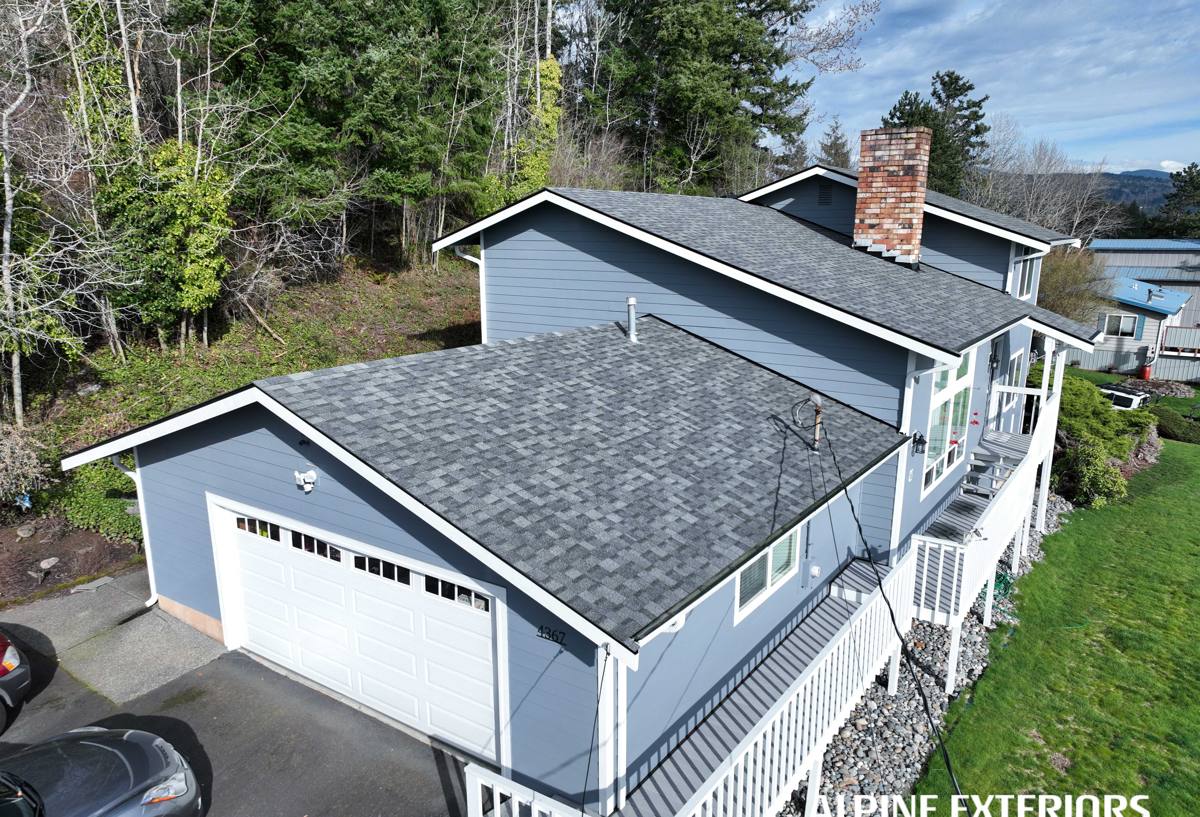
What "Correct" Asphalt Shingle Roofing Actually Involves
A shingle roof is a system, not a single product. The shingle itself gets the attention, but the layers underneath and the details around penetrations do most of the work of keeping a Laurel home dry through a wet Northwest winter.
The Layers That Matter
- Deck condition — sound, dry sheathing underneath; any soft or delaminated spots get replaced before anything else goes down.
- Underlayment — a synthetic or self-adhered membrane rated for the wind-driven rain this area sees, not a minimum-code product.
- Ice and water barrier — installed at eaves, valleys, and around penetrations, where wind-driven rain and ice damming are most likely to force water backward under shingles.
- Flashing — new step flashing, counter-flashing, and valley metal at every wall intersection, chimney, and skylight, rather than reusing old flashing under new shingles.
- Shingles and fasteners — corrosion-resistant nails, correct nailing pattern, and a shingle rated for the wind exposure this location actually gets.
- Ventilation — balanced intake and exhaust so the attic isn't trapping moisture against the underside of the deck.
Skipping any one of these doesn't show up right away. It shows up two, five, or eight years later as a leak that seems to come from nowhere, because the failure point was never visible from the ground.
Our Process for a Laurel Roofing Project
We keep the process straightforward because a roof replacement or repair shouldn't feel like a mystery to the homeowner paying for it.
1. On-Site Assessment
We walk the roof, not just look at it from the driveway. That means checking the deck for soft spots, inspecting flashing at every wall and roof transition, looking at attic ventilation from inside, and noting how moss and moisture have already affected the existing shingles. For a repair, this tells us whether the damage is isolated or a sign of a bigger problem underneath.
2. Honest Scope and Written Estimate
We tell you what we actually found, what needs to happen, and why — including if a repair is the right call instead of a full replacement. The estimate breaks out material, labor, and any deck repair separately so there are no surprises mid-project.
3. Tear-Off and Deck Inspection
For full replacements, we remove the old roofing down to the deck rather than layering over it. That's the only way to actually see what condition the sheathing is in, and it's where hidden moisture damage from years of Whatcom County rain tends to turn up.
4. Underlayment, Flashing, and Ventilation First
Before a single shingle goes down, the water management layer goes in: ice and water barrier at vulnerable areas, new underlayment across the field, new flashing at every intersection, and any ventilation corrections. This is the part of the job that determines how the roof performs in year eight, not year one.
5. Shingle Installation
Shingles go down to manufacturer spec — correct exposure, correct nailing pattern, correct fastener count for the wind exposure Laurel actually gets off the water. We don't cut nailing patterns to speed up a job; it's the single most common cause of early wind damage.
6. Final Walkthrough
We walk the finished roof with you, point out what was done, and make sure gutters, vents, and flashing are clean and functioning before we consider the job finished.
Choosing the Right Shingle for This Climate
Not every asphalt shingle product is a good match for salt air and heavy moss pressure. Wind rating, algae resistance, and how forgiving the shingle is during installation all matter more here than they would in a drier region.
| Shingle Class | Typical Wind Rating | Algae/Moss Resistance | Best Fit For |
|---|---|---|---|
| Standard 3-tab | Lower | Minimal unless treated | Budget projects, low wind/shade exposure |
| Architectural (laminate) | Higher | Often includes algae-resistant granules | Most Laurel homes — better balance of cost and durability |
| Premium/designer laminate | Highest of the three | Strong algae resistance, heavier granule base | Homes with heavy shade, moss history, or high wind exposure |
We generally steer Laurel homeowners toward architectural or premium laminate shingles with algae-resistant granules, simply because the maintenance burden and repair frequency of a bare 3-tab product tends to outweigh the upfront savings once moss and salt exposure are factored in. That's a trade-off we'll walk through honestly for your specific roof and budget rather than upselling by default.
Cost Factors Worth Understanding Upfront
- Roof pitch and complexity — steep or cut-up roofs with multiple valleys take longer and use more flashing detail.
- Deck condition — hidden rot found at tear-off adds material and labor that can't be quoted until the deck is exposed.
- Shingle class — premium laminate costs more per square than 3-tab, but often costs less over the life of the roof in this climate.
- Ventilation corrections — adding or rebalancing intake/exhaust vents is a smaller add-on during a full tear-off than it is later.
- Access and site conditions — mature trees, tight lot lines, and staging area affect labor time.
Moss, Algae, and the Realities of a Long Wet Season
Whatcom County's moss season isn't a minor cosmetic issue. Moss holds moisture directly against the shingle surface for months, and as it grows it physically lifts shingle edges, breaking the seal that keeps wind-driven rain out. Black algae streaking is mostly cosmetic, but it's a sign that a roof is staying damp longer than it should between rain events, which is worth paying attention to even if it isn't causing leaks yet.
Correct roof-facing gutter and downspout function matters here too — a roof that's shedding water properly but into a clogged or undersized gutter system will still see water back up under the eaves. We check this as part of any roofing project, because a new roof draining into a failing gutter system doesn't solve the underlying moisture problem.
Signs a Laurel Roof Needs Attention Now
- Granules collecting in gutters or at downspout outlets
- Shingles that look curled, cupped, or lifted at the edges
- Visible moss growth, especially on north-facing or shaded slopes
- Dark streaking across the shingle field
- Soft spots or sagging visible from the ground or attic
- Daylight visible through the roof deck from inside the attic
- Water stains on ceilings or in the attic after a heavy rain
- A roof over 15-20 years old that hasn't had a professional inspection recently
Any one of these on its own doesn't necessarily mean a full replacement is needed. But it's worth having someone who knows what a coastal Whatcom County roof looks like at each stage of wear take a look before it becomes a bigger repair.
Ventilation: The Part of the Roof You Never See
Attic ventilation gets overlooked because it's invisible from the street, but it directly affects how long shingles last and whether moisture builds up inside the roof assembly. In a climate with as much sustained damp weather as this one, an attic that isn't venting properly stays humid longer, which accelerates deck deterioration and can void shingle warranties that require balanced ventilation. Part of our assessment on any Laurel roofing project includes checking intake at the soffits and exhaust at the ridge or roof vents, and correcting the balance where it's off — not just adding vents without checking whether intake air can actually reach them.
Why Hiring a Crew That Already Works in Laurel Matters
A roofing crew that works across a wide region without a real base in this specific area is guessing at things a local crew already knows: how wind actually moves across this stretch of Whatcom County, which shingle classes hold up against moss pressure over time, and what a deck typically looks like after years of this rain pattern once it's opened up. That translates directly into fewer surprises during the job and a roof that's specified correctly the first time instead of adjusted after a callback.
Being local also means we're not disappearing after the invoice is paid. If a question comes up two years down the line about a flashing detail or a maintenance question, we're still the crew that installed it and still in the area.
Get a Straight Answer About Your Roof
If you're dealing with moss buildup, an aging roof, or a leak that's hard to pin down, we're glad to come take an honest look. The estimate is free, there's no pressure, and you'll get a clear explanation of what we found and what your real options are — use the form below to get started.