 Custer
 Why Bellingham Roofs Wear Differently Than Roofs Inland
A roof in Bellingham lives a harder life than the same roof forty miles inland. The combination of Puget Sound salt air, long stretches of driving rain off the water, and short winter days that keep north-facing slopes damp for weeks at a time is a specific set of conditions, not generic "Pacific Northwest weather." Asphalt shingles can handle all of it, but only if they're specified and installed with this climate in mind. A roof detailed the same way you'd detail one in eastern Washington or California will fail here faster than it should, usually starting at the flashing and the shaded slopes long before the shingles themselves wear out.
Salt Air and Marine Exposure
Homes closer to the water deal with airborne salt that accelerates corrosion on exposed metal — nails, flashing, vent stacks, and gutter hardware. Standard electro-galvanized fasteners and thin flashing stock corrode faster in this environment, which shows up years later as rust streaking, loosened shingle tabs, and leaks at penetrations that were never the "roofing" part of the job in the customer's mind but are almost always where the failure starts.
Moss, Shade, and Prolonged Damp
Whatcom County's tree cover and cloud-heavy winters mean north- and east-facing slopes stay wet longer after every rain. That moisture is what moss needs to establish, and once moss gets a foothold under shingle tabs it lifts them, holds water against the mat, and speeds up granule loss. A roof that looks fine from the driveway can be quietly degrading on the back slope for years before anyone notices a soft spot or a stain on the ceiling below it.
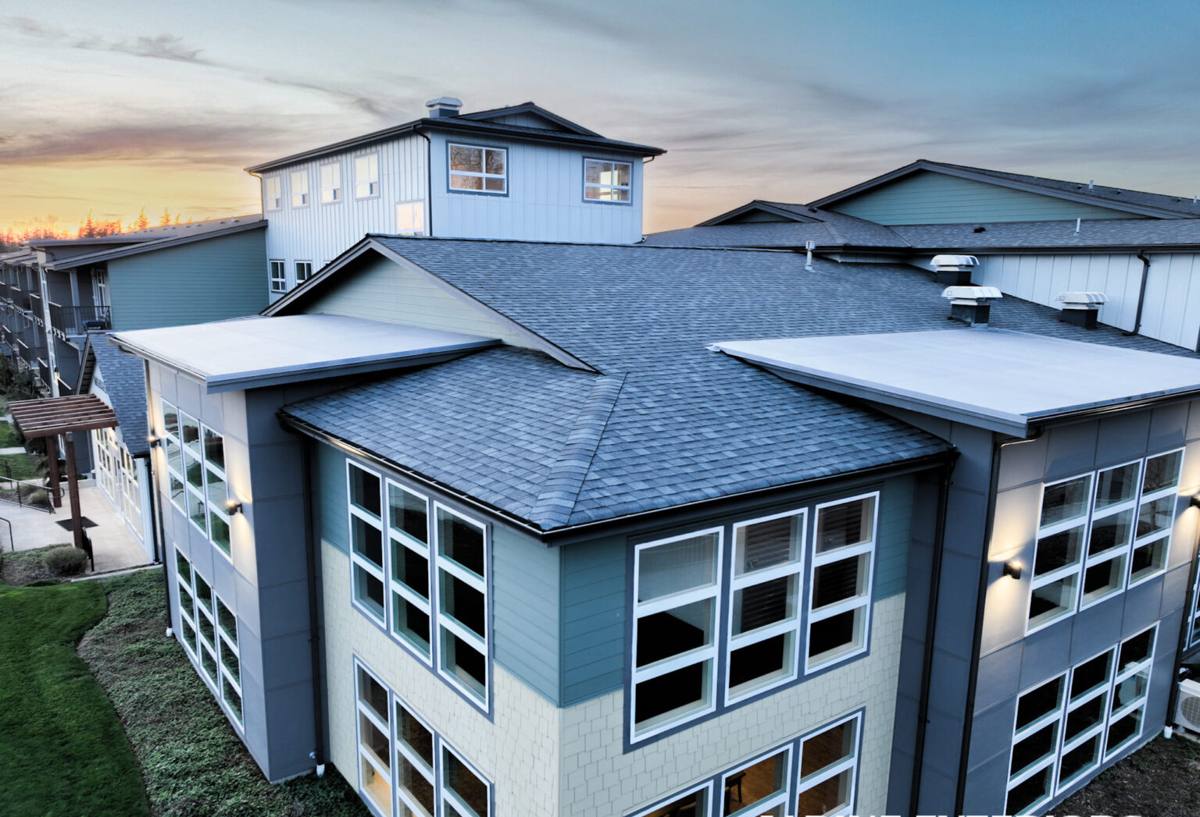
What a Correctly Built Shingle Roof Needs Here
Getting a shingle roof right in this climate isn't about buying a fancier shingle — it's about the layers underneath it and the details around it. The shingle is the visible surface; the underlayment, ventilation, and flashing are what actually keep the house dry.
Underlayment and Water-Entry Points
We use synthetic underlayment as standard across the field of the roof and self-adhered ice-and-water membrane at the vulnerable spots: eaves, valleys, around chimneys and skylights, and anywhere a roof plane meets a wall. In a region with sustained wind-driven rain, that membrane at the eaves and valleys is doing real work — it's the backup layer that keeps water out if wind pushes rain up under the shingle tabs, which happens here more than in drier climates.
Ventilation
A roof deck that can't breathe traps moisture from inside the house against the underside of the sheathing, which shortens the life of everything above it and can lead to rot you don't see until it's expensive. Balanced intake at the soffits and exhaust at the ridge is not optional in a climate this damp — it's one of the first things we check on any re-roof, and on older Custer and Bellingham homes it's often undersized or blocked by old insulation.
Fasteners and Flashing Material
Given the salt exposure closer to Bellingham Bay, we use corrosion-resistant fasteners and step flashing rather than the minimum-spec galvanized hardware that's fine in drier, inland markets. It costs a little more up front and saves a callback five years later.
Choosing a Shingle for This Climate
Most manufacturers sell several tiers of asphalt shingle. The differences matter more here than in mild, dry climates because wind uplift and algae staining are real, ongoing stresses, not occasional ones.
| Shingle Type | Typical Wind Rating | Algae Resistance | Best Fit |
|---|---|---|---|
| 3-tab (economy) | Lower | Usually none built in | Budget projects, short-hold properties |
| Architectural / laminate | Higher, multi-layer construction | Often available with algae-resistant granules | Most Bellingham-area homes |
| Premium laminate / designer | Highest in the asphalt category | Algae-resistant granules standard | Exposed, shaded, or high-visibility roofs |
For most homes in and around Bellingham, we steer people toward a mid-to-premium architectural shingle with algae-resistant (copper-infused) granules. Given the moss and shade issues common here, that granule technology is one of the few upgrades that actually pays for itself by slowing regrowth between cleanings. We're straightforward about 3-tab shingles too — they're a legitimate lower-cost option, they just carry a shorter realistic service life in this climate and we tell customers that up front rather than upselling for its own sake.
Our Installation Process
- Inspection and tear-off scope: we check the deck for soft spots and rot before quoting, rather than after the old roof is already off.
- Tear-off: full removal down to the deck — we don't layer over existing shingles, which traps moisture and hides deck problems.
- Deck repair: any soft or delaminated sheathing gets replaced, not just covered.
- Ice-and-water membrane: installed at eaves, valleys, and penetrations before the field underlayment goes down.
- Synthetic underlayment: covers the remaining field of the roof.
- Flashing: new step flashing, valley metal, and pipe boots — reused flashing is a common source of "mystery" leaks on re-roofs.
- Shingle installation: per manufacturer nailing pattern and exposure, which matters for both the wind warranty and actual wind performance.
- Ridge vent and final details: ventilation tied in, then a walk-through with the homeowner.
The Details That Actually Cause Leaks
Almost every roof leak we're called out to investigate traces back to a detail, not the shingle field. Valleys, chimney and skylight flashing, and pipe boots take the brunt of driving rain because water concentrates at these transitions instead of sheeting evenly off an open slope.
Valleys
Closed-cut and open metal valleys both work when installed correctly; what fails is undersized valley metal or valley underlayment that wasn't lapped correctly against wind-driven rain coming up the slope, which is a more realistic scenario here than in calmer inland climates.
Pipe Boots and Penetrations
Rubber pipe boot collars are usually the first component to fail on any roof, often within 10-15 years, well before the shingles are due for replacement. We flag their condition on every inspection because a five-minute boot replacement now is cheaper than the drywall repair after it fails.
Moss Control and Roof Maintenance
A shingle roof in Whatcom County needs a maintenance rhythm that a drier-climate roof doesn't. None of this is complicated, but skipping it is how a 25-30 year roof turns into an 18-year roof.
- Keep overhanging branches trimmed back so shaded slopes get more light and dry out faster after rain
- Clear debris from valleys and gutters each fall before the wet season sets in
- Have moss growth treated before it lifts shingle tabs, not after
- Check pipe boots and flashing every few years, especially after a hard winter
- Confirm attic ventilation isn't blocked by insulation added during other home upgrades
- Address any interior ceiling staining right away — it's cheaper to chase early than after it spreads
Cost Factors on a Bellingham-Area Re-Roof
Every roof is different, but the same handful of factors move the price up or down on most jobs we quote in this area.
| Factor | Why It Matters Here |
|---|---|
| Roof pitch and access | Steeper roofs and limited driveway/yard access slow the job and add safety equipment needs |
| Deck condition | Rot from long-term moss or past leaks means sheathing replacement, which isn't known until tear-off |
| Number of valleys and penetrations | More flashing detail work means more labor, regardless of shingle cost |
| Shingle tier | Algae-resistant, higher-wind-rated laminate shingles cost more than 3-tab but hold up better against local moss and storms |
| Ventilation upgrades | Undersized older systems often need added soffit or ridge venting during the same job |
We give a written, itemized quote so homeowners can see exactly what's driving the number rather than a single lump figure.
Why It Matters That We Already Work in Bellingham
A crew that works this area regularly already knows which neighborhoods sit closer to the water and need extra attention to fastener and flashing corrosion, which streets have heavy tree cover that keeps roofs perpetually damp, and how to schedule tear-offs around the wetter months so a roof deck isn't sitting open during a storm system. We also know the local permitting process and inspection expectations, so there are no surprises mid-project. That local familiarity is the difference between a roof that's built for this specific climate and one that's built to a generic spec and hopes for the best.
Getting Started
If your roof is showing granule loss in the gutters, moss on the north slope, or you just want an honest read on how many years it has left, we're happy to take a look. We'll walk the roof, check the deck and ventilation where we can, and give you a straight answer — repair, maintain, or replace — with no pressure either way. Reach out below for a free estimate.