 Custer
 Repairing Siding on a Lynden Home
Most siding repair calls in Lynden start the same way: a homeowner notices one bad spot — a cracked panel near a downspout, a soft patch below a window, a section that stayed dark and damp long after the rest of the wall dried out — and wants to know whether that spot can be fixed or whether it's the first sign of something bigger. Both are common answers, and the only way to know which one applies is a real inspection, not a guess from the driveway. We're based in Custer, a few minutes from Lynden, and we handle repair calls across this stretch of Whatcom County as a routine part of the work, not as a lead-in to an upsell pitch for a full re-side.
This page is about siding repair specifically — patching, board replacement, trim and flashing fixes, and the judgment call between repairing and replacing. We install and repair James Hardie fiber cement exclusively, so the repair methods, matching process, and long-term expectations described here are specific to that product, not a generic repair overview.
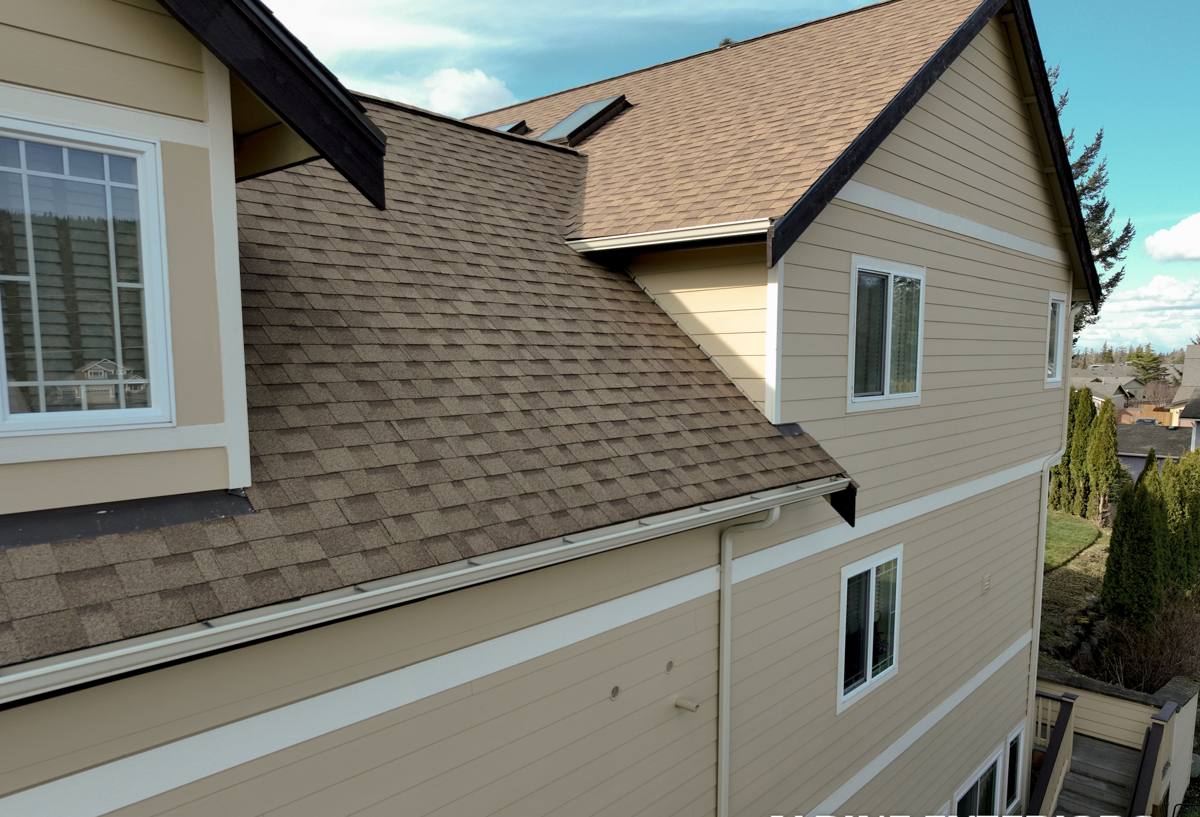
Why Lynden Siding Needs Repair in the First Place
Salt Air Working on Fasteners and Trim
Lynden is inland enough that salt exposure isn't the first thing people blame when siding fails, but marine air moves across this whole part of the county and it adds up over years. The most common place it shows is at the hardware level — corroding fasteners, rusting trim flashing, and finish breakdown around metal components — long before the fiber cement board itself is compromised. A repair that only addresses the visible board and ignores corroded fasteners underneath it tends to fail again within a season or two.
Driving Rain Finding the Weak Point
Wind-driven rain in this region doesn't fall straight down, and it finds whatever gap or failed seal already exists in a wall assembly. That's why siding damage in Lynden so often shows up at predictable spots: below window sills, around deck ledger connections, at inside corners, and anywhere trim meets siding without a clean overlap. Repair work here isn't just about replacing a damaged board — it's about figuring out why that specific spot let water in and fixing that detail too.
A Long Moss Season
Lynden's mix of open farmland and tree-sheltered lots means moss and mildew pressure varies a lot from house to house. A wall that faces open field dries out fast after rain; a shaded wall against a tree line can stay damp for weeks. Moss holds moisture against whatever it's growing on, and on siding that's approaching the end of its finish life, that trapped moisture is often what turns a cosmetic problem into a repair-or-replace decision.
What a Correct Siding Repair Actually Involves
A repair that's done right on a Lynden home follows the same discipline as a full installation, just on a smaller footprint. Skipping steps because it's "only a repair" is exactly how a patched spot fails again in a year or two.
Diagnosis Before Anything Gets Removed
We start by figuring out why the damage happened, not just what it looks like. A cracked board near a downspout might be impact damage, or it might be a downspout dumping water directly onto that section every time it rains — and those two causes call for different fixes. Cutting out the damaged board without addressing the cause just resets the clock on the same failure.
Checking the Sheathing Behind the Damage
Any time siding comes off for a repair, we check what's behind it. Fiber cement itself resists rot, but the wood sheathing and framing behind it don't, and water that got past a failed seam or crack can sit against that structure for a long time before it shows on the surface. A repair that covers over soft or damaged sheathing is a repair that will need to be redone, usually at a higher cost, once the underlying problem is bigger and more visible.
Matching Board, Profile, and Color
James Hardie's ColorPlus finish is a factory-applied, consistent color run, which makes matching an existing wall more predictable than it is with field-painted siding — but it still requires knowing the exact product line, profile, and color match, or planning a transition that doesn't look patched. On older installations where the original product line has been updated or discontinued, we talk through the realistic options with the homeowner up front rather than promising an invisible match we can't deliver.
Flashing and Sealant, Not Just the Board
Most of the repair calls we see that turn into repeat calls a year later had the visible board replaced but the flashing or sealant detail around it left alone. If the water got in around a window, at a butt joint, or where trim meets siding, that detail gets corrected as part of the repair — otherwise the new board is sitting in the same failure point as the old one.
Repair vs. Replacement: How We Make the Call
Not every damaged section justifies a full re-side, and not every re-side conversation should start with a homeowner assuming the worst. Here's roughly how the decision plays out on the properties we look at:
| Situation | Usual Recommendation |
|---|---|
| Isolated impact damage (one or two boards, recent, rest of siding sound) | Spot repair — remove and replace the damaged boards, correct the flashing detail if relevant |
| Localized rot from a single traceable source (bad flashing, downspout, roof leak) | Repair the affected section after fixing the water source, with a sheathing check underneath |
| Scattered soft spots and moisture damage across multiple walls | Depends on scope — sometimes several targeted repairs, sometimes a sign the siding is past its service life broadly |
| Siding over 20-25 years old with no documented repair history and widespread wear | Full replacement usually makes more financial sense than a series of ongoing patches |
| Cosmetic issues only (fading, minor staining, no moisture intrusion) | Cleaning or a maintenance conversation, not a repair |
We'll give a straight answer either way. A repair that's genuinely the right call costs a lot less than a re-side, and we'd rather do the smaller job well and earn a repeat call than push a bigger project a house doesn't need yet.
Signs a Lynden Home's Siding Needs a Repair Call
- A single cracked, split, or missing board after a windstorm or impact
- Soft or spongy siding in one localized area, especially low on the wall or below a window
- A section that stays visibly damp or discolored longer than the surrounding wall after rain
- Moss or staining that keeps returning to the same spot after cleaning
- Gaps opening up at trim, corners, or butt joints
- Rust streaking from a specific fastener or piece of trim hardware
- A musty smell or interior staining on a wall that backs up to a specific exterior section
Any one of these is worth a look before the next wet season gives it more time to spread. A repair caught early is usually a small job; the same issue left through another winter often isn't.
What Affects Siding Repair Cost in Lynden
Repair pricing is more variable than a full re-side, because so much depends on what's found once the damaged area opens up. A few things consistently move the number: how many boards need replacement, whether the sheathing underneath is sound or needs its own repair, how much trim and flashing work is involved in correcting the actual water source, and how close a color and profile match is available for the existing siding. We give a specific number after a real look at the damage, not a flat estimate over the phone.
Why a Local Custer-Based Crew Matters for Repair Work
Repair work rewards local knowledge more than new installation does, because so much of it comes down to recognizing patterns — which wall orientations on Lynden properties fail first, which trim details tend to be the actual water source behind a damaged board, and what a genuine James Hardie color match looks like versus a close-but-off substitute. Working out of Custer means we're on repair calls across this part of Whatcom County through every season, and it means if a repair needs a warranty follow-up or the same spot acts up again, it's a call to a crew still working in the area, not a company that did one job and moved on.
If you've got a section of siding on your Lynden home that needs a look — whether it turns out to be a quick repair or something bigger — we're glad to come take a look and give you a straightforward, no-pressure estimate. Reach out using the form below to get started.