 Custer
 Why Ferndale Homes Take a Different Kind of Beating
Ferndale sits in a stretch of Whatcom County where the weather doesn't do subtlety. Homes here deal with a steady mix of salt-tinged marine air rolling off the water, driving rain that hits siding sideways instead of straight down, and a moss season that can stretch from late fall clear into spring. None of that is dramatic on its own, but stacked together year after year, it's exactly the kind of exposure that finds every weak point in a home's exterior. If your siding has a gap, a soft spot, or a failed seal anywhere, this climate will find it before you do.
Salt Air and Coastal Moisture
Proximity to Puget Sound and the surrounding waterways means Ferndale homes get a low, constant dose of salt-laden moisture in the air. That air accelerates corrosion on exposed fasteners and metal trim, and it keeps humidity levels around the home's exterior higher than you'd see further inland. Siding materials that aren't built to handle sustained moisture exposure show it first at the edges, seams, and fastener points.
Driving Rain and Wind-Driven Wetting
Whatcom County storms don't just drop rain straight down — wind pushes it sideways into walls, under trim, and behind loose or poorly lapped siding boards. Wind-driven rain is one of the toughest tests a siding system faces, because it exploits any gap in the water-shedding details: caulk joints, flashing, butt seams, and penetrations for lights, vents, and hose bibs.
The Long Moss Season
Shade, damp ground, and mild temperatures make this part of the state ideal for moss and algae growth, and siding is a favorite surface. Moss holds moisture directly against the wall, and on materials that aren't moisture-resistant to the core, that trapped dampness can lead to softening, staining, and eventually structural decay in the substrate behind the siding — not just a cosmetic problem.
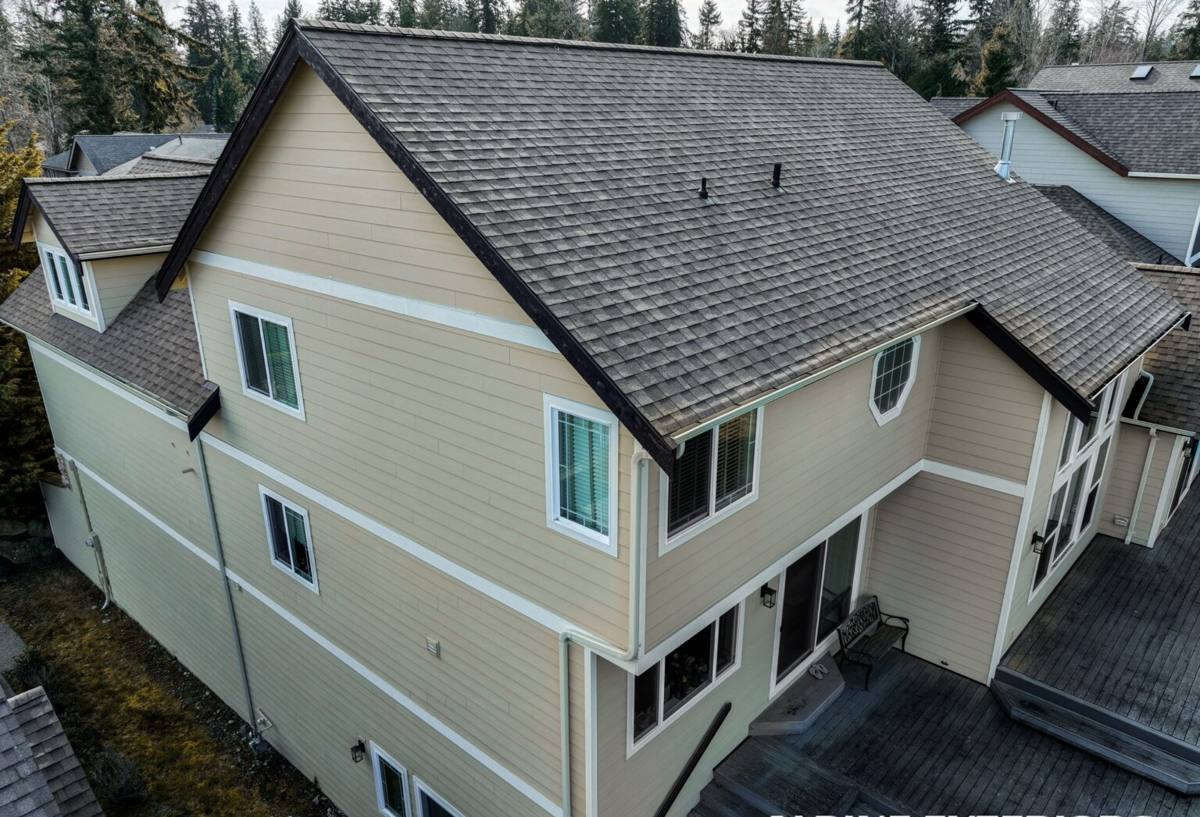
Common Siding Damage We Find on Ferndale Homes
After enough seasons of this weather pattern, certain failure points show up again and again. Knowing what to look for helps you catch problems before they turn into a bigger repair bill.
- Cracked or missing caulk at joints, corners, and trim — the single most common entry point for water
- Warped, swollen, or delaminating boards, especially on wood-based or engineered wood products that have taken on moisture
- Moss and algae staining along shaded walls, under eaves, and near ground level
- Nail pops and loose fasteners from repeated wet-dry cycling
- Soft or spongy sections that indicate moisture has already reached the sheathing behind the siding
- Faded or chalky paint on siding that was field-painted rather than factory-finished
- Gaps at window and door trim where sealant has shrunk, cracked, or pulled away
What a Correct Siding Repair Actually Involves
A siding repair that only addresses what's visible from the driveway is a repair that fails again in a year or two. Doing it right means treating every repair as a small investigation.
Start With the Cause, Not Just the Symptom
Before we touch a board, we want to know why it failed. Was it a flashing detail that was never installed correctly? A caulk joint that dried out and cracked? A moisture barrier that was compromised behind the siding? Replacing a damaged board without fixing the underlying cause just buys you a few more seasons before the same spot fails again.
Check What's Behind the Siding
Any time we pull damaged siding, we inspect the water-resistive barrier and sheathing underneath. In a climate that pushes rain sideways into walls, this step matters more here than in drier parts of the state. If the sheathing has soaked up moisture or started to soften, that needs to be addressed before new siding goes back on — otherwise you're covering up a problem instead of fixing it.
Match Material, Profile, and Reveal
A patch job that doesn't match the existing siding's profile, reveal, and finish stands out and can create new water paths where old and new material meet. Proper repair work matches these details precisely, or in some cases makes the case for a broader section replacement so the finished wall looks intentional, not patched.
Rebuild the Water-Shedding Details
Flashing above windows and doors, kickout flashing at roof-to-wall intersections, and properly lapped and sealed joints are what actually keep water out — the siding itself is really the last line of defense. Every repair we do restores these details to spec, not just to "looks fine."
Why We Repair — and Recommend — James Hardie Fiber Cement Only
We don't install or patch siding with vinyl, LP SmartSide, Cemplank, Allura, primed spruce, or cedar, and that standard applies to repair work too. It's not that these products can't be repaired — it's that in a climate like Ferndale's, repeated repair cycles on moisture-sensitive materials tend to be a losing battle. Wood and engineered wood products can swell, delaminate, or rot once moisture gets past a compromised seal. Vinyl can crack in cold snaps and fade or warp under sun and heat cycling. Every material has its trade-offs, and in our experience the trade-offs on those products show up fastest in exactly the conditions Whatcom County delivers.
James Hardie fiber cement is engineered from cement, sand, and cellulose fibers, which makes it non-combustible and dimensionally stable in wet climates — it doesn't absorb and release moisture the way wood-based products do. Hardie's ColorPlus factory finish is baked on under controlled conditions, which holds up better against UV and salt air than field-applied paint, and it comes backed by a strong, transferable limited warranty. Hardie also engineers specific product lines (its HZ5 line, for example) for colder, wetter climate zones like the Pacific Northwest, which matters when the whole point of your siding is to keep driving rain and salt air out of your walls year after year.
When we repair a home that currently has a different siding product, we're honest about what's involved: sometimes a targeted repair using compatible material is the right call, and sometimes the smarter long-term move is transitioning the affected section — or eventually the whole exterior — to Hardie. We'll tell you which situation you're in rather than pushing one answer for every job.
Our Siding Repair Process for Ferndale Homeowners
- Inspection. We walk the full exterior, not just the spot you called about, since damage in this climate often shows up in more than one place at once.
- Diagnosis. We identify the root cause — flashing, sealant failure, moisture intrusion, impact damage — and explain it in plain terms.
- Written plan. You get a clear scope of what needs to happen and why, including whether repair or partial replacement makes more sense.
- Material matching. For homes with existing Hardie siding, we match profile, reveal, and color precisely. For other materials, we discuss the best path forward with you directly.
- The repair. We remove damaged material, address the underlying cause, and install the replacement to manufacturer specification — correct fastening, correct flashing, correct sealant.
- Cleanup and walkthrough. We clear debris and walk the finished work with you before we consider the job done.
Repair vs. Replacement: How We Help You Decide
Not every damaged section needs a full re-side, but sometimes a repair is just delaying an inevitable, more expensive fix. Here's how we generally think through it:
| Factor | Leans Toward Repair | Leans Toward Replacement |
|---|---|---|
| Extent of damage | Isolated to one or two areas | Spread across multiple walls or elevations |
| Underlying sheathing | Dry, sound condition | Soft, stained, or water-damaged |
| Siding material | Existing Hardie in good general condition | Wood, LP, or vinyl showing widespread wear |
| Home's age and siding age | Siding is relatively recent | Siding is at or near the end of its service life |
| Cause of failure | One-time event (impact, isolated seal failure) | Systemic issue (chronic moisture, failed original install) |
This isn't a decision we make for you — it's one we help you make with a clear picture of what we actually find once we're up close to the wall.
Why Hiring a Crew That Already Works in Ferndale Matters
Siding repair isn't just a generic skill — it's specific to the climate it's being done in. A crew that mostly works drier inland regions may not think twice about a caulk joint that would fail here within a season, or may not recognize early moss growth as an early warning sign rather than just a cosmetic issue. Working regularly in Whatcom County, including Ferndale and the surrounding area, means we already know how this climate attacks a home's exterior and where to look first. That local familiarity translates into faster, more accurate diagnosis and repairs built to actually last through another wet season — not just look fixed on the day we leave.
Keeping Your Siding in Good Shape After the Repair
A good repair buys you years, but a little homeowner attention buys you more. Here's what we recommend for Ferndale properties specifically:
- Rinse siding annually to remove salt residue and organic buildup, especially on shaded or north-facing walls
- Trim back vegetation and tree cover that keeps siding shaded and damp longer than it needs to be
- Check and refresh caulking at trim, corners, and penetrations every couple of years — it's cheap insurance against water intrusion
- Watch for early moss or algae growth and address it before it spreads and holds moisture against the wall
- Have gutters and downspouts checked so runoff isn't discharging directly onto or behind siding
- Walk the exterior after major windstorms to catch loose panels or trim early
If you're seeing cracked caulk, soft spots, moss buildup, or siding that just doesn't look right anymore, it's worth a second opinion before it becomes a bigger repair. We offer free, no-pressure estimates for Ferndale homeowners — fill out the form below and we'll take a look and give you an honest read on what your siding actually needs.