 Custer
 What Point Roberts' Exposure Does to a House Exterior
Point Roberts sits on a peninsula surrounded by water on three sides, which means homes there take on more marine exposure than most of inland Whatcom County. Salt-laden air corrodes exposed fasteners and metal trim faster than it does even a few miles inland. Wind-driven rain off the water finds its way into lap joints and butt seams that would stay dry on a more sheltered lot. And the long Pacific Northwest damp season — often stretching from fall through spring — gives moss and algae months of shaded, moist siding surface to colonize if a house doesn't get enough sun and airflow.
None of that is unusual for western Washington. What's different in Point Roberts is the combination and the intensity: salt air plus sustained moisture plus limited afternoon sun on north- and west-facing walls. Siding that's marginal in Custer or Blaine can fail noticeably faster out here.
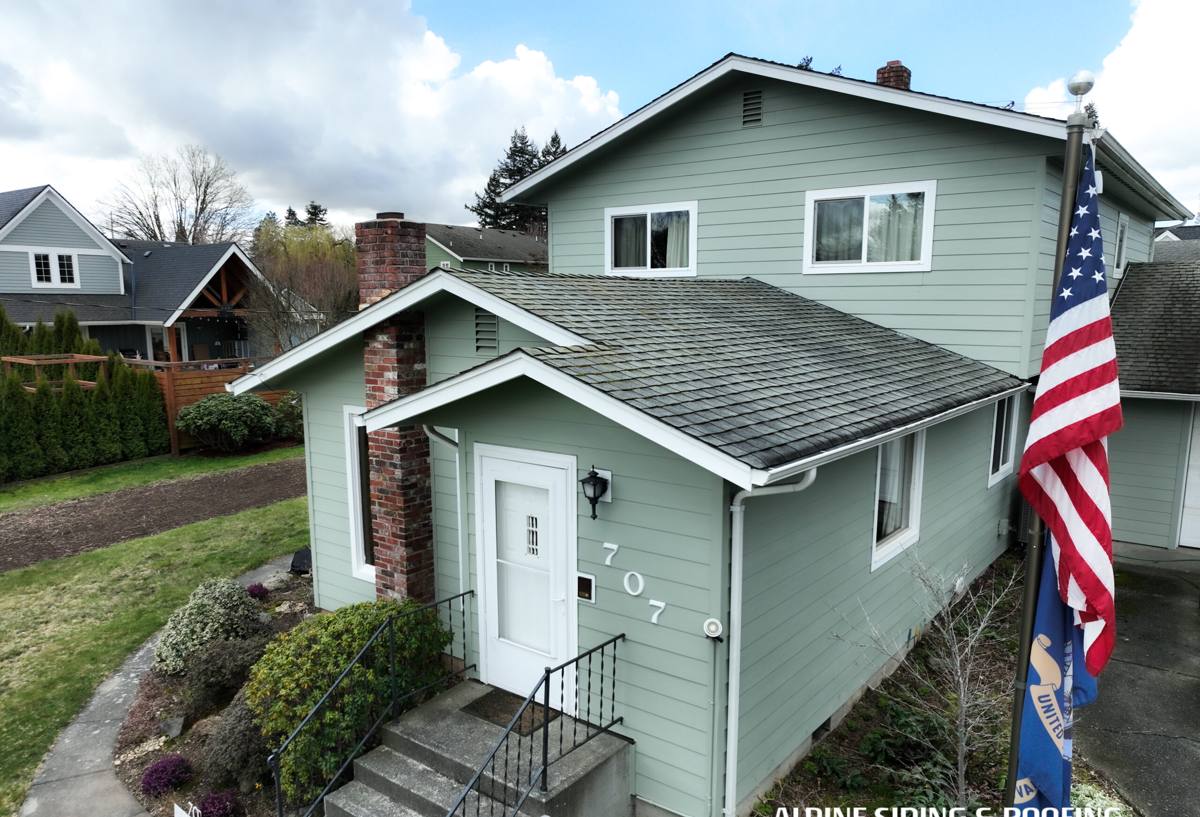
Why We Only Install Fiber Cement in Conditions Like This
We install James Hardie fiber cement siding exclusively — not vinyl, not LP SmartSide, not primed wood or cedar. In a climate like this, the reasoning is straightforward. Vinyl expands and contracts with temperature swings and can warp or crack at the fastening points over time, and it doesn't hold up as a long-term seal against wind-driven rain the way a properly lapped and caulked fiber cement system does. Wood-based products, including primed spruce and engineered wood siding, absorb moisture at cut edges and fastener penetrations; in a place that stays damp for months at a stretch, that moisture uptake is what eventually causes swelling, delamination, or rot at the bottom courses and around windows.
Fiber cement doesn't feed mold or moss the way organic wood fibers can, it's dimensionally stable in wet-dry cycling, and it's non-combustible. James Hardie's ColorPlus factory finish also means the color coat is baked on under controlled conditions rather than field-painted, which matters here specifically because a house near the water gets more UV and salt exposure on its finish than one set back in the trees.
What this doesn't mean
It doesn't mean every other siding product is unusable everywhere — plenty of homes around the country do fine with other materials in gentler climates. It means that for what Point Roberts homes actually face, we've standardized on the one material system we're confident holds up to spec, and we don't put our name on installations of products we don't believe will perform here long-term.
What a Correct Installation Requires in This Climate
Fiber cement's performance depends almost entirely on installation detail. A rushed or generic install will crack, stain, or trap moisture behind the boards regardless of how good the material is. In a marine-exposed location, a few details matter more than usual.
Clearance and drainage
James Hardie specifies minimum clearances from grade, roofing, and decks, plus a drainage plane behind the siding. On a lot with heavier rain exposure, we don't treat those clearances as suggestions — they're the difference between water shedding away from the wall assembly and water sitting against the bottom course of siding for days after a storm.
Fasteners and flashing
In salt air, fastener choice matters more than it does a few miles inland. We use fasteners and flashing rated for corrosion resistance, and we pay close attention to flashing at every penetration — windows, doors, hose bibs, light fixtures — because a pinhole gap that would be a minor issue in a drier climate becomes a chronic leak path here.
Joints, caulking, and the factory finish
Butt joints and trim transitions are where most fiber cement failures actually start. We follow Hardie's fastening and gapping specs so the caulked joints can move with the material instead of cracking open, and we keep field-cut edges primed and sealed so raw cement board doesn't sit exposed to rain before it's finished.
Getting Materials and a Crew to Point Roberts
Point Roberts is a U.S. exclave — the only way to reach it by land is by driving through Canada and back across the border. That's a logistics detail, not a talking point, but it has real effects on a siding project: material deliveries, dumpster and disposal hauls, and daily crew travel all have to account for a border crossing, not just a drive across town. A crew that doesn't regularly work in Point Roberts often underestimates this, which shows up later as delayed material arrivals or compressed on-site days.
We plan for it up front — ordering material with the border crossing built into the timeline, and scheduling crew days so a border delay doesn't stall the whole project.
Our Process for a Point Roberts Siding Project
- On-site assessment — we look at existing siding condition, sheathing moisture at grade and around openings, and how sun and wind actually hit each wall of the house.
- Product and color selection — choosing the right Hardie panel or lap profile and a ColorPlus finish, factoring in how salt air and UV exposure affect certain colors and sheens over time.
- Scheduling with border logistics in mind — material delivery, disposal hauls, and crew days are planned around the crossing, not treated as an afterthought.
- Tear-off and sheathing check — removing old siding gives us a direct look at the wall behind it; any rot or moisture damage found at this stage gets addressed before new siding goes on, not covered up.
- Installation to manufacturer spec — correct clearances, corrosion-resistant fasteners, proper flashing, and caulked joints as described above.
- Final walkthrough — checking trim lines, caulk joints, and touch-up needs before we call the job done.
Cost Factors for a Point Roberts Fiber Cement Project
Every house is different, so we won't quote a number without seeing yours, but these are the factors that actually move the price on a job like this:
| Factor | Why it matters here |
|---|---|
| Home size and number of stories | More surface area and more staging/access work on taller walls |
| Condition of existing siding and sheathing | Moisture-damaged sheathing found at tear-off has to be repaired before new siding goes on |
| Removal and disposal | Old siding hauls factor in the extra logistics of getting materials on and off the peninsula |
| Trim, fascia, and detail work | Corner boards, window trim, and transitions take more time to flash and seal correctly than flat wall runs |
| Siding profile and accessories | Lap width, panel style, and accessory trim (soffit, corners) affect both material cost and labor |
Living With Fiber Cement Through the Moss Season
Fiber cement is low-maintenance compared to wood, but "low-maintenance" doesn't mean "no maintenance," especially with the amount of damp weather this area sees. A little seasonal attention keeps a correctly installed job looking and performing the way it should for decades.
- Rinse salt residue and grime off exterior walls once or twice a year, especially on sides facing open water
- Keep gutters and downspouts clear so water isn't overflowing down the face of the siding
- Trim back shrubs and tree branches that shade siding and keep it damp longer than the rest of the house
- Check caulked joints around windows, doors, and trim annually and have any cracked or separated caulk redone
- Address moss or algae growth early with a gentle wash rather than letting it build up over multiple seasons
- Watch for any soft spots or discoloration near the bottom courses, which can signal a drainage or clearance issue worth having checked
Why Hiring a Crew That Already Works in Point Roberts Matters
Beyond the border-crossing logistics already mentioned, a crew that's worked in Point Roberts before understands the specific ways this location's exposure differs from a typical Whatcom County lot — which walls tend to take the worst of the wind-driven rain, where moss tends to establish first, and how much more attention corrosion-prone details deserve near the water. That experience shows up in the small decisions made during installation, not just in the finished look. It also matters for warranty follow-up: a company that's already set up to work in Point Roberts can actually get back out to your property if something needs attention down the road, instead of treating a return trip as a logistical problem.
If you're weighing siding options for a Point Roberts home, we're happy to walk the property, look at what your walls are actually dealing with, and give you a straightforward, no-pressure estimate for a James Hardie fiber cement installation built for this climate — just fill out the form below to get started.