 Custer
 Point Roberts Sits in a Tougher Spot for Outdoor Structures
Point Roberts is one of the more unusual places to build in Whatcom County. It sits on a peninsula that juts south from British Columbia into the Strait of Georgia, which makes it a U.S. exclave — the only way in or out by land is through Canada. That geography matters for more than just getting groceries. It means the community sits fully exposed to marine weather coming off open water, with none of the wind and rain breaks that inland Custer or Ferndale properties get from tree cover and terrain.
For a deck, that exposure is constant. Salt-laden air moves in off the strait daily, driving rain comes in sideways during fall and winter storms, and the damp, low-light stretches of the Pacific Northwest give moss and algae months at a time to establish themselves on any horizontal wood surface. A deck built to a generic spec — the kind that might hold up fine forty miles inland — often shows problems here within a few seasons: soft spots, corroding hardware, slick green film, boards cupping at the edges. None of that is inevitable. It just means the materials, fasteners, and drainage details have to be chosen for this specific environment, not a general one.
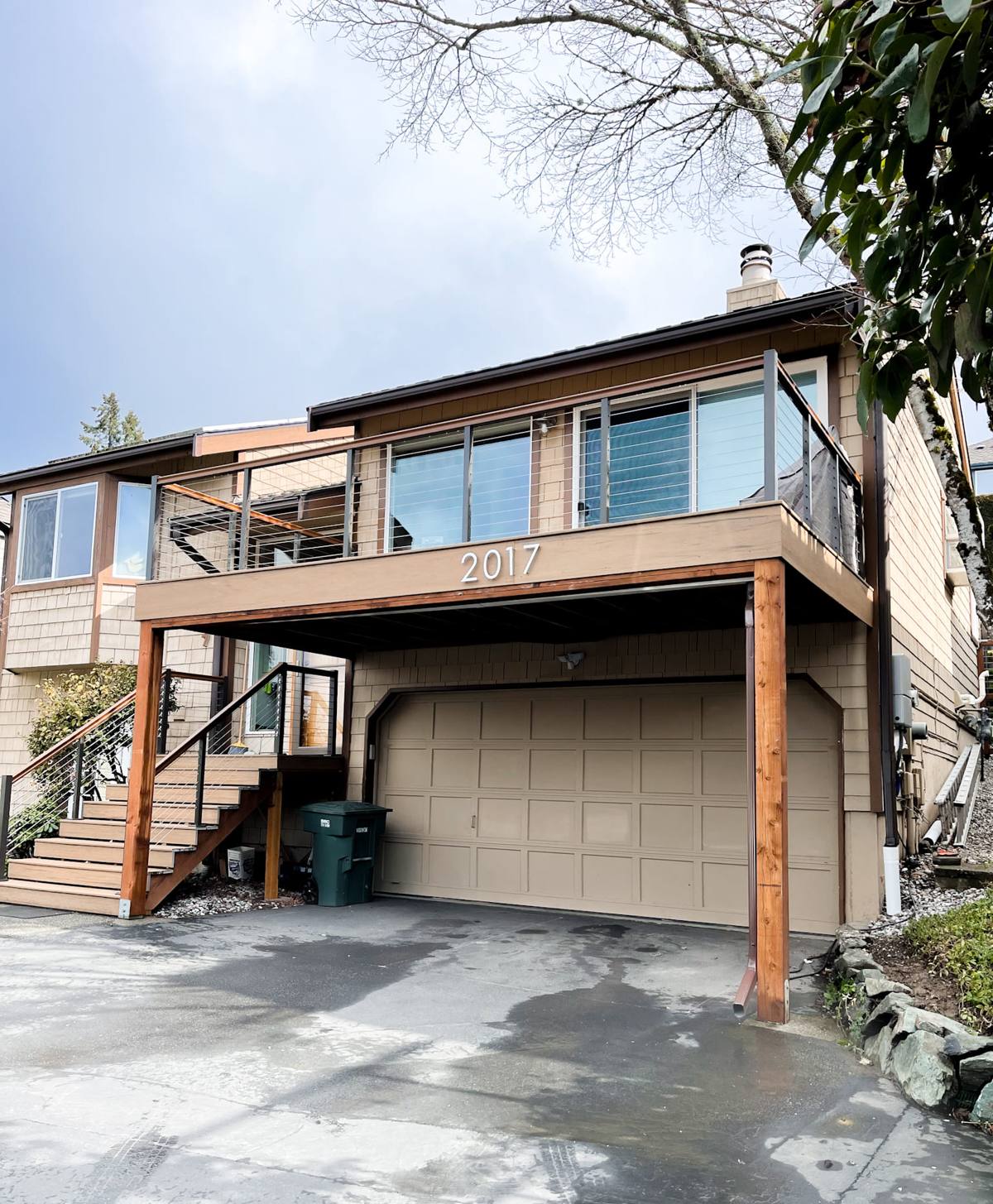
What Salt Air, Rain, and Moss Actually Do to a Deck
Salt Air and Corrosion
Airborne salt accelerates corrosion on anything metal — nails, screws, joist hangers, post bases, railing brackets. Standard galvanized coatings that are perfectly adequate a few miles inland can start breaking down faster in a marine environment, and once corrosion starts on structural hardware, it's invisible until it's a real problem, because it's usually hidden under decking boards or behind railing posts.
Standing Water and Rot
Driving rain doesn't just fall straight down — wind pushes it under railings, into ledger board connections, and into any gap where end grain is exposed. Wood absorbs water fastest through its end grain, so cut ends, notches, and fastener holes are where rot typically starts. If water can get in and can't drain or dry out quickly, the clock starts running on structural decay, usually well before it's visible from the surface.
Moss, Algae, and Slip Risk
Whatcom County's moss season runs long — realistically from fall through spring, with shaded or north-facing decks staying damp even longer. Moss and algae don't just look bad; they hold moisture against the wood surface and turn a deck slick and genuinely dangerous underfoot, especially on stairs. A deck with poor airflow underneath, tight board spacing, or heavy shade will grow moss faster than one built with drainage and drying in mind from the start.
Choosing a Decking Material That Can Handle It
There's no single "right" decking material for every home — it depends on budget, how much maintenance the owner wants to take on, and how exposed the deck is. Here's how the common options actually perform in a salt air, high-rain, moss-prone environment like Point Roberts:
| Material | Moisture & Salt Air Resistance | Moss/Algae Growth | Maintenance | Typical Lifespan |
|---|---|---|---|---|
| Pressure-treated lumber | Good if properly sealed; end cuts need field treatment | Moderate — porous surface holds moisture | Annual cleaning and periodic re-sealing | 15–20 years with upkeep |
| Western red cedar | Naturally rot- and insect-resistant, but still needs sealing near the water | Moderate — grows on any bare wood left damp | Sealing every 1–2 years to maintain color and protection | 15–25 years with upkeep |
| Capped composite/PVC decking | Excellent — non-porous surface, doesn't absorb water | Lower, but still requires occasional washing | Periodic washing; no sealing or staining | 25–30+ years, backed by manufacturer warranty |
| Tropical hardwoods (e.g., ipe) | Excellent natural density and rot resistance | Low, but surface can stay slick when wet | Oiling to maintain color; otherwise low | 25+ years |
For a home this close to open water, we generally steer clients toward capped composite or a dense hardwood when budget allows, simply because the maintenance burden is lower and the material isn't relying on a sealant coat to keep moisture out. That said, cedar and treated lumber are legitimate choices too — they just need a homeowner willing to stay on top of sealing on a real schedule, not just when it starts looking dry.
The Build Details That Determine Whether a Deck Lasts
The decking material gets most of the attention, but in a climate like this, the details underneath and around it usually decide whether a deck makes it to 25 years or starts failing at year eight.
- Fasteners: Stainless steel or coated fasteners rated for coastal/marine exposure, not standard galvanized, especially for anything below the deck surface where corrosion isn't visible.
- Ledger board flashing: Where the deck attaches to the house, proper flashing keeps water from tracking behind siding and into the wall assembly — this is one of the most common failure points on older decks we've inspected.
- Joist protection: A butyl or membrane tape over the top of each joist keeps water from soaking into the wood through fastener holes, which is where rot most often starts on a treated frame.
- Board spacing: Correct gapping between boards lets water drain through instead of sitting on the surface, and lets air move underneath to help the deck dry after rain.
- Post bases: Posts should sit on raised metal bases, never buried in or directly touching concrete, so the end grain isn't sitting in trapped moisture.
None of these show up in a photo of a finished deck, but they're the difference between a structure that ages gracefully and one that needs boards replaced within a few winters.
Footings, Framing, and Permits
Decks need footings sized and set to the correct depth for the local frost line, with framing sized for the actual span and expected loads — snow, furniture, hot tubs if that's the plan. Attached decks also need a properly bolted, flashed ledger connection rather than one that just relies on nails and hope. Most jurisdictions, including Whatcom County, require a permit once a deck rises to a certain height above grade or attaches directly to the house, so this isn't optional paperwork to skip — it's also a second set of eyes on the structural design before it's buried under decking boards. We handle the permitting conversation as part of the process rather than leaving homeowners to figure out the county's requirements on their own.
Our Process for Point Roberts Deck Projects
Building in Point Roberts takes a bit more planning than a job in Custer or Ferndale, simply because of the exclave logistics — crews and material deliveries have to route through the border crossing, and that means scheduling has to account for wait times rather than assuming same-day flexibility.
- Site visit and assessment: We look at sun exposure, wind direction, drainage, and how the existing structure (if any) has held up, which tells us a lot about what the next deck needs to do differently.
- Material and design discussion: We walk through the tradeoffs — composite versus wood, railing style, footprint — with honest maintenance expectations, not just upfront cost.
- Permitting: We handle the Whatcom County permit application and any required inspections tied to the build.
- Scheduling and logistics: Material deliveries and crew days are planned around the border crossing so the job doesn't stall waiting on a delivery that's stuck at Tsawwassen.
- Construction: Footings, framing, flashing, decking, and railing, built to the details above rather than a stripped-down minimum spec.
- Final walkthrough: We go over the finished deck together, including what maintenance it'll actually need and roughly when.
Keeping Moss and Mildew From Taking Over Once It's Built
Even a well-built deck needs some seasonal attention in this climate — the goal is to stay ahead of moss and moisture rather than scrub it off once it's established. A basic yearly routine goes a long way:
- Sweep debris (leaves, needles, seed pods) off the deck regularly through fall — trapped organic matter is what moss and algae feed on.
- Wash the surface at least once a year with a deck-safe cleaner; a pressure washer on the wrong setting can damage wood fibers or composite caps, so keep it low-pressure and wide-fan.
- Check and clear any gaps between boards that have filled with debris, since that's exactly where moisture gets trapped.
- Inspect railing posts and stair connections annually for any give or corrosion at the hardware.
- Re-seal wood decking (cedar or treated lumber) on the schedule the product actually calls for, not just when it visibly grays out — by the time it looks dry, moisture has usually already been getting in underneath.
- Trim back overhanging branches or shrubs that keep sections of the deck shaded and damp longer than the rest.
Why Hiring a Crew That Already Works in Point Roberts Matters
A contractor who hasn't built here before is learning the border logistics, the county's permitting process, and the exposure this peninsula actually gets in real time, on your project. That shows up as delays, underspecified hardware, or a deck detailed like it's twenty miles inland instead of sitting in the salt air off the strait. We already know the routine — how to schedule crossings so a job doesn't sit waiting on a delivery, what the county expects for permitting on an attached versus freestanding deck, and which fastener and flashing specs actually hold up out here instead of failing quietly under the boards. That experience doesn't show up in a quote, but it shows up in how the deck looks and performs five and ten years out.
If you're planning a new deck or replacing one that's showing its age, we're glad to come take a look and talk through what makes sense for your home and budget — no pressure, no obligation. Use the form below to request a free estimate.