 Custer
 Why Nooksack Siding Has to Work Harder Than the Average Product Spec
Nooksack sits in a stretch of Whatcom County where the weather doesn't give a house many breaks. Salt-laden air moves in off the water, driving rain comes sideways for weeks at a stretch in the fall and winter, and the gray months bring a moss season long enough that anything wood-based on the north or shaded side of a house is fighting a losing battle by year three or four. Siding here isn't decorative — it's the single largest piece of moisture management your house has, and it's on duty every day of the year, not just during a storm.
That's the lens we use when we talk to homeowners about what to put on their walls. A product that looks fine in a showroom in a dry climate can behave very differently after a few winters of saturated ground, wind-driven rain, and salt exposure. That's the whole reason this company installs James Hardie fiber cement siding exclusively — it's the product we've found actually holds up to what this specific corner of Washington throws at it, year after year, without the maintenance treadmill that softer materials demand.
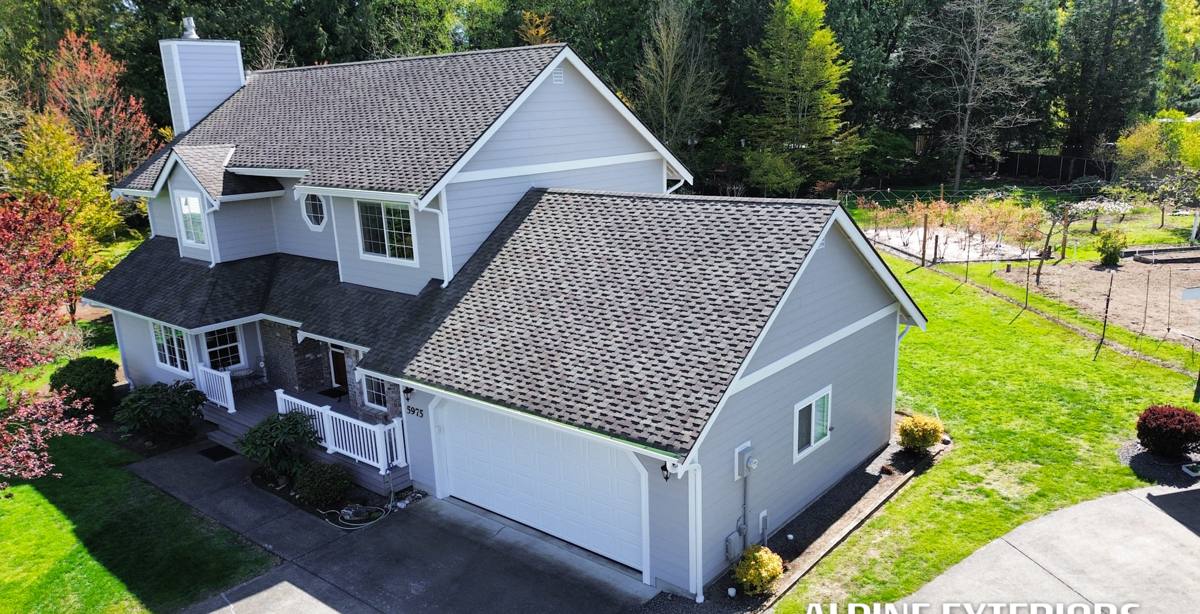
What James Hardie Actually Solves for This Climate
Moisture and dimensional stability
Fiber cement is engineered from cement, sand, and cellulose fibers, which means it doesn't absorb and release moisture the way wood-based products do. In a climate with driving rain and long stretches of damp air, that matters enormously. Wood and wood-composite sidings swell when wet and shrink when they dry, and that repeated movement is what eventually opens up seams, cracks paint, and lets water behind the cladding. Hardie's fiber cement stays dimensionally stable through that cycle, which is a big part of why it doesn't rot, cup, or delaminate the way softer materials can after a few Whatcom County winters.
Fire resistance
James Hardie siding is non-combustible. That's not the primary reason most Nooksack homeowners call us, but it's a real, tangible benefit that vinyl and wood-based sidings simply can't match, and it's one more reason we don't hedge on which product we put on a house.
Built for this specific climate zone
James Hardie doesn't make one product for the whole country — its HZ5 engineered formulation is built specifically for climates like ours, where freeze-thaw cycles, sustained moisture, and coastal air are the norm rather than the exception. That's a meaningful difference from a generic fiber cement or composite product that wasn't engineered with this kind of weather in mind.
The James Hardie Product Lines We Use in Nooksack
Not every Hardie product fits every house, and part of doing this job right is matching the siding profile to the home's style, exposure, and existing trim details. Here's how the main lines typically get used on homes in this area:
| Product Line | Typical Use | Why It Fits This Climate |
|---|---|---|
| HardiePlank Lap Siding | Most common choice for full re-sides on traditional and craftsman-style homes | Wide range of exposure widths and textures; sheds driving rain efficiently when lapped and fastened correctly |
| HardieShingle | Accent gables, dormers, and homes going for a coastal or cottage look | Won't cup or split like cedar shingles exposed to constant damp and salt air |
| HardiePanel | Modern or farmhouse-style vertical siding, porch ceilings, accent walls | Clean lines that hold up without the seam movement of wood board-and-batten |
| HardieTrim | Fascia, corner boards, window and door trim | Matches the siding's moisture behavior so trim and field siding age together instead of the trim rotting first |
Color and Finish: ColorPlus vs. Field-Applied Paint
One of the most overlooked details on a Hardie install is the finish. James Hardie's ColorPlus technology bakes the color onto the board at the factory in a controlled environment, which produces a more consistent, UV- and moisture-resistant finish than paint applied on site after installation. In a climate with this much sustained rain and salt exposure, that factory finish matters — it's less prone to the early fading and touch-up cycle you'll eventually deal with on a field-painted board. We install ColorPlus siding on the large majority of Nooksack projects for exactly that reason, and we walk homeowners through the color and texture options as part of the estimate, not as an afterthought.
What a Correct Nooksack Installation Actually Involves
Fiber cement is only as good as the installation underneath it. This is where a lot of siding jobs — regardless of brand — go wrong, and it's the part homeowners can't always see once the project is done.
Clearances and drainage
Hardie's own installation instructions call for specific clearances between the bottom of the siding and roof lines, decks, patios, and grade. In a wet climate, skipping these clearances is one of the fastest ways to trap moisture at the bottom edge of a wall, which is exactly where we see the worst rot on old siding tear-offs. We also install a proper drainage plane — typically a weather-resistant barrier with a rain screen gap — so that any moisture that does get behind the cladding has somewhere to go instead of sitting against the sheathing.
Fastening and flashing
Hardie siding needs to be fastened at the correct pattern and depth — not too shallow, not overdriven — or it won't perform the way it's engineered to. Flashing at every horizontal transition, window, door, and roofline penetration is non-negotiable in a climate that sees this much driving rain; a missed flashing detail is very often the actual cause of a "siding failure" that gets blamed on the product itself.
A few things we check on every job before we call it done
- Correct bottom clearance from grade, roofing, decks, and walkways
- Weather-resistant barrier installed and lapped correctly, with a functioning drainage gap
- Flashing at every window, door, and horizontal siding transition
- Fasteners at the manufacturer's specified pattern, depth, and location
- Caulking used only where Hardie's specs call for it — not as a substitute for proper flashing
- Trim, corner boards, and siding all installed to the same moisture-management standard
Our Process, Start to Finish
- On-site assessment. We look at the existing siding, sheathing condition, and any problem areas — north-facing walls, spots with heavy moss, areas near grade — before we quote anything.
- Tear-off and inspection. Old siding comes off and we inspect the sheathing underneath. If there's rot or water damage from a previous installation, we address it before anything new goes up — covering a bad substrate with new siding just hides the problem.
- Weather barrier and drainage plane. This layer goes on correctly the first time, since it's the last line of defense once the siding is up.
- Siding and trim installation. Installed to Hardie's fastening, clearance, and flashing specifications, not shortcuts.
- Final walkthrough. We go over the finished work with the homeowner and confirm everything meets the standard we'd want on our own house.
Living With Hardie Siding in a Nooksack Climate
One of the real advantages of fiber cement in this area is how little it demands from a homeowner afterward. It won't need repainting on the schedule that wood or old vinyl does, and it doesn't rot. That said, this climate's long moss season means algae and moss can still build up on siding surfaces, especially on shaded north walls and under tree cover — that's a surface-level growth issue, not a sign the siding is failing, and it typically comes off with a gentle wash rather than pressure that could damage the finish. Keeping gutters clear and making sure downspouts direct water away from the foundation also goes a long way toward keeping moisture away from the base of the siding, which is the area under the most stress in a wet climate.
Cost Factors on a Nooksack Hardie Project
Every house is different, but the same handful of factors drive the cost on most projects we quote in this area:
| Factor | Why It Matters |
|---|---|
| Square footage and wall complexity | More corners, gables, and dormers mean more cutting, flashing, and labor time |
| Condition of existing sheathing | Rot or water damage found during tear-off adds repair work before siding can go on |
| Siding profile and texture | Lap siding, shingle-style accents, and panel siding carry different material and labor costs |
| ColorPlus vs. custom paint | Factory-finished ColorPlus is typically more cost-effective long term than field painting |
| Trim scope | Full trim replacement alongside siding changes the total but keeps the whole exterior aging at the same rate |
As a very rough starting point, a full single-family re-side with James Hardie in this area often lands in the mid five-figure range, though smaller homes or partial re-sides can run lower and larger or more complex homes can run higher. We don't quote real numbers until we've actually looked at the house.
Why Hiring a Crew That Already Works Nooksack Matters
Installation quality is the biggest variable in how long any siding lasts, and that's true of Hardie siding as much as anything else. A crew that already works this stretch of Whatcom County knows what this climate does to a wall that isn't flashed correctly, has already seen what happens on the shaded, moss-prone sides of houses here, and isn't guessing at clearances because it's their first time working in this kind of sustained wet weather. That local experience shows up in details a homeowner may never think to check — but that determine whether the siding is still performing well in fifteen years or starting to show problems in five.
If you're weighing a siding replacement or new construction siding in Nooksack, we're happy to come take a look at your home, walk you through what James Hardie would involve for your specific house, and put together a straightforward, no-pressure estimate — just use the form below to get started.