 Custer
 Why Birch Bay Roofs Wear Differently Than Roofs Ten Miles Inland
Birch Bay sits right on the water, and that changes what a roof has to deal with day to day. Salt-laden air moves off the bay and settles on every exposed surface, including fasteners, flashing, and any metal that isn't rated to handle it. Add Whatcom County's long wet season — months of low-intensity, driving rain pushed sideways by wind off the Strait of Georgia — and you've got a roof that stays damp longer than one a few miles inland. Damp plus shade plus mild temperatures is exactly what moss wants, and Birch Bay's tree cover and marine humidity give it a long growing season to work with.
None of that makes metal roofing a bad choice for Birch Bay. It's usually the opposite — metal handles wind-driven rain and moss better than most roofing materials when it's specified and installed correctly. But "correctly" is doing a lot of work in that sentence, and it's where a lot of roofs in this area fall short.
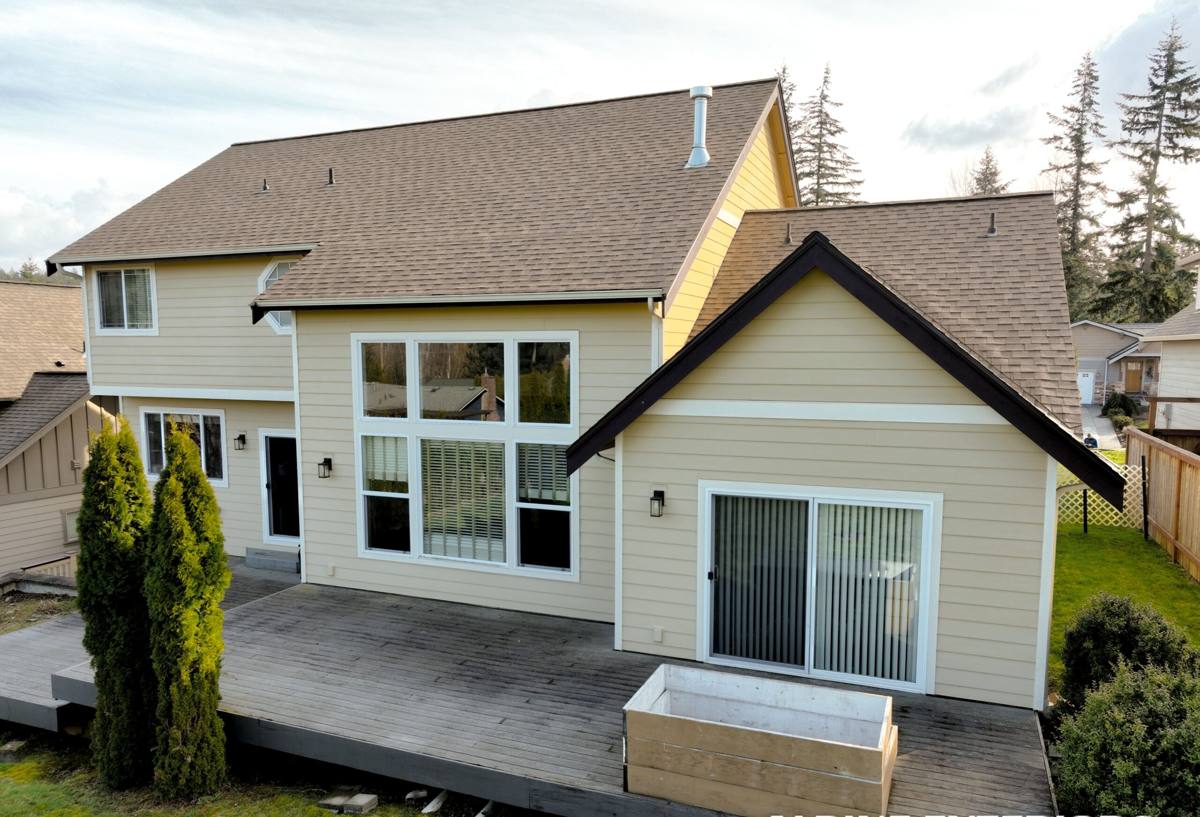
What a Metal Roof in Birch Bay Actually Needs to Hold Up
Corrosion Resistance, Not Just a Coating
Close to the water, fastener and flashing corrosion is the most common early failure point on metal roofs — not the panels themselves. Cheap or mismatched fasteners rust and streak the roof, and once a fastener's seal fails, water gets underneath the panel where it can sit against the deck. For a bay-facing roof, we spec fasteners and flashing rated for coastal exposure and match metals so you don't get galvanic corrosion where two dissimilar metals touch.
Wind-Driven Rain Management
Rain that comes in sideways doesn't behave like rain that falls straight down. It can work its way under lapped panels or through fastener penetrations that would be fine in a calmer inland location. That means underlayment, panel overlap, and sealant details matter more here than they do a few miles away, and it's not a place to cut corners on the "invisible" parts of the job.
Moss and Organic Growth
Metal roofing doesn't feed moss the way wood shakes or granulated shingles can, but that doesn't make it moss-proof. Debris that collects in valleys, against fascia, or on low-slope sections still holds moisture and gives moss and algae something to grab onto. Panel profile, slope, and how clean the roof-to-wall and valley details are built all affect how much moss becomes a problem over time.
Metal Roofing Options for Birch Bay Homes
Not every metal roof system is built the same way, and the right choice depends on the home, the budget, and how much maintenance the owner wants to take on. Here's how the common options compare for a shoreline property like the ones around Birch Bay:
| System | Fastener Exposure | Typical Lifespan Here | Best Fit |
|---|---|---|---|
| Standing seam | Concealed clips, no exposed fasteners on the field | Longest of the common options when installed correctly | Full re-roofs, homes closest to the water, owners who want the lowest long-term maintenance |
| Exposed-fastener panel (screw-down) | Fasteners through the panel face | Shorter than standing seam; fastener seals are the weak point | Shops, outbuildings, budget-driven projects where some future fastener maintenance is acceptable |
| Stone-coated steel | Concealed, similar to shingle-style install | Long, with good wind and impact resistance | Owners who want a shake or tile look with metal's durability |
For most Birch Bay homes exposed to open bay wind and salt spray, we lean toward standing seam because it has no exposed fasteners for salt air to attack. Exposed-fastener panels aren't wrong for every application — they cost less and go on faster — but we're upfront that the fastener seals will need periodic checking over the life of the roof, and that trade-off matters more here than it would inland.
What a Correct Metal Roof Installation Involves
A metal roof is only as good as what's underneath it. The panels get the attention because they're visible, but the parts that actually determine whether the roof performs are mostly hidden once the job is done.
- Deck inspection and repair — any soft, rotted, or previously water-damaged decking gets replaced before anything goes on top of it, not covered over.
- High-quality synthetic underlayment — a proper moisture barrier matters more on a bay-facing roof than almost anywhere else in the county.
- Ice-and-water shield at vulnerable points — valleys, eaves, and roof-to-wall transitions get extra protection where wind-driven rain is most likely to find a way in.
- Correct panel overlap and seam direction — run with prevailing wind and rain patterns, not just whatever's convenient to install.
- Coastal-rated fasteners and flashing — matched metals, correct gauge, and washers rated for the exposure.
- Proper attic and roof ventilation — keeps condensation from forming under the panels from the inside, which is a separate problem from rain getting in from the outside.
- Clean valley and flashing details — fewer ledges and gaps for debris and moss to take hold.
Skip any one of these and the panels can still look fine for a few years while a slower problem builds underneath. That's the failure pattern we see most often on re-roof jobs in this area — not the metal failing, but something under it that was never addressed.
Our Process for a Birch Bay Metal Roof
- On-site assessment. We look at the existing roof, the deck condition, slope, exposure to prevailing wind and salt spray, and any moss or moisture staining that points to an existing problem.
- Honest scope and options. We walk through panel system options, what each one costs to maintain over time, and what actually fits the home and the budget — not just the highest-margin option.
- Written estimate. Clear line items for materials, underlayment, flashing, and labor, so there's no guessing at what's included.
- Tear-off and deck repair. Old roofing comes off, the deck gets inspected, and anything compromised is replaced before installation starts.
- Installation to spec. Underlayment, flashing, and panels go on in the order and manner that hold up to this specific climate, not a generic install.
- Final walkthrough. We go over the finished roof with the homeowner, including what maintenance to expect and when.
Maintenance in a Salt Air, High-Moisture Climate
A well-installed metal roof in Birch Bay needs less maintenance than most roofing materials, but "less" isn't "none." A short seasonal routine catches small issues before they become roof-replacement issues.
- Clear debris from valleys and low-slope sections after fall leaf drop and windstorms.
- Check gutters and downspouts so water isn't backing up against roof edges.
- Look for early moss or algae growth in shaded or north-facing sections and remove it before it spreads.
- Have exposed fasteners (on screw-down systems) checked periodically for seal wear.
- Watch for streaking near flashing or fasteners, which can be an early sign of corrosion starting.
- After major windstorms off the bay, do a visual check for lifted or shifted panels.
Why It Matters to Hire a Crew That Already Works Birch Bay
A lot of roofing crews can install metal panels. Fewer of them install roofs regularly on homes that sit right on open water with salt spray and near-constant wind exposure. That difference shows up in the small decisions — which fasteners to spec, how tight to run flashing details, which panel system actually makes sense for a specific lot's exposure versus a more sheltered, tree-covered one a few blocks inland.
We're based in Custer and work this stretch of Whatcom County regularly, so we're not learning the local conditions on your project. We know how differently a roof on a wide-open bayfront lot behaves compared to one tucked back in the trees, and we spec accordingly instead of using the same install everywhere.
Metal Roof vs. Repair: Knowing Which One You Need
Not every roof problem in Birch Bay means a full replacement. Some signs point to a repair; others mean the roof has reached the end of its useful service life and a patch job is just delaying the inevitable.
| Sign | Usually Means |
|---|---|
| Isolated leak at a single flashing point | Targeted repair, not a full re-roof |
| Widespread rust or fastener corrosion across the roof | The fastening system has reached the end of its life; replacement is more cost-effective than repeated repairs |
| Heavy moss coverage with no underlying deck damage | Cleaning and maintenance may be enough |
| Soft spots, sagging, or stained decking visible from the attic | Underlying moisture damage — needs a full inspection before deciding on repair vs. replacement |
If you're not sure which category your roof falls into, that's exactly what an on-site assessment is for. We'll tell you plainly if a repair will get you several more good years out of the roof, rather than pushing a replacement you don't need yet.
Cost Factors for a Birch Bay Metal Roof
Every roof is different, but the main variables that move the price on a metal roofing project here are consistent: the panel system chosen, roof size and complexity (number of valleys, penetrations, and roof planes), the condition of the existing deck once torn off, and how much of the coastal-rated detail work — flashing, fasteners, underlayment — the job requires. A simple, single-plane roof will always cost less than one with multiple dormers, valleys, and roof-to-wall transitions, regardless of which panel system you choose. We give a firm written number after seeing the roof in person rather than a phone estimate, because deck condition especially can't be judged from a photo.
If you're weighing a metal roof for a home in Birch Bay, we're happy to take a look and walk you through what your specific roof needs — no pressure, no obligation. Reach out below for a free estimate.