 Custer
 Meridian's Climate Is Harder on Siding Than It Looks
Meridian sits in the stretch of Whatcom County between Custer and the rest of the county's low, open farmland — close enough to the Salish Sea to catch salt-laden air on windy days, open enough to take driving rain straight on, and shaded and damp enough through the fall, winter, and spring to grow moss on almost anything that holds moisture. None of those three things is dramatic on its own. Together, over years, they're exactly the combination that finds the weak point in a siding system and works on it until something fails — a swollen seam, a soft spot behind a downspout, paint that's chalked and peeling five years early.
Homes in this area don't need siding that merely looks good going up. They need a material and an installation that can shed wind-driven rain without trapping it, resist the slow chemical effect of salt air on fasteners and finishes, and not give moss and mildew anything organic to feed on. That's the standard we hold every Meridian project to, and it's why we install one product system rather than whatever a homeowner happens to ask for.
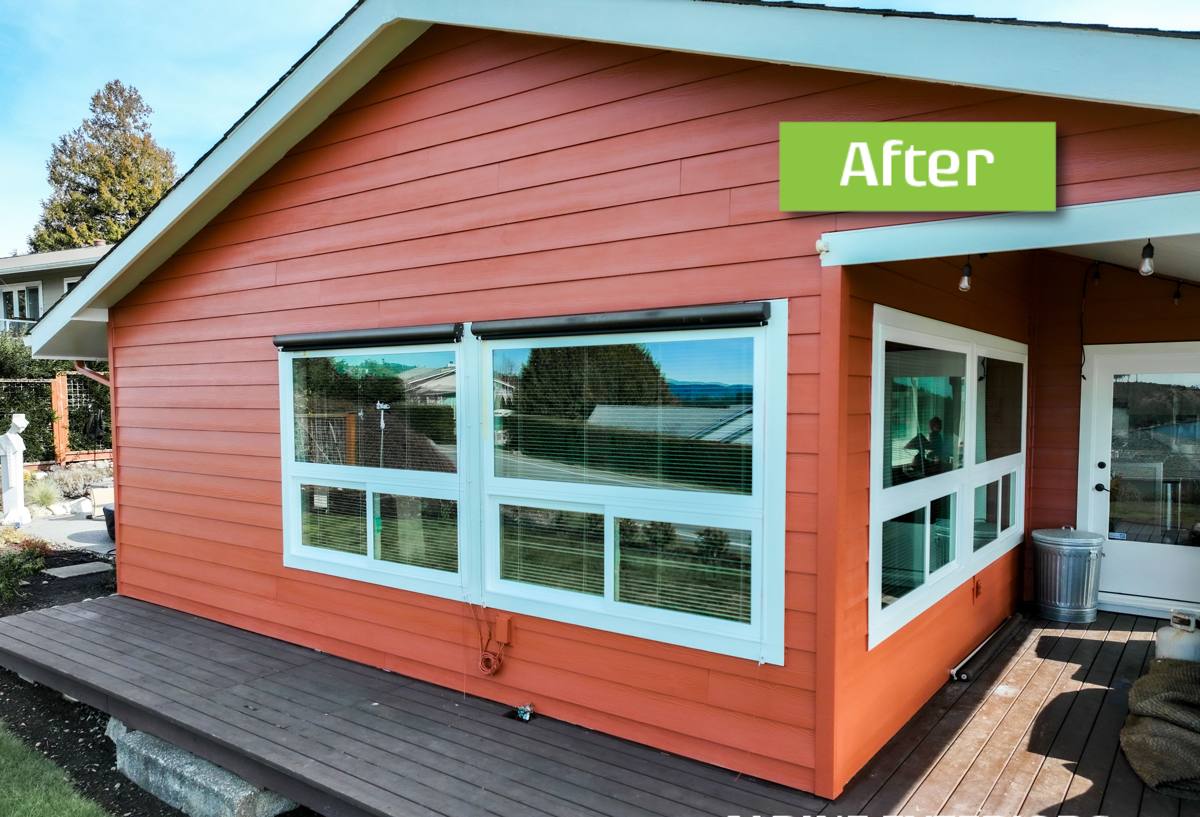
Why Fiber Cement Is the Right Category for This Area
Fiber cement is a mix of cement, sand, and cellulose fiber, pressed and cured into a rigid board. It doesn't rot, it isn't a food source for moss or mildew the way wood is, and it holds its shape through the wet-dry cycling that's constant in a coastal-influenced Whatcom County climate. That combination matters more in Meridian than it does in a drier inland market, because the freeze-thaw and soak-dry cycles here are frequent, not occasional.
It's also non-combustible, which is a real advantage during Washington's dry summer stretches when wildfire smoke and regional fire risk are a normal part of the season, even for homes nowhere near a fire line.
What It Doesn't Solve By Itself
Fiber cement is durable, but it isn't magic. A poor installation — wrong fastener placement, no rainscreen gap, caulked joints that should have been left to drain, siding run too close to grade — will let this climate find problems in fiber cement almost as fast as it would in a lesser material. The product matters. The installation matters just as much.
Why We Only Install James Hardie
Fiber cement isn't a single product — brands vary in formulation, factory finish, and engineering, and we've made a deliberate call to install only James Hardie. A few reasons drive that:
- Climate-engineered product lines. Hardie makes HZ5 formulations specifically for regions with the kind of moisture exposure Whatcom County sees, rather than a single one-size-fits-all board.
- ColorPlus factory finish. A baked-on, multi-coat finish applied under controlled conditions holds color and resists fading and moisture intrusion better than field-applied paint, which is especially valuable where salt air accelerates finish breakdown.
- A warranty that's actually transferable. Hardie's warranty structure is well established and follows the house, which matters to homeowners who may sell within the warranty period.
- A long, proven track record. Hardie has been manufacturing fiber cement siding for decades, with installation specifications refined over that time for exactly the wet, coastal-influenced conditions Meridian sits in.
We don't install LP SmartSide, vinyl, Cemplank, Allura, primed spruce, or cedar. Each of those has a legitimate place in the market — we simply don't think any of them holds up as well, over as long a period, in this specific climate, and we'd rather stand behind one system we know inside and out than offer several we can't fully vouch for.
The Hardie Product Lines We Work With
Most Meridian homes end up with one of these, sometimes combined for accent detail:
- HardiePlank lap siding — the standard horizontal look, available in several exposure widths and textures.
- HardiePanel vertical siding — often used for board-and-batten sections, porch gables, or accent walls.
- HardieShingle — a shingle-profile option for homes that want a more traditional Pacific Northwest look without the maintenance of real wood shingle.
- HardieTrim — matched trim boards so window, corner, and fascia details weather the same way the field siding does.
What a Correct Installation Involves Here
Fiber cement is only as good as the water management system built behind it. In a climate that sees sustained wet seasons and salt-carrying wind, this is where jobs succeed or fail.
Water Management Comes First
Before a single board goes up, the wall needs a weather-resistive barrier installed correctly, with flashing at every window, door, and penetration that directs water out and down rather than behind the siding. On most Meridian jobs we also build in a rainscreen gap — a small drainage space between the barrier and the siding — so that any moisture that does get behind the boards can drain and dry instead of sitting against the material.
Clearances and Fastening
Hardie's specifications call for minimum clearances above grade, roof lines, decks, and walkways, and those clearances aren't a suggestion — they're what keeps splash-back and standing moisture away from the bottom edge of the siding, which is where moss and rot problems start first in this area. Fasteners need to be the corrosion-resistant type and driven correctly, since salt air accelerates corrosion on the wrong hardware faster than most homeowners expect.
Joints and Caulking
Butt joints, corners, and trim intersections need to be treated per Hardie's guidelines — some sealed, some deliberately left to drain — rather than caulked shut everywhere out of habit. Over-caulking is one of the most common mistakes we see on prior installs, and it traps water instead of releasing it.
Fiber Cement vs. Other Options Homeowners Consider
| Factor | James Hardie Fiber Cement | Vinyl | Cedar | LP SmartSide |
|---|---|---|---|---|
| Moisture/rot resistance | Strong — cement-based core | Won't rot, but seams and gaps allow water behind it | Needs consistent maintenance to resist rot | Engineered wood core, vulnerable if the finish is compromised |
| Salt air / coastal durability | Strong with correct fasteners | Can become brittle and discolor over time | Weathers unevenly, needs refinishing | Edge and cut-end sealing is critical |
| Moss resistance | No organic material for moss to feed on | Resistant but traps moisture behind panels | Organic surface, moss-prone if shaded/damp | Organic wood component |
| Finish longevity | ColorPlus factory finish, long fade resistance | Color molded in, can chalk over time | Requires repainting/staining every few years | Factory-primed or finished, field maintenance still needed |
| Fire resistance | Non-combustible | Combustible | Combustible | Combustible |
This table reflects our professional standard, not a claim that other products can't perform. It's why, after weighing these trade-offs against what Meridian's climate actually does to a house, we standardized on one system.
Our Process for a Meridian Project
- On-site assessment. We look at existing siding condition, sheathing, moisture staining, and problem areas specific to the home's exposure — which side takes the prevailing wind and rain, where moss has already established itself.
- Tear-off and inspection. Old siding comes off and we inspect the sheathing underneath for rot or moisture damage before anything new goes up. Problems found here get addressed, not covered.
- Weather barrier and flashing. Installed per manufacturer spec, with attention to every window, door, and penetration.
- Rainscreen and siding installation. Hardie boards installed to spec — correct clearances, correct fasteners, correct joint treatment.
- Trim, caulking, and final detail work. Matched HardieTrim and finish work so the whole system weathers consistently.
- Walkthrough and cleanup. We review the finished work with the homeowner before we consider the job done.
Living With Fiber Cement Siding in a Moss-Prone, Salty Climate
Correctly installed Hardie siding is low-maintenance, not zero-maintenance. A little seasonal attention keeps it performing the way it's engineered to:
- Rinse off accumulated grime, salt residue, and organic debris once or twice a year, especially on north-facing or shaded walls where moss is more likely to take hold.
- Keep gutters clear so overflow doesn't run down the siding face during heavy fall and winter rain.
- Trim back vegetation and tree cover that keeps a wall surface shaded and damp longer than it needs to be.
- Check caulked joints periodically and have any cracked or failed caulk addressed before a wet season sets in.
- Watch bottom courses near grade, decks, and walkways — these are the areas most exposed to splash-back and the first place moisture problems tend to show up.
Why Local Experience on This Product Matters
Fiber cement installation isn't complicated in principle, but it's unforgiving of shortcuts, and the right details shift depending on how exposed a given wall or home is. A crew that's already installed Hardie siding across Meridian and the surrounding Custer area has seen which walls take the worst of the wind-driven rain, which yards hold moisture longest, and which details actually matter here versus in a drier inland market. That local pattern recognition — not just knowing the manufacturer's spec sheet, but knowing how this specific stretch of Whatcom County behaves through a wet season — is what separates a siding job that looks right on installation day from one that still looks right ten winters later.
If you're weighing siding options for a home in Meridian or anywhere around Custer, we're happy to walk the property, look at what your current siding is telling you, and put together a straightforward, no-pressure estimate for a correctly installed James Hardie system. There's a form below — reach out and we'll get you scheduled.