 Custer
 Metal Roofing Built for Lynden's Climate
Lynden sits in one of the wetter corners of Whatcom County, close enough to the Salish Sea to pick up salt-laden air off the water and far enough inland to still catch the heavy, driving rains that roll in off the Pacific most of the year. Add in a moss season that can run eight months or longer in shaded, north-facing yards, and you've got a roofing environment that punishes anything installed with shortcuts. We've worked on homes throughout Lynden and the surrounding Custer area long enough to know which metal roofing details matter here and which ones are just marketing.
Metal roofing has become a popular option for Lynden homeowners replacing aging composition shingle roofs, and for good reason — a correctly installed metal roof handles this climate better than almost anything else on the market. But "correctly installed" is doing a lot of work in that sentence. Metal roofing is unforgiving of bad flashing, wrong fastener choices, or panel systems mismatched to the roof's actual pitch and exposure. This page walks through what a metal roof needs to hold up on a Lynden home, and how we approach the job.
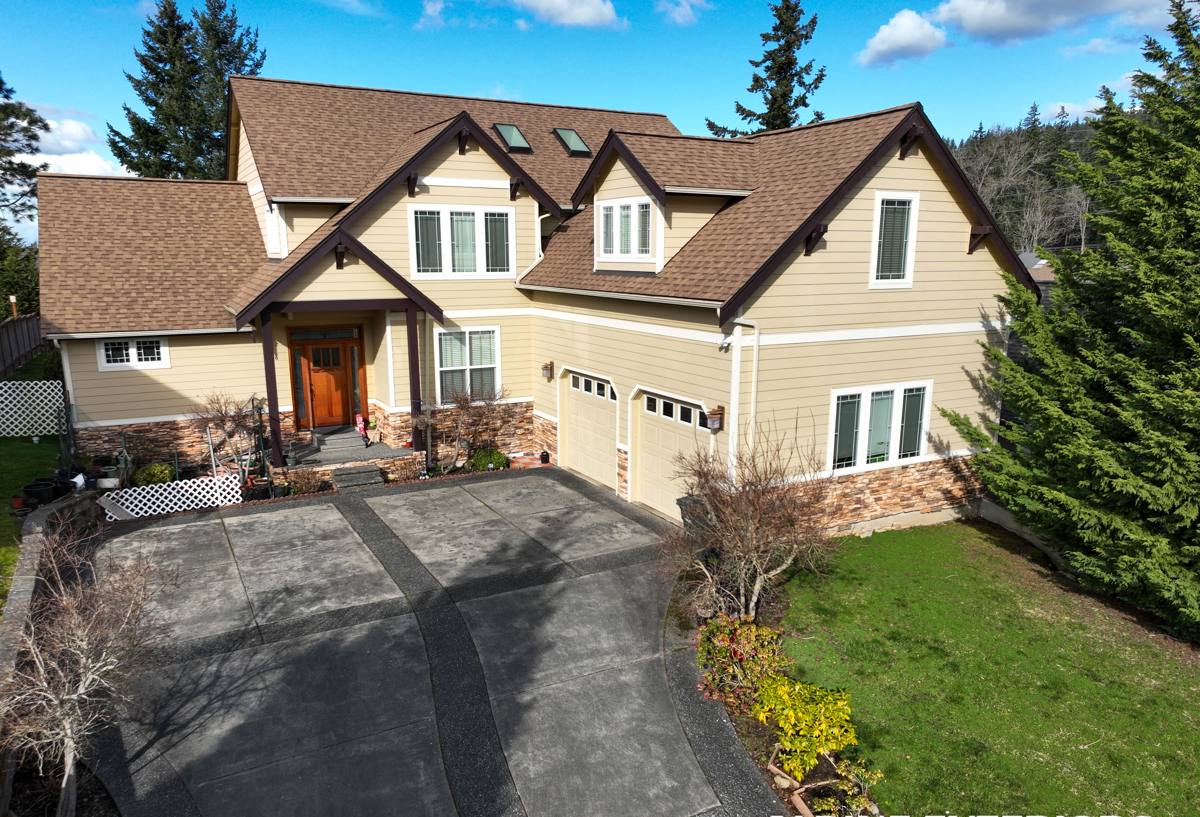
Why Local Conditions Change the Job
Salt Air and Corrosion
Lynden isn't beachfront, but Whatcom County's proximity to the Strait of Georgia and Puget Sound means airborne salt is a real factor, especially on homes with western or northwestern exposure. Salt-laden moisture accelerates corrosion on unprotected steel edges, cut ends, and fastener heads. It's not dramatic — you won't see a roof fail in a season — but over ten or fifteen years, an unprotected fastener or an exposed panel cut can start rusting well before the rest of the roof shows any wear. This is why fastener selection and cut-edge treatment matter more here than they would on a dry-climate roof.
Driving Rain and Wind-Driven Water
Most of our rain doesn't fall straight down — it comes in sideways off Pacific storm systems, pushed by wind. That changes how water behaves at every transition point on a roof: valleys, wall intersections, chimney flashings, and low-slope sections. A metal roof detail that would be fine in a calmer climate can leak here if the underlayment, flashing laps, and fastener sealing weren't built with wind-driven rain in mind. We lap everything with the prevailing weather in mind, not just gravity.
Moss and Organic Growth
Shaded roofs in Lynden and Custer can stay damp for most of the year, which is exactly what moss and algae need to establish. Moss holds moisture against roofing material, and on shingle roofs that moisture retention is a major driver of premature failure. Metal roofing doesn't feed moss the way organic shingle mat does, and its smooth, hard surface gives moss far less to grip. It's one of the clearest climate-driven reasons Lynden homeowners choose metal over asphalt for long-term roofs — less moss means less maintenance and less trapped moisture against the deck.
What a Correct Metal Roof Installation Involves
A metal roof is only as good as the layers underneath it and the details at every edge and penetration. Here's what we consider non-negotiable on a Lynden install:
- Full synthetic underlayment rated for the exposure — not just felt paper, which degrades faster under sustained Whatcom County moisture.
- Ice-and-water shield at eaves, valleys, and any low-slope transition, since these are the spots most exposed to wind-driven rain backup.
- Proper deck inspection and repair before any panel goes down — metal roofing telegraphs an uneven or soft deck, and it hides nothing.
- Matched fastener systems — the fastener metal has to be compatible with the panel metal to avoid galvanic corrosion, which is a bigger issue near salt air.
- Closed or foam-filled ridge details to block wind-driven rain and pest entry at the ridge line.
- Flashing custom-bent for the actual roof geometry, not stock trim pieces forced to fit.
Panel Types We Install in Lynden
Not every metal roofing system fits every home. We install a few different profiles depending on the roof's pitch, budget, and how the homeowner wants it to look.
| System | Best For | Local Consideration |
|---|---|---|
| Standing seam (concealed fastener) | Main roofs, homes wanting a 40+ year system | No exposed fasteners to fail over time — the strongest choice against driving rain and salt exposure |
| Exposed-fastener panel (e.g. corrugated/ribbed steel) | Shops, additions, budget-conscious re-roofs | Costs less upfront but fastener washers need periodic checking; more sensitive to salt-air corrosion over time |
| Stone-coated steel | Homeowners wanting a shingle or tile look with metal durability | Heavier system; good moss resistance but more detailing at cuts and edges |
For most primary Lynden homes, we lean toward standing seam. The concealed fastener design removes the single biggest long-term weak point — exposed screws working loose or corroding — which matters more here than in a drier climate where that maintenance item can be ignored longer.
Our Process, Start to Finish
1. On-Site Assessment
We walk the roof and the attic, not just the roof. Deck condition, ventilation, existing moisture staining, and moss buildup patterns all tell us something about how the current roof has performed and what the new one needs to correct.
2. Panel and System Selection
We talk through pitch, budget, and appearance goals, and recommend a system based on that roof specifically — not a one-size answer. A low-slope shed roof and a steep main gable roof on the same property often call for different underlayment strategies even if the panel color matches.
3. Tear-Off and Deck Prep
Old roofing comes off, the deck gets inspected board by board, and any soft or water-damaged sheathing is replaced before anything new goes down. Skipping this step is the most common shortcut in the industry, and it's the one that causes the most callbacks.
4. Underlayment and Flashing
This is where the weather-resistance of the roof actually gets built. Ice-and-water membrane at vulnerable points, synthetic underlayment across the field, and custom-bent flashing at every wall, valley, and penetration.
5. Panel Installation
Panels go down with fastener spacing and clip systems matched to the local wind exposure, not just manufacturer minimums. Cut edges get treated to slow corrosion.
6. Final Walkthrough
We walk the finished roof with the homeowner, check ridge and trim details, and go over what maintenance — if any — the system needs going forward.
Cost Factors Homeowners Ask About
Metal roofing costs more upfront than asphalt shingles, and homeowners deserve a straight answer about why, and what actually moves the price.
| Factor | Effect on Cost |
|---|---|
| Panel system (exposed-fastener vs. standing seam) | Standing seam typically costs more due to labor and concealed-fastener hardware |
| Roof complexity (valleys, dormers, penetrations) | More cuts and flashing details mean more labor time |
| Deck condition | Rot or soft sheathing found during tear-off adds repair cost not visible in an initial quote |
| Roof pitch and accessibility | Steeper or harder-to-access roofs require more safety setup and time |
| Panel material and gauge | Heavier-gauge steel or aluminum (better for salt-air areas) costs more than lighter panels |
We give honest ranges during the estimate rather than a number pulled before we've seen the roof — deck condition alone can shift a bid significantly once tear-off starts.
Maintenance in a Wet, Mossy Climate
One of the real advantages of metal roofing in Lynden and Custer is how little maintenance it needs compared to shingles — but "little" isn't "none." A few habits keep a metal roof performing for decades:
- Clear debris and needle buildup from valleys once or twice a year, since trapped organic matter holds moisture against the panel even on metal.
- Check gutters and downspouts each fall — Whatcom County's rain volume means clogged gutters back water up under eave flashing fast.
- Watch for any moss establishing on north-facing slopes in shaded yards; even though metal resists it far better than shingles, moss can still take hold in seams and trim over many years if never disturbed.
- After major windstorms, a quick visual check for lifted trim or ridge caps is worth the five minutes.
Why Hire a Crew That Already Works in Lynden
Metal roofing is a trade where installer experience shows up in the details that don't get noticed until they fail — flashing laps, fastener choice, underlayment overlap direction relative to prevailing wind. A crew that's worked roofs throughout Lynden and greater Custer already knows which slopes on which orientations catch the worst of the wind-driven rain, and which yards tend to stay shaded and damp long enough to grow moss most of the year. That local pattern recognition means fewer surprises during tear-off and a roof detailed for the weather it will actually face, not generic manufacturer minimums.
We're not the cheapest bid you'll get for a metal roof in Whatcom County, and we won't pretend otherwise. What we will do is install it the way this climate requires — full underlayment coverage, correct fastener and flashing choices for salt-air exposure, and deck work done right the first time.
If you're considering a metal roof for a home in Lynden or the surrounding Custer area, we're happy to take a look and give you a straightforward assessment — no pressure, no inflated urgency. Use the form below to request a free estimate.