 Custer
 Why Everson Decks Wear Out Faster Than the Manuals Say
Most decking and framing products are rated and warrantied based on lab testing or averaged national conditions. Everson and Custer don't get average conditions. Sitting near the Strait of Georgia and the open flats of northern Whatcom County, this stretch of coastline gets a steady mix of salt-laden air, wind-driven rain that gets pushed sideways under eaves and railings, and a wet season that runs long enough to keep wood and composite surfaces damp for weeks at a time. That combination is harder on a deck than dry heat or even straight rainfall would be on its own.
We see the same failure pattern on a lot of older decks in this area: framing that looks fine from the top but is soft or rotted where boards meet joists, fasteners that have corroded and stained the wood around them, and surface boards that are visibly rougher, greyer, or spongier than they should be for their age. None of that is unusual here — it's just what happens when a deck wasn't built or maintained with this specific climate in mind.
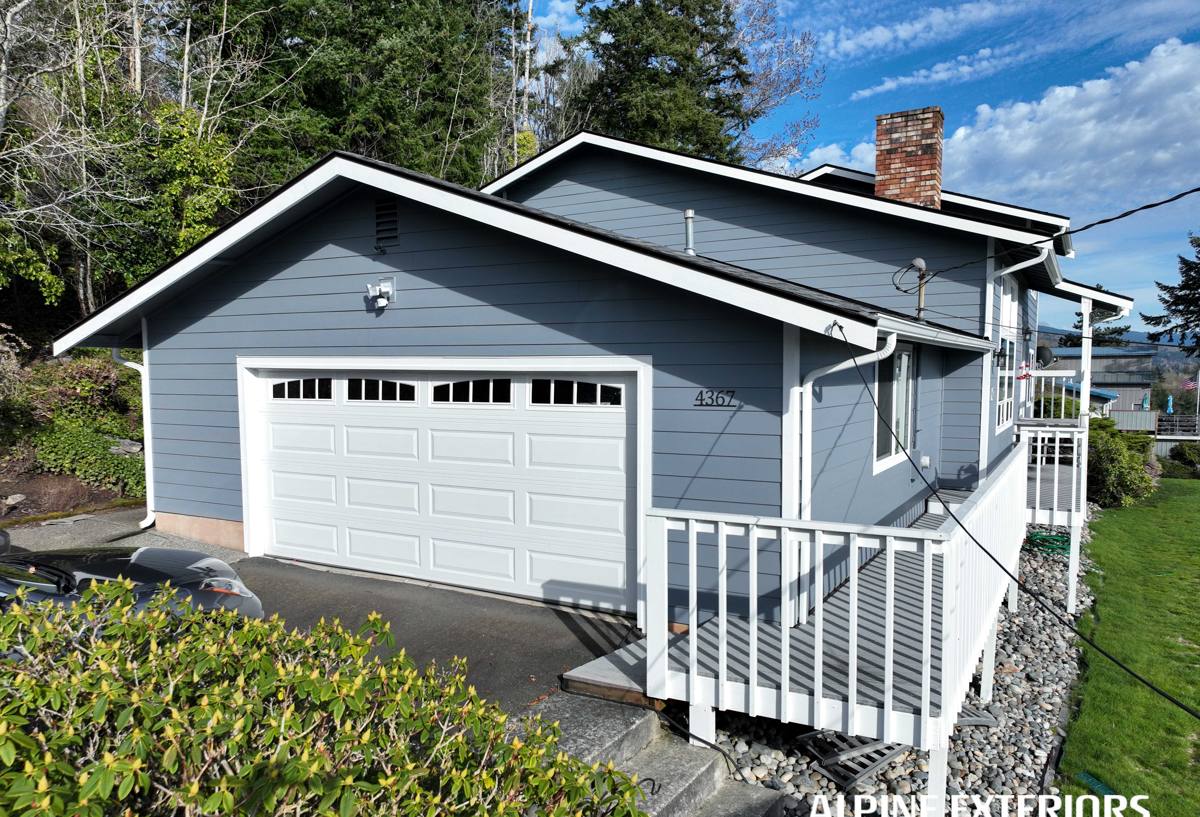
What "Correct" Looks Like for a Custer-Area Deck
A deck replacement done right for this region isn't just about picking nicer boards. It's about addressing the three things that actually shorten a deck's life here: moisture that doesn't drain or dry out, hardware that corrodes, and organic growth (moss and algae) that holds water against the surface.
Moisture Management
Every ledger board, joist, and post base needs to be able to shed water, not trap it. That means proper flashing where the deck meets the house, gapping between boards for drainage and airflow, and, ideally, a drainage plane or joist tape system that keeps standing water off the framing lumber itself. On older Everson-area decks, the ledger connection is one of the most common places we find hidden rot, because it's also the hardest spot for water to escape once it gets behind the siding.
Corrosion-Resistant Hardware
Salt air accelerates corrosion on fasteners and connectors that would otherwise last decades. We use fasteners and structural hardware rated for coastal exposure — not because code always requires it, but because standard hardware in this environment can start staining and weakening years before a homeowner expects to be dealing with a repair.
Surface Choice for Moss Season
Moss doesn't just make a deck slippery — it holds moisture against the board surface for months at a time during our wet stretch, which is exactly the condition that breaks down wood fiber and traps grime in composite grain patterns. The right surface material and the right board spacing both matter more here than they would in a drier climate.
Comparing Decking Materials for This Climate
There's no single "best" decking material for every homeowner — budget, maintenance tolerance, and how the deck will be used all matter. Here's how the common options actually perform under Whatcom County's salt air, rain, and moss conditions:
| Material | Moisture & Moss Behavior | Maintenance | Typical Lifespan Here |
|---|---|---|---|
| Pressure-treated lumber | Absorbs water readily; needs gapping and airflow to avoid cupping and rot | Annual cleaning and periodic sealing | 10–15 years with upkeep |
| Cedar | Naturally rot-resistant but still needs sealing to resist moss staining | Sealing every 1–2 years | 15–20 years with upkeep |
| Capped composite | Won't rot; textured surfaces still need cleaning to prevent moss film buildup | Periodic washing, no sealing | 25+ years |
| PVC decking | Fully moisture-resistant surface; least hospitable to moss growth | Occasional washing | 25–30+ years |
We don't push one product on every job. Some homeowners want the lower upfront cost of treated lumber and are fine with sealing it regularly; others want to stop thinking about deck maintenance for the next 20 years and go composite or PVC. Where we do steer people away from certain framing approaches — like ground-contact wood posts set directly in soil without a proper base, or fastener systems not rated for coastal exposure — it's because we've seen how those choices age specifically in this climate, not because a product is inherently bad everywhere.
Our Deck Replacement Process
Replacement work follows the same core sequence on every job, adjusted for the specific deck's size, height, and attachment to the house.
- On-site assessment. We check the ledger connection, framing condition, footings, and any drainage issues before quoting anything, so the estimate reflects what's actually there rather than a guess.
- Full removal. Old decking, railings, and any compromised framing come out. We don't build new surface boards over questionable framing — if the structure underneath is soft, it gets replaced, not covered.
- Structural correction. Ledger flashing, joist protection, footings, and post bases are brought up to a standard that accounts for this climate, not just minimum code.
- Decking and railing installation. Boards are installed with proper spacing and fastening for the chosen material, with attention to drainage at the framing level.
- Final walkthrough. We go over the finished deck with the homeowner, including basic care guidance specific to whatever material was installed.
Signs It's Time to Replace Rather Than Repair
Not every deck problem means a full replacement — sometimes a board swap or hardware upgrade is enough. But certain signs point toward replacement being the more honest recommendation:
- Soft or spongy spots when you press on the decking, especially near the house or at board ends
- Visible rot, discoloration, or crumbling wood at the ledger board or post bases
- Rust staining streaking down from fasteners or connectors
- Persistent moss or algae film that returns within weeks of cleaning, even after washing
- Railings that flex or feel loose when leaned on
- A structure that's more than 20–25 years old and was built before modern flashing and fastener standards were common
If a deck is showing two or more of these signs, patch repairs usually end up being a short-term fix on a structure that's already past the point where piecemeal work makes financial sense.
Framing and Footings Matter More Than the Surface
Homeowners often focus on the decking boards because that's what they see and touch every day, but the framing underneath is what determines how long the deck actually lasts. In this climate, footings need to be set below frost depth and positioned so water doesn't pool around the post base. Joists benefit from a protective tape or membrane along the top edge, since that's the surface that stays wettest longest after a rain event. Beam and post connections should use hardware rated for the exposure, not just whatever's cheapest at a big-box store. None of this is visible once the deck is finished, which is exactly why it's worth asking a contractor to walk through it before work starts rather than assuming it's handled.
Railings, Stairs, and Code Considerations
Railing height, baluster spacing, and stair guard requirements are governed by the Washington State building code, and Whatcom County permitting applies to most deck replacement projects, particularly when the deck is elevated or attached to the house. Beyond meeting code minimums, railing hardware in this area faces the same corrosion pressure as the rest of the structure, so the fasteners and post attachment method matter as much for railings as they do for the deck frame itself. We handle permitting as part of the project scope so homeowners aren't left navigating that process on their own.
Why Hire a Crew That Already Works This Area
A deck built to a generic national spec can look identical to one built for Whatcom County's conditions — until a few winters of driving rain and salt air pass. The difference shows up in the ledger flashing, the fastener choice, the drainage detailing, and the surface material's resistance to moss, not in anything visible on installation day. A crew that regularly works Everson and Custer has already seen how different materials and details hold up here over time, which shapes what gets recommended and how the structural work is done, not just what the finished deck looks like on day one.
Get a Free, No-Pressure Estimate
If your deck in Everson or Custer is showing soft spots, persistent moss, rust-streaked hardware, or is simply old enough that you're wondering whether it's still safe to use, we're happy to take a look. The estimate is free, there's no pressure to move forward, and you'll get a straightforward assessment of what your deck actually needs. Fill out the form below to get started.