 Custer
 Why Bellingham Decks Wear Out Faster Than the Manual Says
Bellingham sits close enough to the water that salt-laden air is a daily fact of life, not an occasional event. Add Whatcom County's long, wet winters and the shoulder-season drizzle that can stretch on for weeks, and you get a climate that is genuinely harder on outdoor structures than most manufacturer literature accounts for. Fasteners corrode faster. Untreated end grain wicks moisture instead of shedding it. And anywhere a deck sits in partial shade near trees or a fence line, moss and algae get a foothold early and never really let go.
None of this means a deck in Bellingham is doomed — it means the deck has to be built and replaced with this specific environment in mind, not with a generic set of assumptions from a drier region. That's the difference between a deck that needs attention every year and one that quietly does its job for decades.
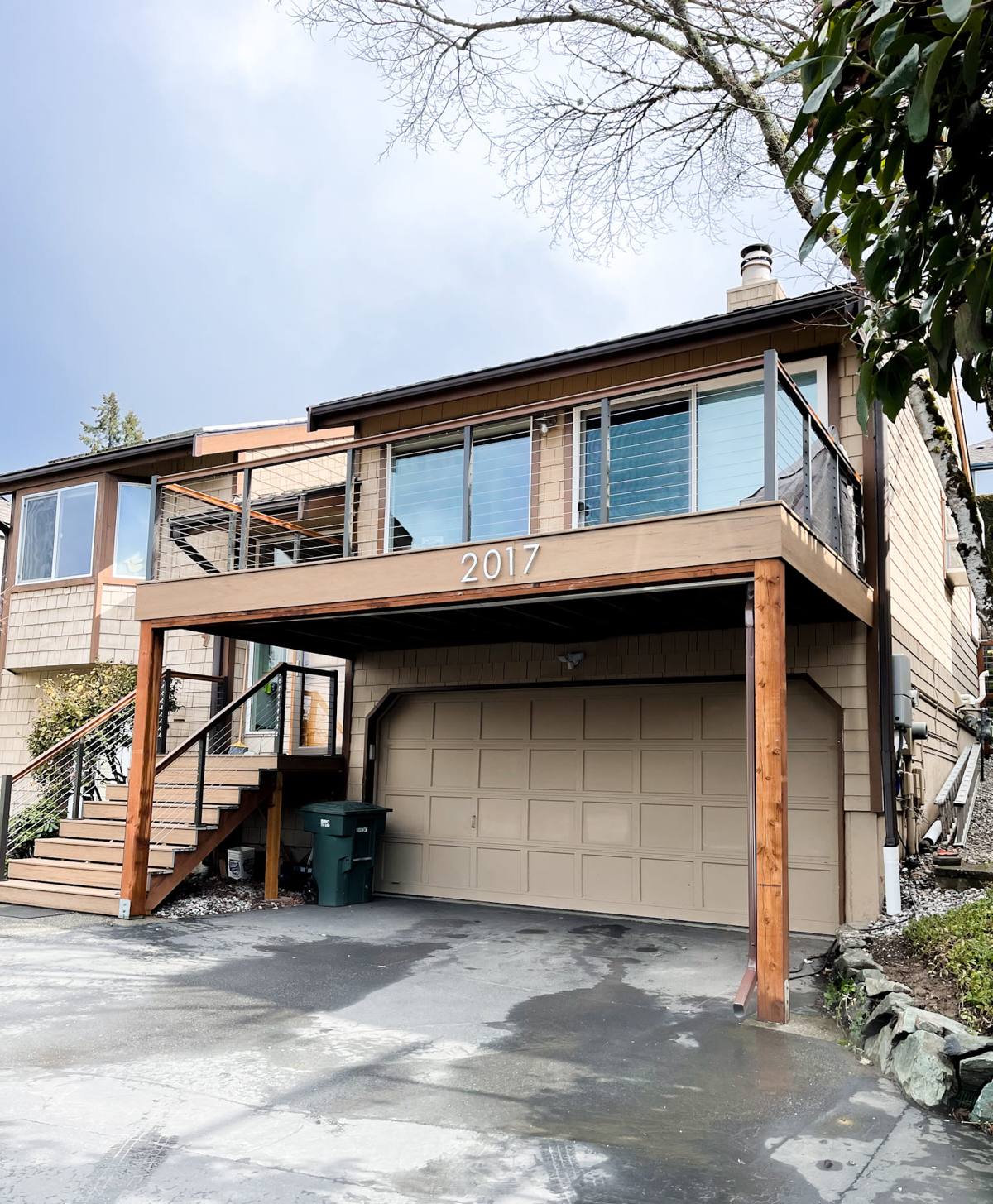
How Salt Air, Rain, and Moss Actually Damage a Deck
Salt Air and Metal Fatigue
Coastal salt air accelerates corrosion on anything metal — nails, screws, joist hangers, post bases, and railing hardware. Once a fastener starts rusting, it swells slightly and loosens its grip in the wood, which opens a path for water to get in behind it. On an older deck, this is often the real reason boards feel spongy or railings feel loose, long before the wood itself is actually rotten.
Driving Rain and Water Intrusion
Rain that comes in sideways, which is common here, finds its way into places vertical-only rain never would: behind fascia boards, under poorly lapped flashing, and into end-grain cuts that were never sealed. Once water gets past the surface of a board, it doesn't evaporate quickly in our humidity, and that's when rot sets in from the inside out — often invisible from above until the damage is advanced.
Moss, Algae, and Trapped Moisture
A long moss season means any deck surface that stays damp for more than a day or two is a candidate for growth. Beyond looking bad, moss and algae hold moisture against the wood surface, block airflow, and make boards slicker and more dangerous underfoot. Decks with poor drainage, tight board spacing, or heavy shade are the first to show it.
What a Correct Deck Replacement Involves
A deck replacement done right in this climate is not just swapping old boards for new ones on the same frame. It starts with an honest look at everything below the decking surface, because that's where most failures actually begin.
Substructure First
Posts, beams, and joists get inspected for rot, insect damage, and undersized framing relative to current code. In a lot of older Bellingham-area decks, the substructure was built to a different era's standards and simply isn't adequate to carry modern load requirements or support heavier composite decking.
Ledger Board and Flashing
The ledger board — where the deck attaches to the house — is one of the single most common failure points in this region. If it wasn't flashed correctly the first time, water has likely been getting behind it for years. Correct flashing includes proper step flashing or a continuous flashing membrane, correctly lapped with the house's water-resistive barrier, not just a bead of caulk.
Fasteners and Hardware
Given the salt air issue described above, hardware selection matters more here than in a lot of inland markets. Stainless steel or high-grade coated fasteners rated for coastal or ACQ-treated lumber exposure are the standard we build to, not an upgrade we upsell.
Decking Material
Whatever surface material is chosen, it needs to handle standing moisture, resist moss colonization, and tolerate the freeze-thaw swings that happen here in winter without cracking or cupping.
Choosing a Decking Material for This Climate
There's no universally "best" decking material — there's a best fit for a given budget, maintenance appetite, and exposure. Here's how the common options actually perform in a Bellingham-area setting.
| Material | Moisture & Moss Resistance | Maintenance | Typical Lifespan Here |
|---|---|---|---|
| Pressure-treated wood | Fair — needs sealing to perform well | Annual cleaning and re-sealing recommended | 10-15 years with upkeep |
| Cedar | Good natural rot resistance, but surface still grows moss without maintenance | Periodic cleaning, staining, or oiling | 15-20 years with upkeep |
| Composite decking | Very good — doesn't rot, but surface can still grow algae/moss if shaded and unwashed | Occasional washing, no sealing or staining | 25-30+ years |
| PVC/capped polymer | Excellent — fully moisture-sealed surface | Occasional washing | 30+ years |
We'll walk through these trade-offs honestly during your estimate — including upfront cost versus long-term maintenance labor — rather than steering everyone toward the same product regardless of their budget or how the deck will actually be used.
Drainage and Design Choices That Prevent Moss and Rot
Board Spacing and Airflow
Correct board gapping lets water drain through rather than pool on the surface, and it lets air move underneath the deck so the substructure can actually dry out between storms. Decks built with boards too tight, often to chase a cleaner look, are some of the fastest to develop moss and surface staining in our climate.
Slope and Runoff
A deck surface should have a slight slope away from the house so water sheds instead of sitting against the ledger board or pooling in low spots. This is a design decision made during framing, not something that can be fixed after the fact without real structural work.
Under-Deck Drainage
For decks over living space, patios, or storage areas, an under-deck drainage system can be worth discussing so water is captured and directed away rather than dripping through indefinitely. This isn't necessary on every project, but it's worth a conversation for the right layout.
Signs a Deck Needs Replacement, Not Just Repair
Not every tired-looking deck needs a full teardown. But there are signs that point toward replacement being the more honest recommendation than another round of patchwork:
- Soft or spongy spots in the decking or framing when you walk across them
- Rust staining running down from screws, nails, or hardware
- Persistent moss or algae that comes right back within weeks of cleaning
- Visible gaps or separation where the ledger board meets the house
- Railings or posts that feel loose or move under normal pressure
- Boards that are cupping, splitting, or delaminating rather than just weathering in color
- A deck built more than 15-20 years ago with no known upgrades to flashing or hardware
If you're seeing more than one or two of these, it's usually a sign the underlying structure — not just the surface — needs attention.
Permits and Whatcom County Considerations
Most deck replacements involving structural changes, new footings, or attachment to the house require a permit locally, and inspections typically check ledger attachment, footing depth, and railing height and spacing. Skipping this step to save time is a common shortcut that creates real problems at resale, when a lender or buyer's inspector asks for permit history that doesn't exist. We handle the permitting process as part of the job rather than leaving it to the homeowner to sort out.
Our Replacement Process
- On-site assessment — we inspect the existing deck from the ground up, including crawling underneath where possible, to see the actual condition of the framing and ledger connection.
- Honest scope and options — we explain what's failing, why, and what materials and design choices make sense for your specific exposure and budget.
- Permitting — we pull the required permits and coordinate inspections so the finished deck is fully documented.
- Demolition and disposal — old decking, framing, and hardware are removed and hauled off, with attention to protecting landscaping and the house itself.
- Rebuild — correct flashing, appropriately rated fasteners, adequate framing, and proper drainage slope, followed by the decking material and railings.
- Final walkthrough — we go over the finished deck together, including any maintenance the specific material will need going forward.
Why Local Experience in Bellingham Matters
A crew that only occasionally works this area will treat flashing details, fastener grade, and drainage design as optional upgrades. A crew that works Bellingham and the surrounding Whatcom County area regularly treats them as the baseline, because we see what happens when they're skipped — the callbacks, the rot, the moss that never really goes away. We're not guessing at what this climate does to a deck over time; we're replacing decks that failed for exactly these reasons on a regular basis.
That local familiarity also means we're realistic about timelines around our wetter months, and we plan projects with weather windows in mind rather than promising a schedule that ignores the forecast.
Maintenance After Your New Deck Is Installed
Whatever material you choose, a little seasonal attention goes a long way here. Clearing debris from between boards, keeping gutters and downspouts clear so runoff isn't dumping onto the deck, and washing the surface once or twice a year to stay ahead of moss will meaningfully extend the life of the replacement. We'll give you material-specific guidance at the end of the job so you know exactly what upkeep — if any — your new deck actually needs.
If your current deck is showing rust stains, soft spots, or moss that keeps coming back, we're happy to take a look and give you a straight answer about what it needs. Reach out for a free, no-pressure estimate using the form below.