 Custer
 Board & Batten Siding for Bellingham Homes
Board and batten has become one of the most requested looks in the Bellingham area over the past several years — on new construction, on remodels, and on older homes getting a full exterior refresh. The vertical lines read as modern farmhouse on some houses and traditional Pacific Northwest on others, which is part of why it works so well here: Bellingham's housing stock ranges from newer builds near the water to older homes further inland, and board and batten sits comfortably on both. But the look is only half the story. In a climate that combines salt-laden air off Bellingham Bay and the Strait of Georgia, long stretches of driving rain, and a moss season that can run most of the year, board and batten is also a functional decision — one that depends heavily on what material it's made from and how it's installed.
This page covers what board and batten siding needs to hold up in Bellingham specifically, what a correct installation actually involves, and how we approach the job when we're working in this part of Whatcom County.
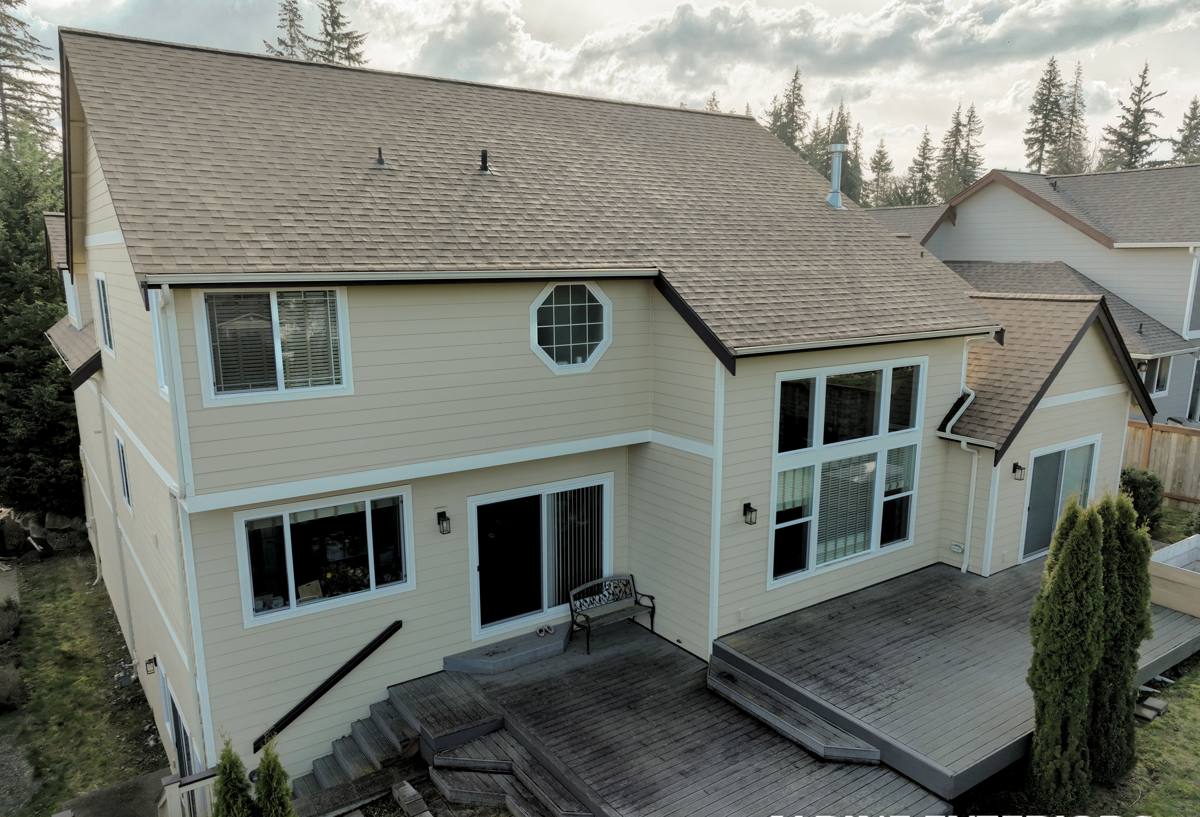
Why Bellingham's Climate Is Hard on Vertical Siding
Board and batten siding is defined by its battens — the narrow strips that cover the seams between the wider boards. Those battens create dozens of vertical joints running down the face of a house, and every one of those joints is a place where water can find its way behind the cladding if the material or the installation isn't right. In most of the country that's a manageable design detail. In Bellingham, three regional conditions make it a bigger deal.
Salt Air
Homes near Bellingham Bay and the surrounding shoreline take on airborne salt that accelerates corrosion of fasteners and metal flashing, and it also speeds up the breakdown of siding materials that aren't rated for coastal exposure. Board and batten's extra layer of trim and extra fastener count means more exposed metal and more painted surfaces than a standard lap profile — which is exactly why the underlying material and hardware matter more here than they would inland.
Driving Rain
Storms off the Strait don't always come straight down. Wind-driven rain hits vertical siding at an angle and works its way under battens and around butt joints if there isn't a proper water-resistive barrier and flashing detail behind the cladding. A board and batten wall is only as good as what's happening behind the boards, not just the finish coat on the front.
Moss Season
Bellingham's mild, wet winters and shaded lots (especially on tree-lined streets) keep siding damp for long stretches, which is ideal for moss and algae growth. On north-facing walls and anywhere shaded by mature trees, moss can establish on a siding surface within a couple of seasons if the material holds moisture rather than shedding it. Vertical battens create ledges and shadow lines where moss gets a foothold, especially where caulking has failed or where the material itself absorbs water.
What Correct Board & Batten Installation Involves
A board and batten job that's going to last through Whatcom County winters isn't just nailing up boards and strips. There's a sequence, and skipping steps is where most premature failures start.
- Water-resistive barrier: A continuous, properly lapped weather barrier behind the siding, integrated with window and door flashing — not just stapled house wrap with gaps at penetrations.
- Rainscreen or drainage gap: A small air gap between the barrier and the siding lets any water that gets past the boards drain and dry out instead of sitting against the wall assembly. This matters more in a wet climate than almost anywhere else in the country.
- Fastener placement and type: Corrosion-resistant fasteners, set to manufacturer spec for depth and spacing — over-driven or under-driven nails are one of the most common causes of cracking and water intrusion on vertical siding.
- Batten spacing and fastening: Battens need to land over the board seams correctly and be fastened without restricting the material's normal expansion and contraction.
- Flashing at every horizontal transition: Window heads, door heads, and any horizontal trim need step or drip flashing so water is directed out and away from the joint, not trapped behind it.
- Factory-finished material where possible: A factory-applied finish is more consistent and more resistant to moisture intrusion at the surface than field-applied paint, which is one more reason material choice and installation are linked, not separate decisions.
Why Material Choice Matters as Much as Installation
We install James Hardie fiber cement exclusively, and board and batten is one of the clearest examples of why. Vertical siding profiles are less forgiving of material weaknesses than lap siding, because there's more trim, more seams, and more exposed edge surface. A few comparisons worth understanding before you choose a material:
| Material | Behavior in Salt Air / Moss Conditions | Long-Term Maintenance |
|---|---|---|
| Vinyl board and batten | Can warp or fade under UV and temperature swings; seams are more visible over time | Low upfront cost, but panels can crack in cold snaps and aren't repainted easily |
| Primed wood (spruce/cedar) | Absorbs moisture readily; prone to swelling, splitting, and moss/algae growth in shaded, damp spots | Requires regular repainting and caulking to stay ahead of moisture damage |
| Engineered wood (LP SmartSide) | Resin-treated to resist moisture, but edges and cut ends remain a vulnerability if not fully sealed | Moderate; depends heavily on installer diligence at every cut and seam |
| James Hardie fiber cement | Non-combustible, dimensionally stable, engineered to resist moisture and hold factory finish through wet climates | Low; ColorPlus finish is baked on and warrantied, no regular repainting needed |
Fiber cement doesn't swell, rot, or feed moss the way wood-based products can, and it holds its factory finish far longer than field-painted materials — which matters directly in a climate where surfaces stay damp for months at a time. It also doesn't corrode or become brittle the way some vinyl products can near salt air. That combination is why we standardized on it rather than offering multiple product lines.
James Hardie's HZ5 Line and Why It Fits This Region
James Hardie engineers its siding by climate zone, and the HZ5 product line is built for the wetter, more moisture-exposed regions of the Pacific Northwest — including Whatcom County. It's formulated and tested for freeze-thaw cycling and sustained moisture exposure, which is the exact combination Bellingham sees most winters. Choosing the right HZ line isn't a marketing detail; it affects how the board holds its dimensions and finish over years of exposure to driving rain and salt air.
For board and batten specifically, Hardie's vertical siding panels and matching trim boards are manufactured to work together — same material, same finish process, same expansion characteristics — which reduces the mismatched-movement problems that can show up when boards and battens come from different product lines or manufacturers.
Color and Finish Considerations for a Coastal-Adjacent Climate
Board and batten's strong vertical lines make color choice more visible than it is on lap siding, since the shadow lines from the battens emphasize contrast and depth. In Bellingham, a few practical points come up often:
- Darker colors on south- and west-facing walls will show more sun fading over time than lighter tones, though ColorPlus finishes are formulated to resist this better than site-applied paint.
- Lighter colors on shaded, north-facing walls make early moss and algae growth easier to spot before it spreads, which is useful on tree-shaded lots.
- A factory finish means color is consistent panel to panel — something that matters more on board and batten, where the vertical battens create visible seams every twelve to sixteen inches across the wall.
Our Process for a Bellingham Board & Batten Project
- On-site assessment: We look at wall orientation, shading, existing moisture damage, and how the current siding (if any) has performed, since a home with heavy moss on the north wall tells us something different than one with sun-faded siding on the south wall.
- Tear-off and inspection: Removing old siding lets us check sheathing and framing for hidden rot or water damage before anything new goes up — catching this now is far cheaper than finding it in five years.
- Barrier and drainage plane installation: This is the step that determines how the wall performs in driving rain, and it's not visible once the job is done, which is exactly why it needs to be done right the first time.
- Hardie board and batten installation to spec: Correct fastener schedule, batten spacing, and flashing at every window, door, and horizontal transition.
- Final inspection and walkthrough: We go over the finished work with you before calling the job done.
Signs Your Current Siding Is Losing the Fight
- Moss or dark streaking concentrated on shaded or north-facing walls
- Soft or spongy spots when you press on board or batten edges
- Visible gaps opening up at seams or where boards meet trim
- Paint that's chalking, peeling, or needs recoating more often than every several years
- Warping or bowing along board edges, especially near the ground or roofline
Why Local Experience on This Coastline Matters
A crew that's worked board and batten jobs in and around Bellingham has already seen how salt air, shaded lots, and driving rain off the Strait play out on real houses — which walls tend to hold moss, which flashing details actually stop wind-driven rain, and where a north-facing wall needs different treatment than a south-facing one. That's the kind of judgment that shows up in the details: fastener spacing, drainage plane continuity, flashing sequencing — not in anything you'd notice on day one, but in how the wall performs in year eight.
We work Custer, Bellingham, and the surrounding Whatcom County communities regularly, which means we're not guessing at how this climate treats a given product or installation detail — we're applying what we've already seen hold up and what hasn't.
Cost Factors for Board & Batten Projects
| Factor | Why It Affects Cost |
|---|---|
| Home size and wall complexity | More corners, gables, and dormers mean more battens, more cuts, and more flashing detail |
| Tear-off vs. new construction | Removing and disposing of existing siding, plus repairing any hidden sheathing damage, adds labor |
| Trim and batten spacing chosen | Tighter batten spacing uses more material and more install time than wider spacing |
| Color and finish selection | Factory ColorPlus finishes vary by color family and can affect material cost slightly |
| Site access and shading | Wooded or tight lots common around Bellingham can add setup and staging time |
We're happy to walk through actual numbers for your home once we've seen it — broad ranges online rarely reflect what a specific house and site actually need.
If you're considering board and batten siding for a home in Bellingham or elsewhere near Custer, we'd be glad to take a look and talk through what your walls actually need given their orientation, shading, and exposure. Reach out for a free, no-pressure estimate using the form below.